

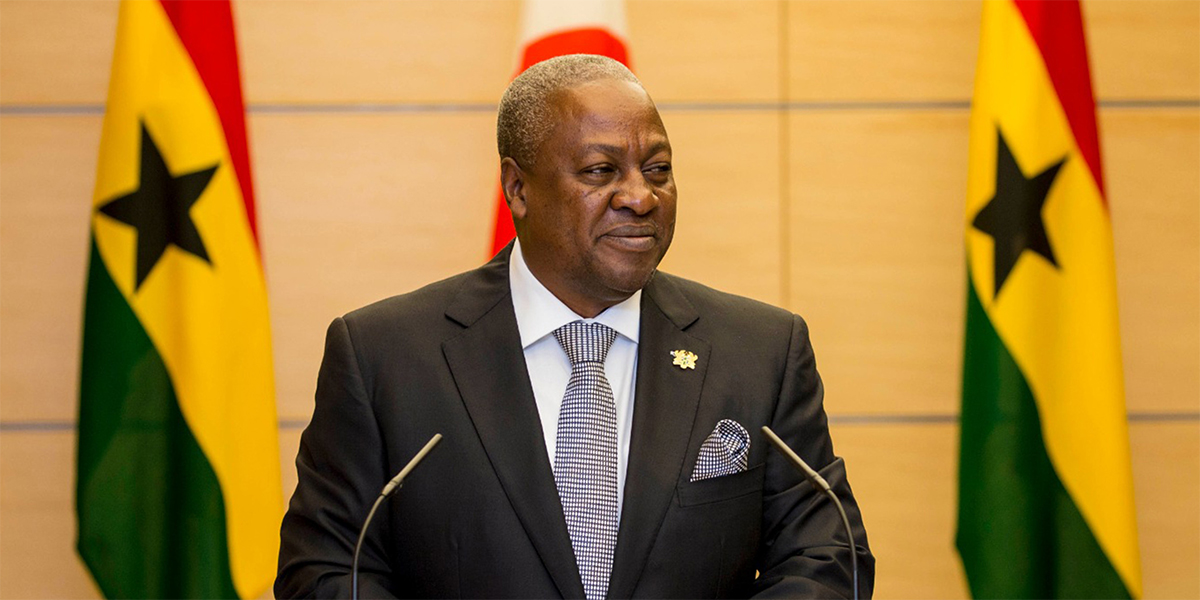

- Boards Of GNPC, BOST, VALCO and CBG Dissolved with Immediate Effect – President Mahama
President John Dramani Mahama has dissolved the governing boards of nine state institutions with immediate effect, in a significant reset of leadership across some of Ghana’s most strategically important public enterprises and agencies.
The affected institutions are Prestea Sankofa Gold Limited, the Bulk Oil Storage and Transportation Company Limited, Volta Aluminium Company Limited, Consolidated Bank Ghana Limited, Ghana Post Company Limited, the Road Maintenance Trust Fund, TDC Ghana Limited, the Ghana National Petroleum Corporation and the National Sports Authority.
The Presidency announced the decision on Wednesday, September 2, in a statement issued by Felix Kwakye Ofosu, Spokesperson to the President and Minister for Government Communications. No reason was assigned for the dissolution, although it comes at a time of heightened scrutiny of the performance, governance and financial sustainability of state-owned entities.
Relevant sector ministers have been directed to take the necessary steps under the applicable laws and governing instruments to give effect to the decision. The boards are expected to be reconstituted in due course, suggesting the move is intended as a governance reset rather than an attempt to alter the legal status of the affected institutions.
The timing is particularly notable because the performance of state-owned enterprises has recently returned to the centre of Ghana’s fiscal and governance debate following the release of the 2025 State Ownership Report by the State Interests and Governance Authority.
That report showed a sharp improvement in the aggregate financial position of state-owned enterprises, with the sector moving from a consolidated net loss of GH¢2.25 billion in 2024 to a net profit after tax of GH¢19.80 billion in 2025. Total SOE revenue also increased strongly, reinforcing the government’s argument that the public-enterprise sector is beginning to stabilise.
But the aggregate improvement has also intensified questions about the performance of individual entities, the quality of governance across boards and whether stronger headline results are translating into sustainable commercial performance.
The institutions affected by Wednesday’s decision span some of the most important sectors of the economy, including energy, petroleum, banking, aluminium production, property development, transport infrastructure, postal services, mining and sports administration.
GNPC, in particular, sits at the centre of Ghana’s petroleum sector and manages the state’s commercial interests in upstream oil and gas. Its governance therefore has direct implications for petroleum investment, state revenues and the country’s longer-term energy strategy.
BOST is similarly important to Ghana’s downstream petroleum infrastructure. The company is responsible for strategic petroleum storage and transportation and has a significant role in the security and distribution of fuel products across the country.
VALCO is central to Ghana’s long-running ambition to develop an integrated aluminium industry using the country’s bauxite resources. Questions over capital requirements, energy costs, ownership structure and the future of the smelter have made the company strategically important to the government’s industrialisation agenda.
The inclusion of Consolidated Bank Ghana also places the financial sector within the leadership reset. CBG was established as part of Ghana’s banking-sector restructuring and remains a state-owned financial institution, making governance, capital efficiency and commercial sustainability important both to taxpayers and the stability of the banking industry.
TDC Ghana plays an important role in property and urban development, while the Road Maintenance Trust Fund has implications for the financing of road maintenance and infrastructure. Ghana Post, Prestea Sankofa Gold and the National Sports Authority each carry distinct commercial or public-service mandates.
The breadth of institutions affected means the decision cannot easily be interpreted as being driven by a single sector-specific concern. Instead, it points to a wider review of board-level governance across parts of the state-enterprise and public-agency landscape.
The Presidency has not linked the dissolution directly to poor performance, misconduct or any specific finding against the affected boards. That distinction is important because the timing may invite speculation, but the official announcement itself does not establish wrongdoing by any individual board member or institution.
What will matter next is the composition and mandate of the replacement boards.
Ghana’s experience with state-owned enterprises has repeatedly shown that board appointments can have material consequences for procurement, investment decisions, borrowing, executive accountability and financial discipline. A governance reset will therefore have limited value unless new boards are selected on the basis of competence, independence and the specific commercial or strategic needs of each institution.
The latest move also comes after President Mahama’s earlier blanket directive dissolving statutory boards, corporations, commissions and councils appointed by the previous administration under the Presidential (Transition) Act, 2012. Individuals appointed by former President Nana Addo Dankwa Akufo-Addo or former ministers under that directive ceased to hold office from January 7, 2025.
The Presidency had previously clarified that independent constitutional bodies were not affected by that transition directive. Interim arrangements also required management of affected institutions to seek clearance from the Chief of Staff before taking major decisions until new boards were constituted.
The September 2 decision is therefore more targeted, involving nine named institutions rather than a general post-transition dissolution.
For government, the critical issue will be ensuring that the reconstitution process does not create prolonged governance gaps. Institutions such as GNPC, BOST, VALCO and CBG make decisions involving substantial public assets, investment commitments and commercial relationships, making continuity and clarity of authority particularly important.
The decision also raises the stakes for SIGA and sector ministries. If the government intends the new boards to strengthen the performance of state enterprises, future accountability will need to be tied to measurable outcomes including profitability, capital efficiency, service delivery, debt management, investment and governance compliance.
Ghana’s state-enterprise debate has increasingly moved beyond whether SOEs should simply avoid losses. The larger question is whether they can generate sustainable public value, support industrial development and reduce rather than increase fiscal risks.
The dissolution of nine boards therefore represents only the first step. The more consequential test will come when the replacements are announced and the government makes clear what performance expectations, governance standards and strategic objectives they will be required to meet.
For now, President Mahama has reset the governance architecture at nine significant state institutions. Whether that translates into stronger performance will depend less on the act of dissolving boards than on the quality of the boards that replace them.

