

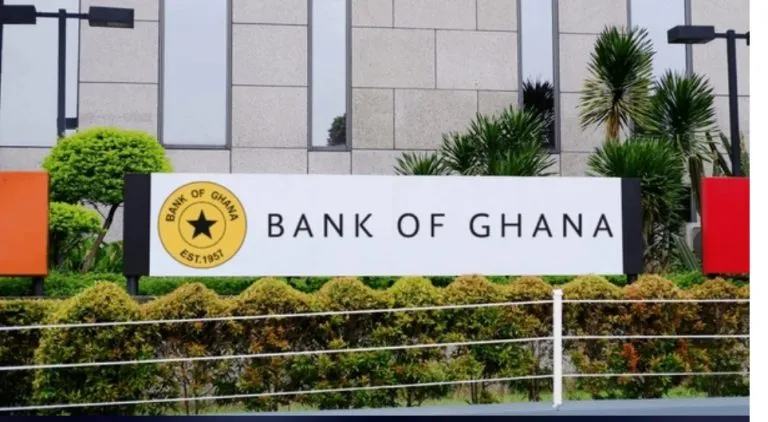

- BoG Absorbs GH¢9.25 billion Through 14-Day Bill as Liquidity Tightening Continues
The Bank of Ghana withdrew GH¢9.25 billion from the money market through the sale of 14-day central bank bills, sustaining its short-term liquidity management operations as inflation, exchange-rate pressures and money-market conditions remain under close policy watch.
According to the Bank of Ghana’s Notice to Banks and Public No. 871, the auction was conducted on Wednesday, July 22, 2026, under the central bank’s securities programme. The notice covered results of Tender 871 for Bank of Ghana Bills.
The 14-day BoG bill, with ISIN GHCBAGH01249, attracted bid rates ranging from 10.4000% to 10.4578%. The bid rates allotted in full were also within the same range, while the weighted average discount rate settled at 10.4547% and the weighted average interest rate closed at 10.4969% for the period July 22 to July 24, 2026.
The central bank said the total amount sold was GH¢9,252.74 million, equivalent to GH¢9.25 billion.
The auction reinforces the Bank of Ghana’s continued use of short-tenor securities to manage excess liquidity in the banking system. Unlike ordinary Treasury bills, which are issued by government for budget financing, BoG bills are monetary policy instruments used by the central bank to absorb surplus liquidity and influence short-term interest-rate conditions.
The size of the sale is significant. At GH¢9.25 billion, the latest auction shows that liquidity sterilisation remains an important part of the central bank’s toolkit, even at a time when inflation has fallen sharply and the policy rate has been reduced. It suggests that the Bank of Ghana is still seeking to prevent excess money-market liquidity from feeding into renewed inflationary pressure or speculative foreign-exchange demand.
The weighted average interest rate of 10.4969% also provides a useful signal about short-term money-market pricing. It sits below the Monetary Policy Rate but remains attractive enough to absorb funds from participating banks over the 14-day tenor.
For banks, the instrument offers a short-term placement option for excess liquidity. For the central bank, it provides a mechanism to control liquidity conditions without necessarily changing the policy rate. For the wider economy, however, the heavy use of such instruments raises a familiar policy question: how should Ghana balance liquidity control with the need to encourage credit to the private sector?
That question is becoming more important as the economy transitions from stabilisation to recovery. If too much banking-sector liquidity is repeatedly parked in central bank instruments, the financial system may remain liquid but less supportive of productive lending. At the same time, if liquidity is left unmanaged, it could undermine inflation gains and place pressure on the cedi.
This is the delicate trade-off facing the Bank of Ghana. The central bank must keep monetary conditions disciplined enough to protect price stability, but not so tight that the banking system becomes more comfortable lending to the state and the central bank than to businesses.
The latest auction therefore tells a broader story about Ghana’s post-stabilisation policy environment. Lower inflation has created room for policy easing, but the central bank appears unwilling to allow liquidity conditions to loosen too quickly. The GH¢9.25 billion mop-up shows that monetary policy is still being conducted with caution.
The tenor of the instrument is also important. A 14-day bill gives the Bank of Ghana flexibility. It can withdraw liquidity quickly, reassess conditions and adjust future auctions without locking the market into long-duration sterilisation. That flexibility matters in a period where inflation, foreign exchange liquidity and fiscal operations can shift quickly.
However, frequent short-term sterilisation comes with costs. The central bank must pay interest on these securities, meaning liquidity management can create quasi-fiscal costs if used heavily and persistently. The policy benefit is stronger monetary control; the fiscal and balance-sheet concern is the cost of maintaining that control.
The auction also sends a message to the market that the central bank remains active in managing liquidity, even after recent gains in macroeconomic stability. Investors, banks and businesses will read the size and pricing of BoG bills as part of the broader policy signal about how quickly monetary conditions may ease.
For now, the message is one of caution. The Bank of Ghana is not simply relying on lower headline inflation to declare victory. It is still absorbing liquidity at scale, keeping short-term rates anchored and ensuring that excess funds do not immediately translate into demand pressure.
That posture is understandable. Ghana’s recent macroeconomic gains remain vulnerable to exchange-rate movements, commodity price swings, energy costs and fiscal pressures. In that environment, liquidity management becomes a defensive tool against a relapse into instability.
Yet the deeper economic challenge remains unresolved. Ghana needs liquidity discipline, but it also needs credit growth. Businesses require working capital, households need affordable finance, and the private sector must be supported if recovery is to translate into jobs and investment. A financial system that repeatedly channels large liquidity volumes into central bank bills may help stabilisation, but it cannot by itself deliver growth.
The July 22 tender therefore captures the contradiction at the centre of Ghana’s current monetary moment. The economy is calmer, but not yet structurally secure. Inflation has eased, but liquidity still needs watching. Banks have funds, but the question is whether those funds will support productive lending or remain concentrated in short-term securities.
The GH¢9.25 billion sale of BoG bills is therefore more than an auction result. It is a reminder that Ghana’s recovery is still being managed defensively.
The Bank of Ghana is buying time with liquidity control. The larger question is whether the broader economy will use that time to rebuild productive capacity, deepen private-sector credit and strengthen the foundations of growth.

