

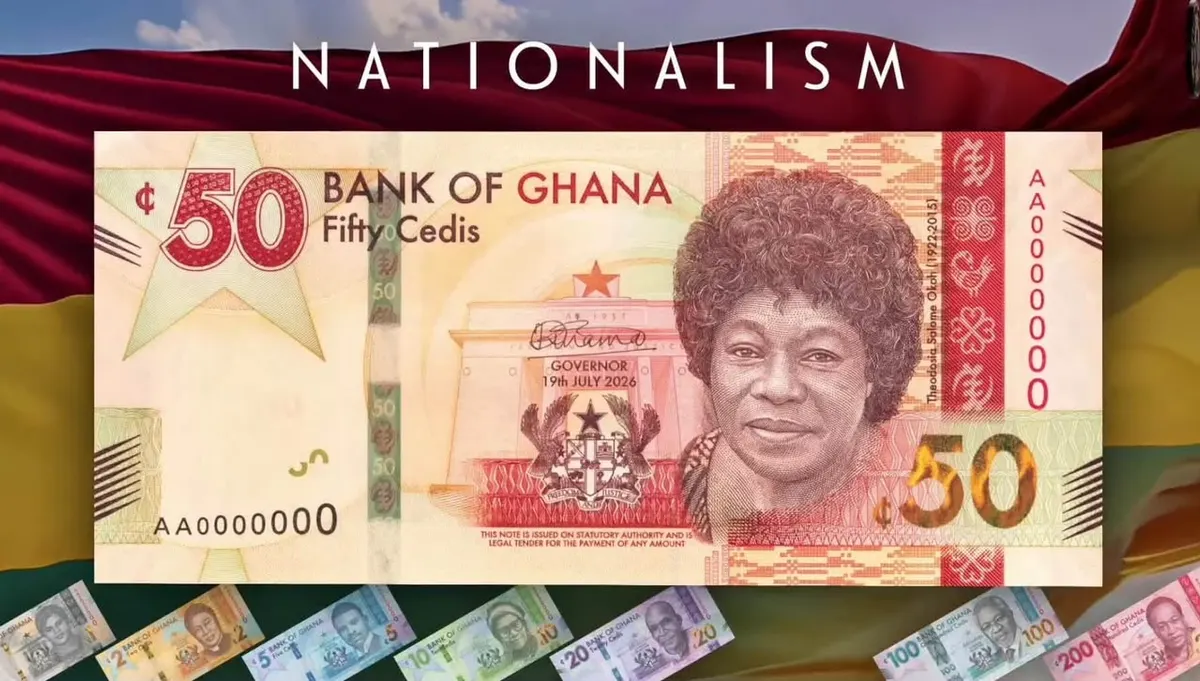

- BoG Says GH¢50 Note Portrait Was Built from Images of Theodosia Okoh
The Bank of Ghana says the portrait of Theodosia Salome Okoh on the new GH¢50 Heritage Series banknote was created from photographs of the designer of Ghana’s national flag not from a photograph of her sister, Dr Letitia Obeng.
The clarification addresses public concerns over the portrait’s resemblance to Dr Obeng. The central bank says the image was developed by combining different photographs of Mrs Okoh and converting them into an engraved artistic representation suitable for currency printing.
It also acknowledges that the final image differs from the appearance with which many people associate her. In adapting the portrait for banknote production, the Bank says it replaced Mrs Okoh’s familiar head-tie with a hairstyle it describes as common during that period. Those changes, it says, contributed to the perceived differences and the resemblance to her sister.
The explanation provides a direct answer to one concern: whose photographs were used. But it also raises a broader question about how Ghana’s most recognisable public figures should be represented on currency and what standards the central bank applies when artistic interpretation and technical requirements alter a familiar image.
A banknote portrait is not simply an illustration. It becomes a widely circulated representation of a person’s place in the national story. The GH¢50 design is intended to honour Mrs Okoh and her contribution to Ghana’s national identity, the Bank says.
Whether the image achieves that purpose depends not only on the intention behind it, but also on whether the person portrayed is recognisable and represented with dignity.
The Bank’s statement argues that technical requirements shaped the image. Currency portraits must be engraved and adapted for printing and security features, which can require changes to photographs.
But the clarification does not explain which specific technical requirements led to the replacement of the head-tie or the choice of hairstyle. Nor does it name the photographs used or explain how the final portrait was reviewed before approval.
Those omissions do not prove that the design process was inadequate. They do leave room for further questions, particularly because the image has become a matter of public discussion before the new notes enter circulation.
A fuller account of the design process could help the public understand where technical necessity ended and artistic choice began.
The central bank says it appreciates the family’s “constructive engagement” and public interest in preserving Ghana’s heritage.
That acknowledgment matters: the concern is not only whether the image was derived from the correct photographs, but whether the family and the wider public see the result as a respectful tribute.
The statement does not say that the portrait will be changed. Instead, the Bank reaffirms that it is intended to honour Mrs Okoh and says it is committed to representing the distinguished personalities featured on Ghana’s currency “with dignity and respect”.
That leaves the public with an explanation of how the image was created, but no indication of whether the design will be reviewed in response to the concerns.
The timing adds urgency. The Heritage Series banknotes are scheduled to enter circulation on December 1. Once distributed, the GH¢50 note will place the image in everyday transactions across the country.
The issue is therefore likely to persist beyond the initial debate: the note itself will become the most visible evidence of how the Bank’s explanation translates into the finished design.
The clarification also presents an institutional test. Currency design requires technical expertise, but national symbols carry meaning that extends beyond printing specifications.
Public confidence depends on the Bank being able to explain not just that a portrait was technically adapted, but why particular choices were made and how those choices preserve the identity and dignity of the person being honoured.
The central bank may consider the matter settled by confirming that it used photographs of Mrs Okoh. Yet the public’s concern appears to include the result as well as the source material.
If the portrait bears a close likeness to another prominent Ghanaian, saying it was created from the correct photographs may not fully resolve questions about recognition and representation.
A transparent process could help bridge that gap. The Bank could explain the design review, the criteria for modifying portraits and whether the family was consulted on the final image.
The release notes constructive engagement, but does not say whether that engagement took place before or after the portrait attracted public attention, or whether it produced any agreed next steps.
The debate is an opportunity to establish clearer expectations for future currency designs. If portraits are intended to honour national figures, the process should make room for technical constraints while ensuring that the person remains recognisable and that families understand how the image will be adapted.
Clear communication before a note is issued may prevent technical decisions from being mistaken for historical or personal misrepresentation.
The Bank has clarified that Mrs Okoh’s image came from photographs of her, and it has explained why the final engraving differs from the familiar head-tie portrait.
The remaining test is whether that explanation is enough to secure public confidence in the note and whether the institution will respond if the concerns continue after circulation begins.

