



- BoG to Hold Policy Rate at 14% Before 2027 Tightening – Fitch Solutions
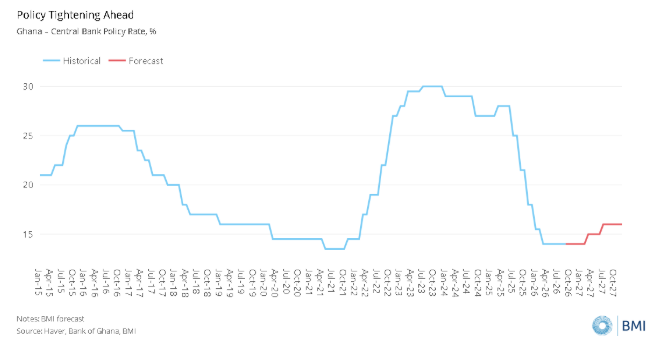
Fitch Solutions expects the Bank of Ghana to keep its policy rate unchanged at 14 per cent for the remainder of 2026 before raising it by a cumulative 200 basis points to 16 per cent in 2027, as exchange-rate support fades and inflationary pressures rebuild.
The UK-based research firm said Ghana’s unusually low inflation would allow the Monetary Policy Committee to maintain the benchmark rate at its final meeting of the year in November.
But it sees little room for further monetary easing because inflation has already begun rising from its March low and could accelerate more sharply during 2027.
The forecast suggests that Ghana’s rate-cutting cycle has effectively ended, even though inflation remains below the Bank of Ghana’s medium-term target band.
“Consumer price growth has remained at multi-decade lows this year, averaging just 4.0 per cent year-on-year, well below the 2010-2025 average of 15.7 per cent and the BoG’s 6.0-10.0 per cent target range,” Fitch Solutions said.
It attributed the subdued price environment to the delayed effects of earlier monetary tightening, favourable base effects and the year-on-year strength of the cedi.
The Bank of Ghana maintained the policy rate at 14 per cent in September for the third consecutive meeting, matching the outcome previously anticipated by NorvanReports as falling reserves and renewed foreign-exchange pressure outweighed the case for another cut.
Fitch Solutions expects inflation to reach 6.8 per cent by the end of 2026, up from 5 per cent in August and the 3.2 per cent recorded in March.
The projection keeps inflation below the 8 per cent midpoint of the Bank of Ghana’s target at year-end, supporting the case for another hold in November.
Yet the direction of travel has changed. Monetary policy must now respond not only to the current inflation rate but also to where prices are likely to move over the next 12 to 18 months.
Energy costs have risen amid the continuing US-Iran conflict, while the cedi has begun to weaken on a year-on-year basis. Both factors could place renewed pressure on transport, fuel and imported goods.
“Inflation will remain low by Ghanaian standards and below the BoG’s target midpoint through quarter four of 2026, limiting the need for monetary tightening,” the firm said.
But with inflation moving higher, Fitch Solutions sees “little appetite for rate cuts”, making another hold the most likely outcome at the November meeting.
That assessment captures the policy dilemma facing the central bank. Cutting the rate could support credit growth and private-sector activity, but it could also weaken the return available on cedi-denominated assets at a time when foreign-exchange demand remains elevated.
Raising the rate immediately would provide additional support for the currency and inflation expectations but could appear premature while inflation remains below target.
Holding at 14 per cent allows the MPC to preserve both credibility and flexibility.
The more significant element of the forecast is the expected reversal in 2027.
Fitch Solutions projects average inflation will increase from 4.7 per cent in 2026 to 11.3 per cent next year. It expects inflation to breach 10 per cent during the second quarter of 2027, prompting the Bank of Ghana to begin raising rates.
“As inflation accelerates and breaches the 10 per cent mark in quarter two 2027, we expect the BoG to begin tightening, raising the policy rate by a cumulative 200bps by year-end,” the firm said.
The forecast is based on three principal domestic factors: weakening exchange-rate support, modest fiscal loosening and rapid money-supply growth.
Broad money supply growth was already exceeding nominal gross domestic product growth by 17.1 percentage points in the second quarter of 2026, according to Fitch Solutions.
When liquidity expands much faster than the value of economic output, it can eventually create excess demand for goods, assets and foreign currency. The inflationary effect may not be immediate, but it increases the risk that today’s low inflation proves temporary.
The firm also expects a strong El Niño event, forecast to peak towards the end of 2026, to raise global food prices and increase imported inflation during 2027.
Ghana’s current-account surplus is expected to narrow from 7.9 per cent of GDP in 2026 to 5.3 per cent in 2027.
Fitch Solutions attributed the expected reduction partly to a decline in gold prices from US$4,400 an ounce to US$4,200 and a projected 9.1 per cent fall in cocoa production because of El Niño-related weather disruption.
A smaller external surplus would reduce one of the supports that strengthened the cedi and helped lower imported inflation.
The Bank of Ghana’s ambition to build reserves equivalent to 15 months of import cover by 2028 could also influence monetary policy. Fitch Solutions considers that target highly ambitious and unlikely to be achieved.
The central bank may consequently seek to maintain positive real interest rates to attract portfolio inflows and strengthen its foreign-exchange buffers.
This creates a direct connection between reserve accumulation and domestic borrowing costs. Even if current inflation appears low enough to justify monetary easing, the need to support the cedi and attract foreign capital may require rates to remain higher.
Fitch Solutions warned that a longer or more severe escalation in Middle East tensions could increase international energy prices and keep domestic fuel costs elevated.
Under that scenario, the Bank of Ghana could begin tightening as early as November 2026 or raise rates by more than the 200 basis points currently forecast for 2027.
The policy outlook is therefore asymmetric. A further cut appears increasingly unlikely, while a worsening oil or currency shock could bring forward the next increase.
For businesses and households, the forecast means the present period of relatively low inflation may not translate into a sustained fall in borrowing costs.
Commercial lending rates respond to more than the policy rate. Bank funding costs, credit risk, government-security yields and the health of borrowers’ balance sheets all influence the price of credit.
The Bank of Ghana may hold at 14 per cent in November, but that stability should not be mistaken for the beginning of a prolonged low-rate era.
Fitch Solutions’ message is more cautious: Ghana has reached the end of monetary easing just as the forces that delivered exceptionally low inflation are beginning to weaken.

