

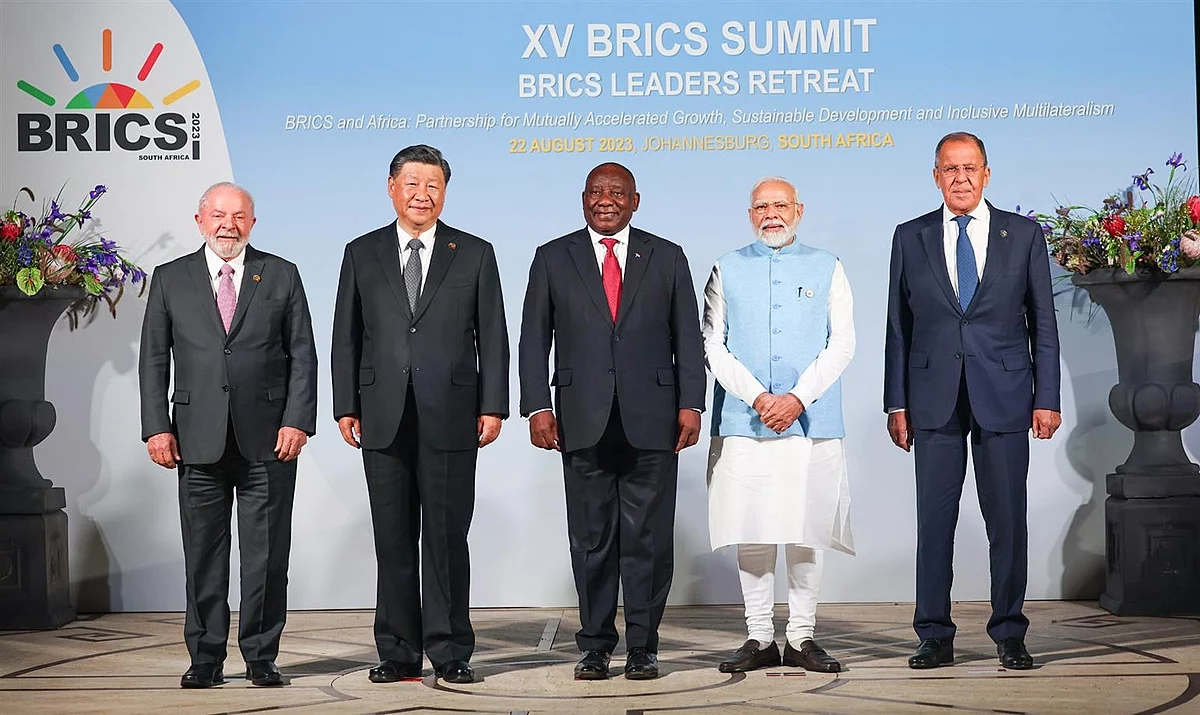

- BRICS Leaders Rally in India as Bloc Pushes Local-Currency Trade and Alternative Payment Systems
Leaders of the expanded BRICS bloc have gathered in New Delhi with cross-border payments, greater use of national currencies and deeper trade cooperation high on the agenda, as some of the world’s largest emerging economies seek greater financial autonomy and a stronger voice in the global economic system.
The 18th BRICS Summit, being held at Bharat Mandapam on September 12 and 13, brings together leaders from an expanded 11-member grouping that now stretches from Brazil and Russia to China, India, Iran, Saudi Arabia and three African economies South Africa, Egypt and Ethiopia.
The gathering comes at a time when geopolitical conflicts, sanctions, tariff pressures and growing concern over the resilience of global supply chains are pushing member states to examine how trade and payments can be conducted with less dependence on established Western-dominated financial channels.
India, which holds the BRICS presidency, is using the summit to advance discussions on new mechanisms for trade cooperation, supply-chain resilience and cross-border financial settlements, with increased use of national currencies emerging as one of the most closely watched issues.
Prime Minister Narendra Modi opened bilateral discussions with Russian President Vladimir Putin and Iranian President Masoud Pezeshkian ahead of the main sessions, while Chinese President Xi Jinping’s participation marks his first official visit to India in almost seven years.
South African President Cyril Ramaphosa and Egyptian President Abdel Fattah El-Sisi are also among the prominent participants, underlining the growing African dimension of a bloc that has expanded significantly beyond its original membership.
BRICS was established by Brazil, Russia, India and China before South Africa joined, with the grouping seeking to strengthen the influence of major developing economies within an international system traditionally dominated by advanced Western countries. The latest expansion has brought Iran, the United Arab Emirates, Saudi Arabia, Egypt, Ethiopia and Indonesia into the group.
The enlarged membership gives BRICS greater economic and geopolitical breadth, but it also brings together countries with different strategic interests, currencies, financial systems and relationships with the United States and Europe.
That tension is particularly visible in discussions about payments. Russia and Iran have faced extensive Western sanctions, while China has increasingly promoted the use of the renminbi in international trade. Against that backdrop, efforts to settle a larger share of commerce in national currencies have attracted scrutiny in Washington because they could reduce, at least at the margins, reliance on US-dollar-based payment channels.
The summit discussions do not amount to the creation of a single BRICS currency. Rather, the focus is on expanding the practical use of member countries’ existing currencies and developing financial infrastructure that can make cross-border transactions faster and less dependent on established settlement arrangements.
For African members, the debate carries particular significance. South Africa, Egypt and Ethiopia are now part of a grouping that includes some of the world’s largest commodity producers, energy exporters, manufacturers and consumer markets. Greater payment connectivity could potentially make trade among BRICS economies easier, particularly where access to foreign exchange or international settlement systems creates additional transaction costs.
The financial discussion is also unfolding against a difficult geopolitical backdrop. Conflicts in the Middle East and Eastern Europe are influencing conversations in New Delhi, including concerns about maritime trade routes and wider supply-chain disruptions.
During talks between Mr Modi and Mr Putin, the two leaders reviewed security issues affecting international maritime trade and agreed to continue efforts to strengthen the strategic partnership between India and Russia, according to India’s foreign ministry.
Analysts have also pointed to instability in the Gulf as a potentially important fault line within the summit, given the presence of both major energy producers and large energy-importing economies inside BRICS.
The bloc’s financial ambitions therefore intersect with broader questions about energy security, trade routes and the ability of member countries to protect commercial relationships from geopolitical shocks.
The United States is likely to watch those discussions closely. Business Insider Africa reported that conversations around increasing the use of national currencies are expected to receive support within the BRICS framework but could generate concern in Washington, particularly because Iran and Russia remain subject to US economic sanctions.
The issue is not simply whether the dollar remains the world’s dominant currency it does but whether BRICS members can build enough bilateral and multilateral settlement capacity to conduct more trade without routing every transaction through dollar-based systems.
That distinction is important because the bloc’s immediate strategy appears to be incremental rather than revolutionary: more local-currency settlement, more interoperability among payment systems and greater resilience against external financial pressure.
For India, the summit also offers an opportunity to position itself as a bridge between competing blocs.
New Delhi maintains close relations with Russia, deep economic ties with the United States and an often-complicated strategic relationship with China. Hosting Putin, Xi, Pezeshkian, Ramaphosa, El-Sisi and other leaders in the same forum gives India an important role in shaping how far BRICS pushes its financial agenda.
The expanded grouping’s ambitions are nevertheless broader than payments alone. Member states are also discussing trade cooperation and supply-chain resilience as they seek to strengthen economic links among themselves and respond to an increasingly fragmented global environment.
For Africa’s BRICS members, that evolution could open additional channels for investment, trade and financing, but it also places them at the centre of a widening contest over the future architecture of global finance.
The New Delhi summit therefore represents more than another diplomatic gathering. It is becoming a test of whether BRICS can translate its larger membership and growing economic weight into practical financial mechanisms that reduce transaction costs, expand trade and give emerging economies more room to manoeuvre within a global system still heavily anchored to the US dollar.

