

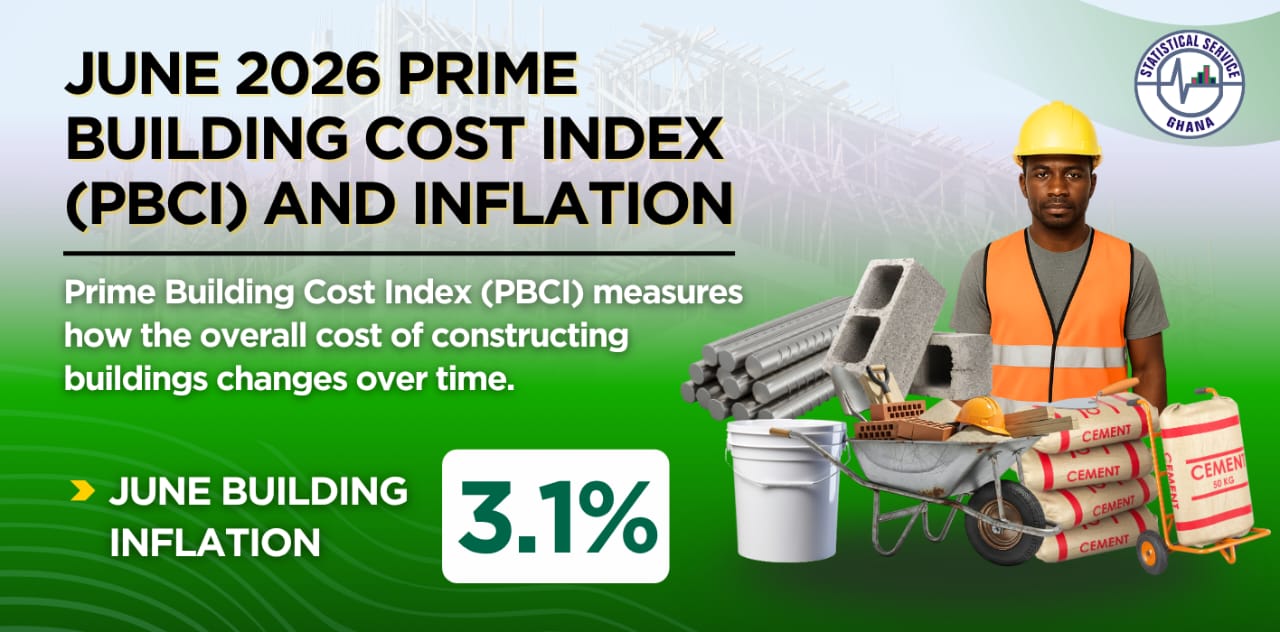

- Building Inflation Rises to 3.10% as Plant Costs Surge 16.00%
Ghana’s building-cost inflation increased for a second consecutive month in June, driven by a sharp rise in machinery, equipment and selected installation materials, even as cheaper cement, steel and labour continued to limit overall construction-cost pressures. The Prime Building Cost Index rose 3.10% year-on-year in June 2026, up from 2.70% in May, according to the Ghana Statistical Service.
The increase leaves building inflation well below the 18.10% recorded in June 2025, reflecting the significant easing in construction-input prices over the past year.
On a month-on-month basis, the index declined by 0.10%, with the headline PBCI easing to 137.90 from 138.00 in May. The annual average rate stood at 5.90%.
The figures indicate that construction costs remain broadly contained, but they also expose a widening divergence among the principal inputs used in residential, commercial and public infrastructure projects.
Plant and equipment recorded annual inflation of 16.00%, rising sharply from 9.80% in May. Prices in the category increased by 5.10% in June alone, making machinery-related expenses the most significant emerging risk to the building-cost outlook.
The category accounted for 20.50% of the upward contribution to headline inflation despite carrying only a 4.00% weight in the index.
Small tools recorded annual inflation of 19.70%, while equipment costs rose by 11.20%, reflecting increasing pressure on contractors reliant on machinery, imported tools and specialised construction equipment.
Materials, which make up 76.50% of the building-cost basket, remained the largest overall driver.
Materials inflation increased to 3.90% from 3.50% in May and accounted for 96.00% of the upward contribution to headline inflation.
The broad materials figure, however, concealed substantial differences among individual products.
Plumbing materials recorded the fastest annual price increase at 23.90%, followed by roofing sheets at 21.40%, reinforcement materials at 18.10%, glazing at 17.90% and electrical works at 17.40%.
The concentration of increases in installation and finishing components suggests that projects entering later construction phases may face greater cost pressure than those focused on basic structural works.
Electrical works made the largest upward contribution among materials at 57.00%, followed by metalwork at 30.20%, glazing at 29.50%, plumbing at 26.30% and tiles at 20.50%.
By contrast, several essential structural materials became cheaper than a year earlier.
Cement prices declined by 13.00%, steel fell by 8.60%, fine aggregate dropped by 5.10% and timber prices decreased by 1.60%. Coarse aggregate recorded only a marginal increase of 0.40%.
The reduction in cement and steel prices provides some relief to households, developers and contractors, particularly during the foundation and structural stages of construction.
However, the rise in roofing, plumbing, electrical and machinery costs means the benefits may not extend evenly across an entire project.
A building could therefore become cheaper to start but remain expensive to complete, particularly where imported fittings, specialised equipment and installation materials form a larger share of the final budget.
Labour costs also helped offset the increase in materials and machinery.
Overall labour inflation stood at negative 2.60%, compared with negative 2.00% in May. Skilled labour costs declined by 1.20% from a year earlier, while unskilled labour costs fell by 4.90%.
Labour accounted for a negative 16.50% contribution to headline building inflation, partially neutralising the increases recorded in materials and plant costs.
The reduction may provide near-term relief for developers but could also indicate weaker wage growth or subdued demand for some categories of construction labour.
The PBCI measures monthly prices for 406 construction items covering materials, labour, plant and equipment. The Ghana Statistical Service gathers prices from 489 outlets across 16 markets and compares them with a 2023 base-year index of 100.
The index is intended to provide households, contractors, government institutions and investors with a more reliable basis for budgeting, contract pricing and investment decisions.
The latest results suggest that the broader construction environment has improved considerably from a year earlier.
The year-on-year rate fell rapidly from 18.10% in June 2025 to 14.20% in July, 12.00% in August and 9.70% in September. It declined further to 2.40% in February 2026 before reaching 2.20% in March and April.
Inflation subsequently increased to 2.70% in May and 3.10% in June, suggesting that the earlier disinflation may be beginning to stabilise rather than continue indefinitely.
For contractors, the mixed trend complicates procurement and contract management.
Firms may benefit from lower cement, steel and labour costs while simultaneously facing higher expenses for machinery, tools and finishing materials. Fixed-price contracts could become vulnerable where budgets fail to account for large differences among individual input categories.
The Statistical Service urged businesses to use current price evidence when preparing contracts, manage exposure to high-inflation plant and material categories and incorporate transparent price-adjustment provisions where appropriate.
Households were advised to update construction budgets, compare supplier quotations and consider completing projects in phases rather than assuming that all inputs are moving in the same direction.
For the government, the low headline rate creates an opportunity to improve the delivery of public infrastructure projects, but machinery and installation costs will require closer monitoring.
The agency also called for stronger local supply chains, improved procurement information and investment in artisan skills to help reduce exposure to volatile imported inputs.
The June figures therefore present a construction sector benefiting from substantially lower inflation but facing a new concentration of risk.
Building costs are rising far more slowly than a year ago, and prices fell slightly during the month. Yet the acceleration in plant, tools, plumbing and roofing indicates that the cost relief remains uneven.
For developers and policymakers, the central challenge is no longer a broad surge across all construction inputs. It is the growing pressure in a smaller group of machinery and installation costs capable of disrupting project budgets even while headline inflation remains low.

