

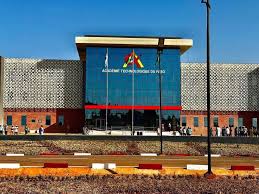

- Burkina Faso Opens Technology Academy to Train Engineers for Mining, Nuclear And Aerospace Sectors
Burkina Faso has opened a state-funded technology academy designed to train engineers in fields ranging from mining and metallurgy to nuclear science and aeronautics.
The $66 million project is a bet that domestic skills can help the country do more with its resources and rely less on expertise and technology brought in from abroad.
The Académie Technologique du Faso (ATF) was inaugurated on November 23 at Pabré, near the capital, Ouagadougou. Its first intake comprises 250 students selected from scientific and technical secondary schools.
They will undertake a two-year preparatory programme before specialising in disciplines including mining, metallurgy, nuclear engineering, aeronautics, telecommunications, computer science, electrical energy, civil engineering, chemistry and cybersecurity.
The academy was built on a site of about 60 hectares. Burkina Faso’s government put the first phase at 37.37 billion CFA francs, funded through the national budget.
The figure has been widely reported as about $66 million. Construction began in December 2025 and was completed in less than a year, according to the government and the presidency.
The opening is significant because the academy’s curriculum responds to an economic challenge: Burkina Faso has valuable natural resources, but capturing more of their value requires technical capability, industrial equipment and people able to operate and maintain complex facilities. The government’s project description links the academy’s purpose to developing an elite workforce for the country’s economic and social prosperity.
Mining makes that ambition especially relevant. Gold accounts for more than 80% of Burkina Faso’s exports, according to the IMF, making the sector a major source of foreign exchange.
The institute’s programmes in mining and metallurgy could help build the expertise needed to move beyond extraction towards mineral processing and more technically demanding operations.
But training is only one part of that transition: the country will also need investment, reliable infrastructure, equipment and firms able to employ graduates.
The government has already signalled a broader push towards domestic value creation. It opened its first gold refinery in September, part of a regional movement to expand local refining and reduce reliance on overseas processing hubs.
The academy is not itself a mining or refining project, but its technical programmes sit alongside that industrial policy: refineries and mines need engineers, technicians and specialist operators if they are to work reliably and safely.
The academy also looks beyond mining. Its nuclear and aeronautics programmes point to ambitions in sectors that require far more than a campus and a curriculum.
Burkina Faso has signed cooperation arrangements with Russia on nuclear energy, and the government has framed technical education as part of developing local capacity for strategic industries.
Building a domestic skills base could help the country participate in future projects, but it does not by itself provide the regulatory systems, financing, technology partnerships or long-term operations those industries require.
That gap between ambition and operating capacity is already visible in the academy’s own development. President Ibrahim Traoré acknowledged that specialised laboratory equipment would be installed gradually because of its high cost.
The campus includes teaching facilities, workshops, laboratories and a forge, but advanced technical education depends on the equipment being available, maintained and integrated into sustained practical training.
A completed building is a starting point; the quality and continuity of instruction will determine what students can do after graduation.
The investment’s cost also raises a question of long-term commitment.
The initial construction phase has been financed from public funds, but a specialist academy will require continuing spending on equipment, faculty, research, safety standards and industry partnerships.
The state will have to sustain those costs while addressing competing demands on public finances.
If funding falls after the opening, the institution risks having impressive infrastructure without the full technical capacity its programmes promise.
The other test is whether the economy can absorb its graduates. Training engineers in mining, metallurgy and energy can strengthen the workforce, but only if domestic projects create opportunities for them to practise those skills.
Partnerships with operating companies, apprenticeships, applied research and clear career pathways could help connect the academy to employers.
Without those links, graduates may be underused or seek work elsewhere, while local industries continue to rely on foreign specialists.
There is also a difference between developing national expertise and achieving technological self-sufficiency.
Advanced industries depend on international research, specialised components, supply chains and technical collaboration.
The academy could improve Burkina Faso’s ability to negotiate, operate and maintain projects; it cannot eliminate the need for external partnerships.
The more realistic measure of progress may be whether local teams take on increasingly complex responsibilities over time.
For a country whose export earnings are so concentrated in gold, developing engineering capacity could have effects beyond the mining sector. Technical skills in electricity, computing, civil engineering and chemistry can support a wider industrial base.
But diversification requires businesses, infrastructure and reliable energy as well as qualified people. The academy can contribute to that foundation; it cannot create the rest of the ecosystem on its own.
Burkina Faso’s $66 million investment therefore carries a larger promise than educating its first 250 students. It is an attempt to connect public education directly to the country’s industrial ambitions.
Whether that promise is fulfilled will depend on what follows the inauguration: properly equipped laboratories, experienced instructors, links with employers and a steady pipeline of projects where graduates can apply their training.
The real measure of the academy will not be the range of subjects printed in its prospectus. It will be whether Burkinabè engineers take on work that has historically been performed by imported expertise and whether the industries they help build retain more value inside the country.

