

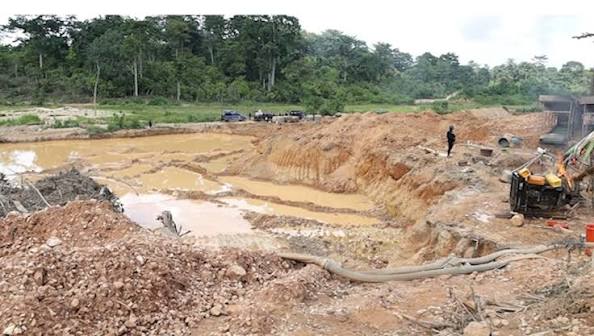

- Anti-Galamsey Fight Will Fail Without Community Protection — CSO Groups
Four civil-society organisations have called on the Ghana Police Service to investigate allegations that a 61-year-old cocoa farmer and her son were threatened and chased from their land by people undertaking suspected illegal mining at Patriensa in the Ashanti Region.
A Rocha Ghana, the Nature and Development Foundation, WACAM and the Network of Legal Advocates for Land and Human Rights said the reported September 29 incident reflected a wider climate of coercion in communities affected by illegal small-scale mining.
The groups said they had submitted a formal criminal complaint to the Konongo District Police Commander and requested an urgent investigation.
Their complaint followed the circulation of a video on social media which they said showed the distressed farmer being chased from her farm by a man brandishing a cutlass.
NorvanReports has not independently established the identities of those shown in the video or verified the ownership and regulatory status of the land and mining activity. The allegations will require investigation by the police and other appropriate authorities.
The organisations acknowledged that determining whether the available evidence disclosed criminal offences remained the responsibility of the police and prosecutorial authorities.
“These are serious allegations that the police must investigate,” the groups said. “We believe they are consistent with what is shown in the video and reflect a pattern familiar to communities in galamsey-affected landscapes across the country.”
According to the statement, the video was recorded by the farmer’s son, who was present during the incident.
The organisations said the son told their teams that he had gone to the farm after learning that a group had entered the land and begun mining without his mother’s knowledge or consent.
He alleged that portions of the cocoa farm had already been cleared and destroyed.
The group allegedly refused to identify who had authorised the activity or produce a mining licence, permit or other regulatory approval when questioned.
The civil-society organisations said the individuals subsequently became aggressive, confronted the farmer and her son with cutlasses and chased them from the property.
The allegations have not yet been tested through a formal investigative or judicial process. But they raise questions extending beyond whether mining activity was taking place without authorisation.
If individuals can use threats or weapons to prevent landholders from questioning activity on their property, the issue becomes one of personal security, property rights and the capacity of the state to enforce the law.
“When people can be chased off their own land with impunity, the rule of law has failed them,” the organisations said.
“Ghana cannot win the fight against illegal mining if the people who live with its consequences have no confidence that the state will protect them.”
The organisations said they had received accounts from farmers in several mining districts alleging the destruction of farms, pollution of water sources and the presence of armed groups on or near agricultural land.
They described a recurring sequence in which land is entered without consent, questions about authorisation remain unanswered, threats follow and those who resist are driven away.
Many incidents may go unreported because affected residents fear retaliation or doubt that law-enforcement agencies will act, the statement said.
The possibility of underreporting presents a serious challenge to Ghana’s anti-galamsey strategy. Enforcement data can understate the scale of abuse if those most directly affected do not feel safe enough to report it.
“Many do not report because they doubt that anything will be done, or fear retaliation if they do,” the organisations said.
This means illegal mining cannot be treated only as an environmental or licensing problem. It is also a public-security issue in which the balance of power may be tilted against farmers and rural households.
Ghana’s policy response has often focused on excavators, river pollution and the regulatory status of mining operations. Those questions are important, but they do not fully capture what happens when residents encounter individuals operating on the ground.
Where communities feel unable to challenge unauthorised entry onto their land, the practical enforcement system has already broken down before the police, Environmental Protection Authority or Minerals Commission becomes involved.
The Patriensa allegations also carry economic implications because the disputed land was reportedly being used for cocoa production.
Ghana’s cocoa sector depends heavily on smallholder farmers whose farms are concentrated in areas increasingly exposed to mining activity.
The destruction of a single farm may appear localised. Repeated across several cocoa-growing districts, however, it could reduce cultivated land, discourage long-term investment and worsen uncertainty over future production.
Cocoa trees take years to mature. A farmer whose trees are destroyed cannot restore income immediately, even if compensation or legal redress is eventually secured.
The groups warned that similar incidents could have “broader implications for farmers’ access to and use of their land, as well as local and national security concerns”.
The tension between mining and agriculture has therefore become a contest over the future use of rural land. Gold can generate immediate financial returns, but destroyed cocoa farms remove productive assets that support households and export earnings over many years.
The organisations asked the Ghana Police Service to conduct a prompt, thorough and impartial investigation into the Patriensa incident.
They also requested protection for the farmer, her son and anyone assisting the investigation against further harassment, intimidation or retaliation.
The police should identify and secure any excavators, vehicles, weapons, minerals or other equipment connected to suspected offences, subject to the law, the groups said.
They further asked the service to prevent additional mining, destruction of crops or alteration of the site while the matter was being investigated.
The statement called for safer and more accessible reporting channels for residents of galamsey-affected areas and requested a public update on the investigation, subject to the privacy and safety of those involved.
Finally, the organisations proposed the establishment of a simplified and anonymous complaints and remedy system for communities affected by illegal mining.
The statement referred to an “anonymous compliant and remedy system”, which appears from the context to mean an anonymous complaint mechanism.
Such a system could reduce the personal risk faced by residents who report threats. But anonymity alone will not restore confidence unless complaints lead to visible investigations, protection and enforcement.
The organisations said the police response must extend beyond incidents that become popular on social media.
“Viral videos of this kind often reveal individual instances of a broader pattern of conduct,” they said.
That may be the most important argument raised by the Patriensa case. The farmer’s experience attracted national attention because someone recorded it. Other incidents may occur without a camera, public outrage or institutional response.
The measure of Ghana’s anti-galamsey effort will therefore not be how quickly authorities respond to a viral video. It will be whether farmers can resist unlawful activity, report threats and remain on their land without needing social media attention to obtain state protection.

