


- CAF Selects Six Cities For 2027 AFCON As Kenya, Tanzania and Uganda Prepare for Historic Tournament
The Confederation of African Football (CAF) has confirmed six host cities across Kenya, Tanzania and Uganda for the 2027 Africa Cup of Nations, marking a significant milestone in preparations for the first edition of Africa’s premier football tournament to be staged jointly by three countries.
The selection, unveiled during CAF’s Ordinary General Assembly in Abuja, Nigeria, on November 21, establishes the geographical framework for the 24-team competition scheduled to take place from June 19 to July 17, 2027.
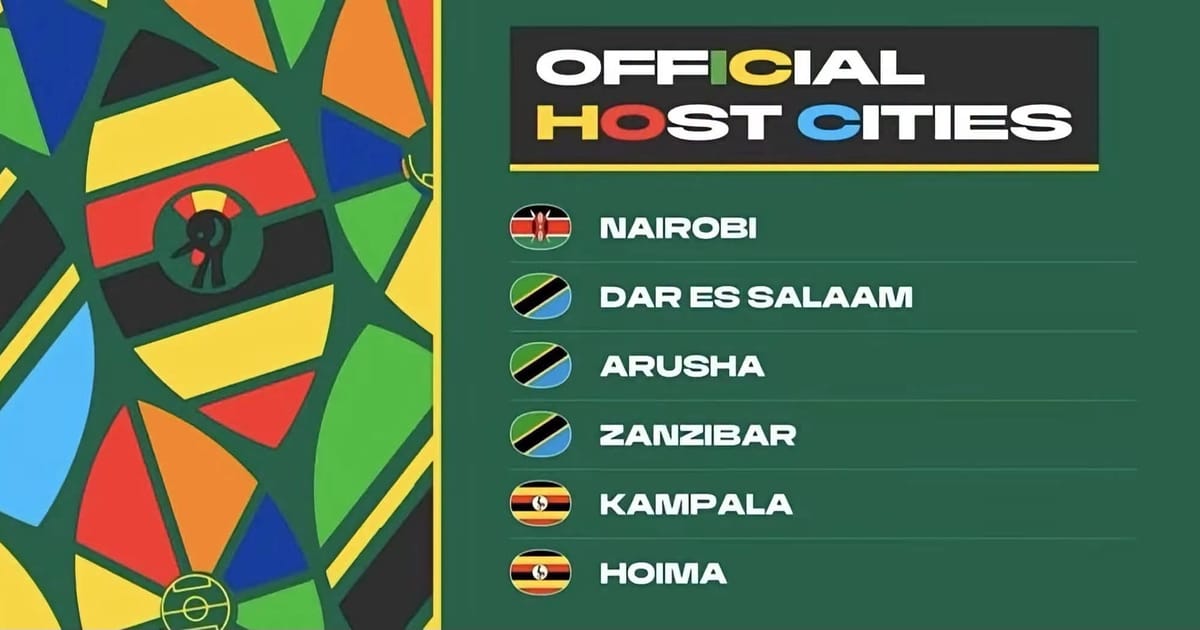
Nairobi will serve as Kenya’s only designated host city, while Tanzania will stage matches in Dar es Salaam, Arusha and Zanzibar. Uganda’s fixtures will be distributed between Kampala and Hoima.
The decision gives Tanzania the largest share of host cities, with three of the six selected locations, compared with two in Uganda and one in Kenya.
However, CAF has yet to determine which country or stadium will host the final, leaving one of the tournament’s most commercially and symbolically important decisions unresolved.
Confirmed host cities for the 2027 Africa Cup of Nations
| COUNTRY | HOST CITIES | PRINCIPAL STADIUMS UNDER PREPARATION |
| Kenya | Nairobi | Talanta/Raila Odinga International Stadium; Kasarani |
| Tanzania | Dar es Salaam, Arusha, Zanzibar | Benjamin Mkapa; Samia Suluhu Hassan; Zanzibar facilities |
| Uganda | Kampala, Hoima | Mandela National Stadium; Hoima City Stadium |
Host cities confirmed by the Football Kenya Federation and CAF-related announcements. Stadium assignments remain subject to final competition arrangements.
The six-city arrangement represents a significant organisational challenge because the tournament will require the movement of national teams, supporters, match officials, broadcasters and commercial partners across three countries.
Unlike previous editions hosted within a single national jurisdiction, the 2027 competition will depend on coordination between governments with separate immigration procedures, transport systems, security structures and infrastructure requirements.
CAF and the three host nations will therefore need to ensure that the tournament operates as an integrated regional event rather than three separate national competitions.
The geographical distribution also raises questions about the allocation of matches, particularly the opening fixture, semi-finals and final.
Those decisions could have substantial implications for tourism revenues, hotel occupancy, commercial activity and the international visibility of the selected cities.
Kenya’s preparations are centred on Nairobi, where the new Raila Odinga International Stadium, previously known as Talanta Sports City, is expected to become a major tournament venue.
The 60,000-capacity stadium has been developed as one of the country’s flagship sporting infrastructure projects and is scheduled for inauguration in January 2027.
Its completion will be closely watched because the facility is intended to accommodate major international football events and provide Kenya with a modern stadium capable of meeting CAF’s competition requirements.
Nairobi’s existing Moi International Sports Centre at Kasarani is also part of the preparations.
The concentration of Kenya’s matches in Nairobi could simplify some operational arrangements by reducing the number of domestic host locations requiring tournament infrastructure.
However, it could also concentrate demand for accommodation, transport, security and other services within the capital during the competition.
For Tanzania, the selection of three host cities provides an opportunity to distribute the tournament’s economic benefits more widely.
Dar es Salaam is expected to rely on the established Benjamin Mkapa Stadium, while Arusha is developing the new Samia Suluhu Hassan Stadium.
Zanzibar will provide another competition location, extending the tournament’s geographical footprint beyond mainland Tanzania.
The inclusion of Zanzibar is particularly significant because its established tourism industry could benefit from increased international visibility and visitor arrivals during the competition.
However, converting football-related travel into sustained economic gains will depend on transport connectivity, accommodation capacity and the ability of local businesses to participate in tournament-related expenditure.
Tanzania’s three-city responsibility also requires careful coordination of stadium operations, domestic travel and security arrangements.
Uganda, meanwhile, will stage matches in Kampala and Hoima.
The Mandela National Stadium, commonly known as Namboole, will serve as a principal venue in Kampala, while the newly constructed Hoima City Stadium will provide an additional location in western Uganda.
Hoima’s inclusion creates an opportunity to extend the economic impact of the tournament beyond the capital.
The stadium has already been used for recent international fixtures, providing an important opportunity to assess operational readiness before the continental championship.
Nevertheless, stadium completion alone will not determine whether the host cities are prepared.
CAF’s requirements extend to training facilities, medical services, security arrangements, broadcasting infrastructure, transportation and accommodation.
These supporting systems will be especially important for a tournament expected to attract thousands of visiting supporters and substantial international media attention.
The three-country arrangement also creates a potentially important test for regional integration in East Africa.
Kenya, Tanzania and Uganda are members of the East African Community, providing an existing institutional framework through which governments can cooperate on transport, customs and cross-border movement.
The tournament could therefore create opportunities to strengthen regional travel arrangements and demonstrate the practical benefits of closer economic cooperation.
However, such benefits cannot be assumed.
Supporters travelling between countries may face different entry requirements, transportation costs and logistical challenges.
Organisers will need to communicate clear travel arrangements and ensure that movement between host cities does not become unnecessarily expensive or complicated.
For participating national teams, scheduling will also be important.
A competition distributed across three countries could introduce additional travel demands, depending on how group-stage and knockout matches are allocated.
CAF will need to balance the commercial and organisational advantages of spreading matches across several locations against the physical demands placed on players.
The tournament’s financial implications are equally significant.
Major sporting competitions can generate temporary increases in tourism, hospitality, retail activity and transport demand.
They can also create opportunities for infrastructure investment and long-term improvements in sporting facilities.
However, host governments must carefully manage expenditure to avoid creating facilities whose maintenance costs become difficult to sustain after the event.
The economic value of the 2027 Africa Cup of Nations will therefore depend partly on whether the investments made for the competition continue serving communities and domestic sports after July 2027.
For Kenya, Tanzania and Uganda, this means developing credible post-tournament plans for stadium operations, maintenance and commercial utilisation.
The decision to select six host cities comes as qualification for the tournament continues across the continent.
CAF has confirmed that Benin, Burkina Faso, Cameroon, Mali, Morocco and Senegal secured qualification during the November international window.
They join the three automatically qualified host nations, bringing the number of confirmed participants to nine.
The remaining 15 places will be determined when the final two rounds of qualifiers take place from March 22 to 30, 2027.
The competition will be the first Africa Cup of Nations staged in East Africa since Ethiopia hosted the tournament in 1976, ending a 51-year absence from the region.
It will also be the first time three countries have jointly hosted the finals, creating a precedent that could influence CAF’s approach to future tournament organisation.
The comparison with the previous edition is instructive.
Morocco hosted the 2025 Africa Cup of Nations across nine stadiums in six cities, providing a relatively concentrated national framework for delivering the competition.
The 2027 edition will use six host cities distributed across three national jurisdictions, making cross-border coordination a defining feature of its organisation.
This presents both opportunities and risks.
For the three governments, successful delivery could reinforce East Africa’s reputation as a destination capable of hosting major international sporting events.
For CAF, the competition will demonstrate whether shared hosting can reduce some of the financial burdens placed on individual countries while maintaining high operational standards.
However, the success of the model will ultimately depend on effective coordination and timely completion of outstanding preparations.
CAF has already established a PAMOJA Oversight Committee to strengthen cooperation among the three host nations.
The committee is intended to provide strategic direction and oversee preparations, including infrastructure development and operational planning.
Its effectiveness will become increasingly important as the tournament approaches and responsibility shifts from construction and planning towards testing and delivery.
The selection of six host cities marks an important achievement, but it is not the final measure of East Africa’s readiness to stage the Africa Cup of Nations.
The decisive test will be whether the three countries can complete their infrastructure programmes, coordinate their operational systems and deliver a tournament that meets the expectations of players, supporters and commercial partners.
The unresolved decision over the final venue will also attract considerable attention because hosting the championship match carries significant prestige.
For now, Nairobi, Dar es Salaam, Arusha, Zanzibar, Kampala and Hoima have emerged as the centres of Africa’s biggest football event in 2027.
Their selection establishes the foundation for an ambitious continental competition.
The challenge facing CAF and the three governments is to convert that framework into a successful tournament capable of delivering lasting sporting and economic benefits beyond the final whistle on July 17, 2027.

