

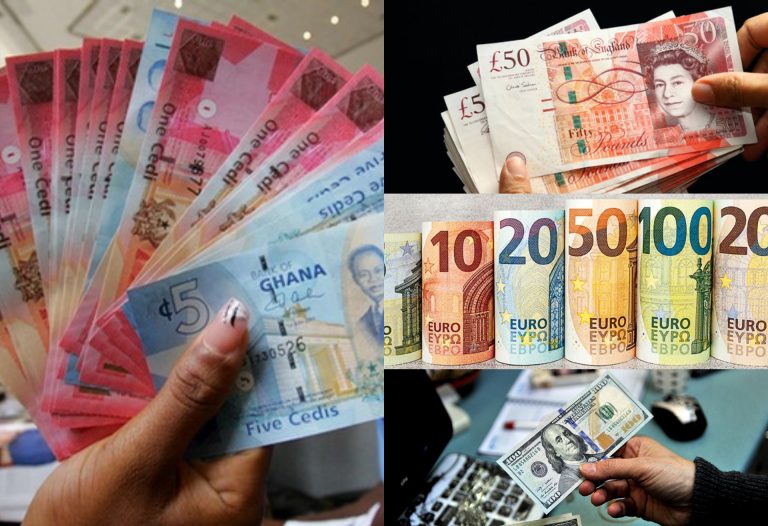

- Cedi Comes Under Fresh Pressure as Q2 Repatriation Demand Builds
Ghana’s cedi extended its losses against major trading currencies over the past two weeks as rising foreign exchange demand and corporate repatriation pressures continued to weigh on the local currency despite aggressive support from the Bank of Ghana.
The local currency weakened across both the interbank and retail foreign exchange markets, with analysts pointing to sustained demand for the US dollar amid moderate foreign exchange supply conditions.
In the interbank market, the cedi slipped to GHS 11.85 per US dollar, compared with GHS 11.63 in the previous review period.
The local currency also depreciated against the British pound and the euro, trading at GHS 15.85 to the pound and GHS 13.66 to the euro, compared with earlier levels of GHS 15.62 and GHS 13.49, respectively.
The pressure was also visible in the retail market, where the cedi declined by 0.81 percent against the dollar, 1.83 percent against the pound and 1.40 percent against the euro.
It closed at mid-market retail rates of GHS 12.30 to the dollar, GHS 16.35 to the pound and GHS 14.30 to the euro.
On a monthly basis, the cedi depreciated by an average of 4.18 percent between April and May 2026, accelerating from the 3.23 percent decline recorded at the end of April.
The latest depreciation came despite approximately US$1.1 billion in foreign exchange interventions by the Bank of Ghana during May, underscoring the scale of demand pressure in the market.
The central bank’s support helped improve liquidity conditions, but it was not enough to fully offset strong corporate and import-related demand.
Market sentiment has remained largely bearish, with analysts noting that demand for foreign currency continues to outstrip available supply.
The pressure has been driven by several factors, including import demand, refined crude oil price pressures and stronger global appetite for the US dollar.
Elevated refined petroleum product prices have increased foreign exchange requirements for fuel imports, adding to demand from other corporate and trading sectors.
Attention is now turning to the second-quarter corporate repatriation window, a period typically associated with increased demand for dollars as multinational companies transfer dividends, profits and other earnings abroad.
“Corporate demand typically peaks during the Q2 repatriation window, driven by multinational dividend and profit outflows,” analysts noted.
This seasonal demand pattern is expected to keep pressure on the cedi in the near term, particularly if foreign exchange inflows do not improve significantly.
Authorities have announced a US$1.2 billion monthly foreign exchange support programme for June, aimed at containing speculative activity, improving market liquidity and supporting currency stability.
The programme is expected to provide additional supply to the market, but analysts warn that intervention alone may not be enough if underlying demand pressures remain elevated.
The cedi’s recent weakness comes after a period of relative stability supported by improved reserves, lower inflation, stronger gold earnings and tighter monetary conditions.
However, the latest movements show that the foreign exchange market remains sensitive to seasonal corporate demand, global dollar strength and energy price developments.
For businesses, the renewed depreciation could raise import costs, affect pricing decisions and complicate planning, especially for firms with dollar-denominated obligations.
For households, sustained currency weakness may eventually feed through to transport costs, imported goods, fuel-related expenses and general price expectations.
The Bank of Ghana has repeatedly cautioned market participants against speculative demand for foreign currency, insisting that transactions should be driven by genuine needs rather than fear of depreciation.
But with corporate repatriation flows rising and global financial conditions still uncertain, market participants are likely to remain cautious.
The pressure on the cedi is not isolated.
Elsewhere on the continent, South Africa’s rand also weakened during the review period, falling 1.15 percent to ZAR 16.28 per US dollar amid rising oil prices and renewed geopolitical tensions that dampened investor appetite for risk assets.
Analysts expect both the cedi and the rand to remain vulnerable in the near term as elevated energy costs, dollar strength and uncertain global market conditions continue to weigh on African emerging-market currencies.
For Ghana, the key issue will be whether the announced June foreign exchange support programme can calm demand, discourage speculative positioning and stabilise expectations.
The challenge for the central bank is delicate.
Too little intervention could allow pressure to deepen. Too much intervention could raise concerns about reserve use if inflows do not keep pace.
The more durable solution will depend on stronger export receipts, improved foreign direct investment, disciplined import demand, continued gold and cocoa inflows, and sustained confidence in the country’s macroeconomic recovery.
For now, the cedi remains under pressure.
The next few weeks will show whether the Bank of Ghana’s additional liquidity support can steady the market, or whether Q2 corporate repatriation demand will push the local currency into another round of depreciation.

