

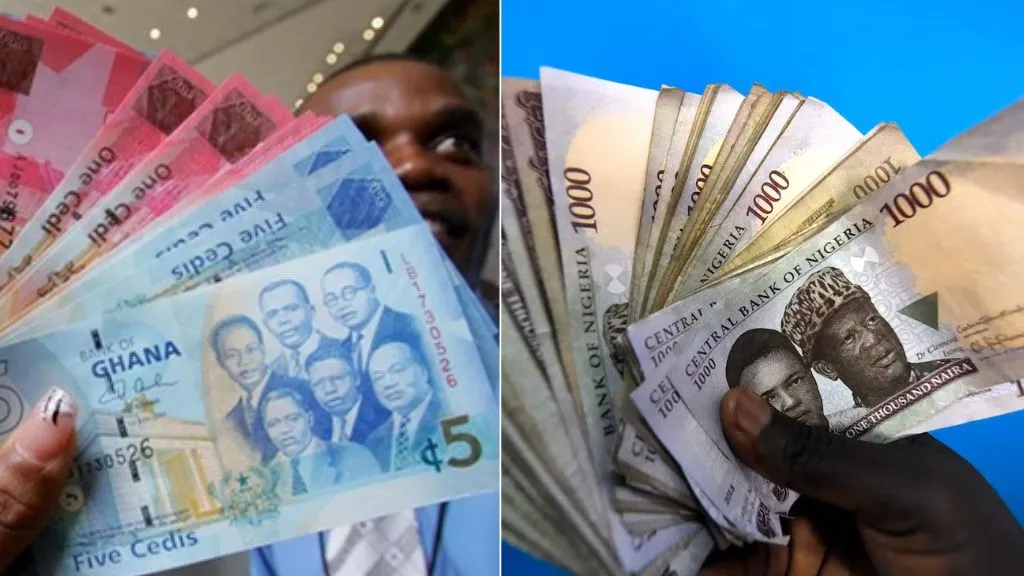

- Cedi Stability Comes at Heavy Intervention Cost as Nigeria’s Naira Strengthens to Two-Year High
Two of West Africa’s largest economies are producing sharply different foreign-exchange signals, with Nigeria’s naira strengthening to its best official-market level in more than two years while Ghana’s cedi remains relatively contained after an estimated US$912.00 million of central-bank dollar supply during August.
The naira strengthened to about ₦1,329/US$ on September 1, appreciating 0.49% from ₦1,335.50/US$ in the preceding session. The move took the currency through the psychologically important ₦1,330 level and marked its strongest official-market closing rate since May 29, 2024, according to market data cited by Nairametrics.
Ghana presents a more complicated picture. The cedi ended August around GH¢11.25/US$ on the interbank market after depreciating 2.67% against the dollar over the final two-week review period, even as the Bank of Ghana continued supplying substantial foreign exchange to the market.
Market estimates indicate the BoG supplied approximately US$912.00 million during August, equivalent to 91.20% of its planned US$1.00 billion monthly foreign-exchange intermediation programme. Analysts cited by Business Post attributed part of the cedi’s relative stability to that supply, which helped ease market pressure and speculative demand.
The scale of that intervention is arguably more important than a single day’s exchange-rate movement. A currency that remains relatively stable because the central bank is supplying substantial dollars presents a different market signal from one whose stability is being generated primarily by autonomous private-sector FX flows.
That distinction does not necessarily mean Ghana’s position is unsustainable. Central banks routinely intervene in foreign-exchange markets to smooth volatility, provide liquidity and prevent disorderly market conditions, particularly in relatively shallow markets.
But US$912.00 million in one month is large enough to make the sustainability and source of intervention an important question for investors. The key issue is whether the supply is smoothing temporary imbalances while underlying FX inflows strengthen or compensating for a persistent gap between private demand and supply.
Official Bank of Ghana data show the end-August interbank exchange rate at about GH¢11.25/US$, compared with GH¢11.69 at the end of July. The currency’s path within the month, however, was uneven, illustrating why period-end movements and shorter review-window depreciation can tell different stories.
The retail market adds another dimension. A licensed forex bureau in Tema was quoting the US dollar at GH¢11.90 buying and GH¢12.20 selling on September 2, substantially above the contemporaneous official interbank selling rate referenced for the same period.
Comparing the bureau’s GH¢12.20 selling quote with an interbank selling rate of GH¢11.2781 implies a premium of approximately 8.17%. That gap should not automatically be interpreted as evidence of systemic FX stress because retail bureau rates incorporate different transaction sizes, liquidity conditions, margins and customer demand.
It nevertheless deserves monitoring. A persistent widening between interbank and retail rates can signal that access to foreign currency is becoming tighter outside the formal interbank market, particularly if importers, households and smaller businesses increasingly have to pay materially more for dollars.
Recent Bank of Ghana actions also point to an effort to tighten the functioning of the formal FX market. The central bank announced sanctions against Fidelity Bank Ghana and First National Bank Ghana for breaches of Ghana’s Interbank Forex Market Conduct rules, while also issuing notices covering the new FX market reference-rate methodology and authorised brokers.
Nigeria, by comparison, is currently producing the stronger outright appreciation signal. The move to ₦1,329/US$ extended gains recorded during the latter part of August and took the currency marginally stronger than the ₦1,329.65 closing rate last seen in May 2024.
Breaking ₦1,330 is significant not simply because of the numerical threshold but because it indicates that the naira has moved beyond merely holding a trading range and is testing exchange-rate levels absent from the official market for more than two years.
The sustainability of that appreciation will depend on the quality of Nigeria’s FX supply, reserve dynamics, oil receipts, portfolio flows and confidence in the country’s exchange-rate framework. A rapid strengthening can itself create volatility if market participants begin positioning for further appreciation faster than underlying fundamentals justify.
Ghana faces almost the reverse problem. The cedi has avoided a disorderly sell-off, but the size of estimated BoG intervention means policymakers must demonstrate that stability can eventually be supported by stronger autonomous FX inflows rather than increasingly large official sales.
That becomes especially important as Ghana moves towards the final quarter, when seasonal import demand can increase pressure on the currency. The capacity of the central bank to continue supplying dollars is therefore only one part of the equation; the trajectory of exports, remittances, portfolio flows and other private FX receipts will determine how much official support is ultimately required.
The contrast between the two markets provides a useful warning against interpreting exchange rates solely through spot movements. Nigeria currently has the stronger headline appreciation, while Ghana’s relatively contained cedi conceals a much more intervention-intensive market.
For investors, the naira’s move below ₦1,330/US$ is the clearest regional currency signal. For Ghana, however, the more consequential number may not be the cedi’s daily midpoint at all.
It is the estimated US$912.00 million supplied by the Bank of Ghana in August.
If that intervention is helping bridge a temporary seasonal imbalance while private FX supply improves, the strategy could reinforce confidence. If similarly large support is repeatedly required simply to prevent renewed depreciation, the durability of cedi stability will become a much harder question.
For now, West Africa’s two major currency stories are moving in different directions: Nigeria is testing how far its naira rally can run, while Ghana is testing how much official dollar supply is needed to keep the cedi stable.

