



- Cement Makers’ Gh¢12 Surcharge Risks Undermining Competition – Cuts Warns
CUTS International, Accra has raised serious competition and antitrust concerns over a decision by the Chamber of Cement Manufacturers, Ghana to introduce a uniform GH¢12 per bag clinker demurrage surcharge, warning that collective agreement among rival producers on a common component of price could bear the hallmarks of cartel conduct.
The think tank acknowledged that cement manufacturers are facing significant cost pressures from congestion at the Tema Port, where COCMAG says vessel waiting times rose from an average of seven days in January to between 30 and more than 40 days by August 2026. The industry estimates that demurrage costs reached between US$45 million and US$50 million in the first eight months of the year.
CUTS said the issue is not whether manufacturers are entitled to recover legitimate costs, but whether competing firms should agree collectively on how much consumers must pay.
“Cement manufacturers have every right to recover legitimate demurrage costs. What raises a red flag is when firms that are supposed to compete meet and collectively determine a common surcharge to be paid by consumers,” said Appiah Kusi Adomako, Esq., Director of the West Africa Regional Centre of CUTS International.
According to COCMAG, the GH¢12 surcharge is made up of GH¢10 before tax and GH¢2 in taxes and levies. CUTS said the decision was reportedly reached at an emergency meeting on August 28, 2026 and is expected to remain in place until December 31, subject to monthly monitoring and a review in January 2027.
The central competition concern is that describing the measure as a “demurrage surcharge” rather than a price increase does not change its economic effect. From the consumer’s perspective, the surcharge forms part of the final amount paid for a bag of cement, meaning coordination over that component can still amount to coordination over price.
CUTS argued that cement manufacturers are unlikely to face identical cost structures. Shipping contracts, clinker volumes, vessel arrangements, inventory levels, financing costs, operating efficiency and exposure to demurrage can differ materially from one producer to another.
That means a uniform response is not necessarily economically justified.
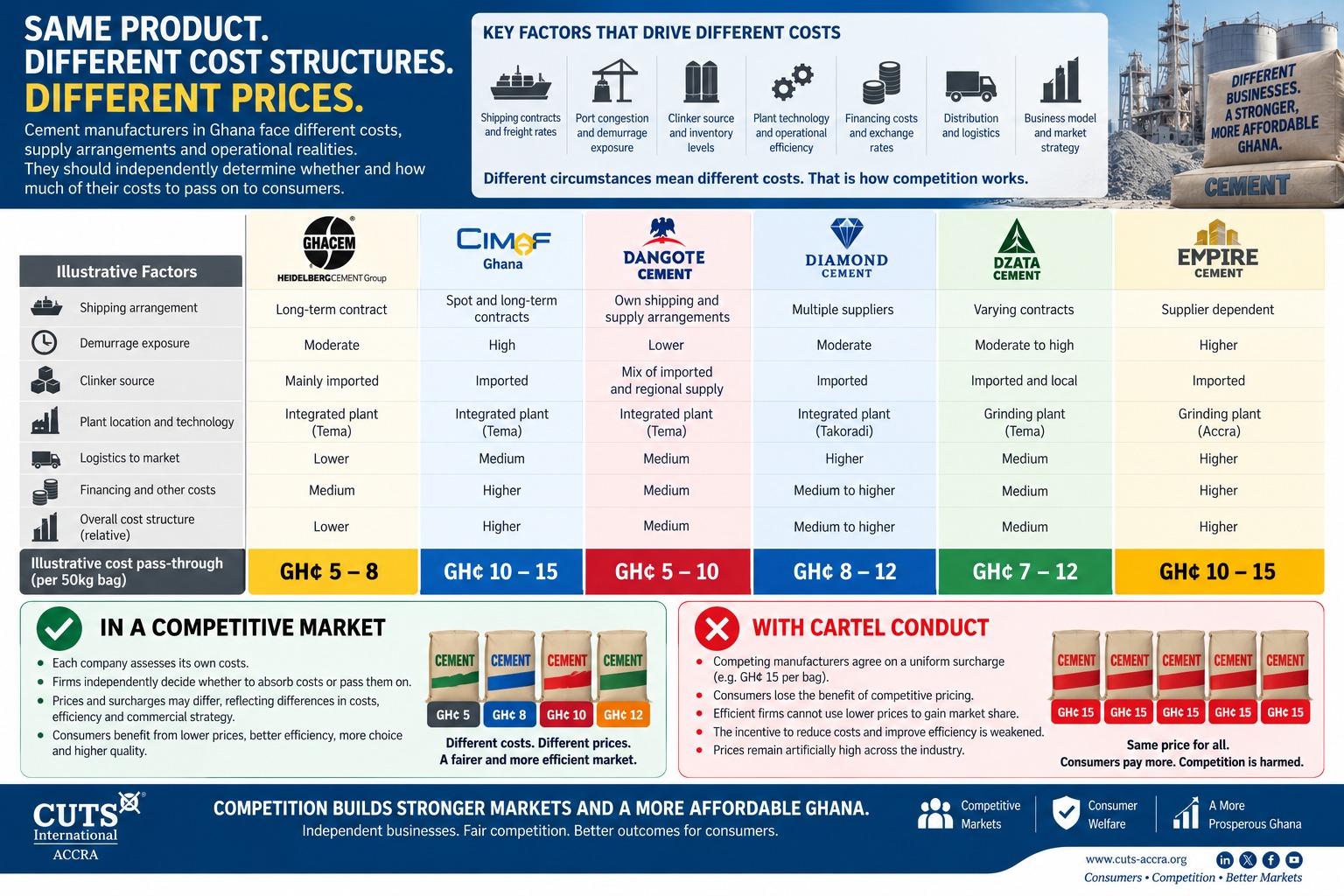
“One manufacturer might need GH¢12 to recover its costs. Another might require GH¢8. A more efficient manufacturer might absorb part of the additional cost to retain customers or gain market share,” CUTS said, arguing that these differences are precisely what competition is meant to reveal.
The organisation drew a comparison with airline fuel surcharges. It said fare information for the Accra-Kumasi route for September 15 showed Africa World Airlines applying a fuel surcharge of GH¢220, while PassionAir applied GH¢75, reflecting different aircraft types, operating costs and commercial strategies.
The point of the comparison is not that cement and aviation markets are identical, but that firms facing the same broad external cost pressure can still respond independently. CUTS argued that a common industry problem does not necessarily require a common industry price.
That distinction places trade associations under particular scrutiny.
CUTS recognised COCMAG’s legitimate role in collectively engaging government, the Ghana Ports and Harbours Authority and other institutions over congestion, berth availability, vessel delays and other shared operational problems. But it warned that trade associations risk crossing a competition-law boundary when members discuss or agree on prices, surcharges or other commercially sensitive matters that individual firms should determine independently.
The think tank has therefore asked COCMAG to clarify whether the GH¢12 surcharge is a binding collective decision, a recommendation, or merely a reference point, and whether individual manufacturers remain free to charge more, less or nothing at all.
It also warned against using the proposed monthly monitoring process and January review as a platform for exchanging sensitive commercial information such as future prices, production volumes, company-specific costs or clinker stock positions.
The issue has broader implications for Ghana’s construction sector.
Cement is a core input into housing, commercial construction and public infrastructure, meaning higher prices can feed through into building costs and eventually into project budgets, rents and household affordability. Persistent demurrage at Tema Port therefore has a direct economic cost, but the method used to recover that cost matters for competition.
CUTS has urged government and GPHA to address the operational constraints behind the congestion, noting that avoidable demurrage ultimately affects manufacturers, builders and consumers. At the same time, it argues that solving the port problem should not come at the expense of competitive pricing.
The organisation’s warning is particularly significant because Ghana still lacks a comprehensive domestic competition law and an effective national competition authority. CUTS said the episode should add urgency to the passage of Competition and Fair Trade Practices legislation.
Importantly, CUTS stopped short of declaring that a cartel infringement has already occurred.
It said a formal determination would require an examination of what was actually discussed and agreed at the August meeting and how the surcharge is implemented in practice. But it maintained that where competitors collectively agree on a uniform component of the price consumers must pay, the arrangement raises a serious cartel red flag that should not be ignored.
The policy challenge is therefore twofold. Government must deal with the port congestion that is imposing genuine costs on cement manufacturers, while producers must retain enough commercial independence for competition to continue disciplining prices.
If every company faces different costs but consumers are presented with the same surcharge, the concern is no longer simply about demurrage. It becomes a question of whether an industry under pressure is still competing or coordinating.

