

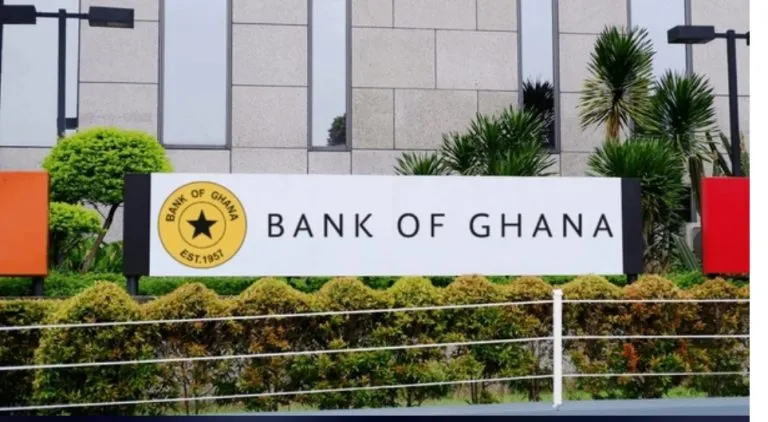

- Central Bank Pays 10.50% to Absorb GH¢13.50 billion of Market Liquidity
The Bank of Ghana has withdrawn GH¢13.50 billion from the banking system through the sale of its short-term securities, reinforcing the central bank’s cautious approach to managing liquidity even as Ghana’s broader macroeconomic conditions continue to improve.
Results of Tender 885, held on October 26, 2026, show that the central bank sold GH¢13.504 billion through its 14-day Bank of Ghana bill. The securities were allotted at a weighted average discount rate of 10.46%, equivalent to an annualised interest rate of 10.50%.
The narrow range of accepted bid rates between 10.4577% and 10.4578% on a discount basis suggests that pricing expectations among participating financial institutions were closely aligned with the level the Bank was prepared to pay.
That pricing stability matters. It indicates that the central bank is not attempting to attract funds by sharply increasing rates. Instead, it is absorbing a substantial amount of liquidity while keeping the cost of its monetary operation anchored.
The GH¢13.50 billion sale should not be interpreted as government borrowing. Bank of Ghana bills are monetary-policy instruments issued by the central bank principally to remove excess liquidity from the financial system. Unlike Treasury bills, whose proceeds support government financing, the purpose of BoG bills is to influence monetary conditions.
When liquidity held by banks rises beyond the level required to support normal payments and productive lending, it can move into foreign exchange, short-term government securities, consumer credit or other assets. Depending on the scale and speed of that movement, the additional money may place pressure on prices, the exchange rate and broader financial stability.
By selling its own bills, the Bank temporarily takes part of that liquidity out of circulation. Participating institutions exchange cash for securities and receive their funds back when the bills mature, together with the applicable return.
The size of the October 26 operation therefore provides an important signal. Although the instrument matures in just 14 days, withdrawing GH¢13.50 billion represents a sizeable intervention in Ghana’s short-term money market.
At the stated 10.50% annualised interest rate, the operation carries an estimated interest cost of about GH¢54.39 million for the 14-day period, based on a simple annualised calculation. The actual settlement amount may vary slightly according to the discounting convention used for the securities.
This cost illustrates one of the difficult choices facing central banks. Leaving excessive liquidity in the system can weaken inflation control and create pressure on the currency. Removing it, however, comes at a direct financial cost to the monetary authority.
The relevant question is therefore not whether sterilisation is expensive, but whether the cost is justified by the risks that unmanaged liquidity could create.
The latest tender suggests that the Bank’s answer remains yes.
The weighted average interest rate of 10.50% is also significant because it sits below the Bank of Ghana’s prevailing monetary policy rate. That difference reflects the instrument’s short maturity and the limited risk faced by institutions holding a central-bank obligation for only two weeks.
For commercial banks, the bills provide a secure destination for funds that may not immediately be required for lending or settlement obligations. For the central bank, they offer a flexible instrument that can be rolled over, reduced or allowed to mature depending on liquidity conditions.
That flexibility is important because the effect of the operation will be temporary unless the Bank renews the securities or replaces them with another sterilisation instrument after maturity. When the bills fall due, the principal and return will move back into the banking system.
The central bank must therefore decide whether the liquidity being absorbed is temporary or structural.
If it is temporary perhaps arising from government payments, foreign exchange transactions or seasonal movements, the 14-day bill may be sufficient to bridge the period until conditions normalise.
If it is structural, repeated issuance may be necessary. That could raise the cumulative cost of monetary operations and create a cycle in which large amounts are continually withdrawn, repaid and absorbed again.
The tender notice does not disclose the total value of bids received, the number of participating institutions or an announced target. It is consequently impossible to calculate a formal subscription rate or determine how much demand the Bank rejected.
The GH¢13.50 billion figure represents the amount sold, not necessarily the full amount that institutions were prepared to invest. Any conclusion that the auction was oversubscribed would therefore go beyond the information published.
Even so, placing such a large amount at an annualised rate of 10.50% points to substantial liquidity within the banking sector and a willingness among institutions to hold short-term central-bank paper at that yield.
This presents a wider policy question. Strong demand for BoG bills can assist the central bank in maintaining monetary control, but it can also reveal the difficulty banks face in deploying their liquidity into productive private-sector lending.
A bank that can earn a predictable return from a short-term central-bank instrument may be less willing to extend credit to businesses carrying higher default risk, particularly where borrower information, collateral and the legal recovery process remain uncertain.
The instrument is therefore useful for liquidity management but should not become a permanent substitute for financial intermediation.
Ghana’s economic recovery ultimately requires banks to convert deposits and capital into credit for agriculture, manufacturing, services, housing and small businesses. If large pools of liquidity repeatedly circulate between banks, Treasury securities and central-bank bills, monetary stability may improve without a corresponding expansion in productive investment.
The October 26 tender captures that tension. The Bank of Ghana is seeking to prevent excess money from undermining the stability already achieved, but the financial system must also find credible channels through which liquidity can support sustainable economic growth.
For now, the GH¢13.50 billion withdrawal signals that the central bank is unwilling to assume that lower inflation automatically eliminates future price and currency risks. It is preserving room to manage liquidity actively, even when doing so carries a financial cost.
The deeper test will come when the bills mature. Whether the funds are released, absorbed again or redirected through other instruments will show whether this was a temporary adjustment or part of a more prolonged effort to keep Ghana’s monetary recovery firmly anchored.

