

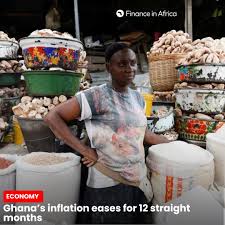

- CERPA Cautions Ghana Against Complacency Despite Sharp Inflation Decline
Ghana’s sharp decline in inflation may be creating a false sense of economic comfort, with deep structural weaknesses still threatening the sustainability of the country’s hard-won price stability, the Centre for Economic Research and Policy Analysis has warned.
In a policy brief titled “Beyond Headline Inflation: Emerging Structural Risks in Ghana’s Inflation Trends,” CERPA said the fall in inflation from 23.8 per cent in December 2024 to 3.2 per cent in March 2026, before edging up to 3.4 per cent in April, represents a major macroeconomic achievement.
But the think tank cautioned that headline inflation alone does not fully reflect the pressures facing households, businesses and regional economies across the country.
“Single-digit inflation is a significant macroeconomic achievement, but it does not automatically signal the resolution of deeper structural challenges within the economy,” CERPA said.
According to the policy brief, Ghana’s inflation slowdown has been impressive, but several underlying drivers of price instability remain unresolved. These include supply chain weaknesses, high distribution costs, imported price pressures, regional market disparities, food system inefficiencies and persistent cost pressures in services and housing.
CERPA said emerging trends in the data suggest that inflationary pressures may be shifting away from broad consumer demand toward more structural and supply-side constraints.
The think tank pointed to the services sector, where inflation accelerated from 7.2 per cent in March to 9.6 per cent in April 2026, as one of the clearest signs that price pressures have not fully disappeared.
Imported inflation also moved from a deflation rate of negative 0.6 per cent to a positive 0.5 per cent over the same period, suggesting that Ghana remains exposed to external price shocks and exchange-rate-related pressures.
Regional disparities further show how uneven the inflation story has become.
CERPA noted that while the Savannah Region recorded deflation of negative 3.5 per cent, the North East Region recorded inflation of 9.5 per cent, pointing to significant differences in market access, supply conditions and local economic structures.
For CERPA, these disparities mean that national inflation averages may hide serious pressure points in parts of the country.
The think tank warned that without targeted reforms, Ghana’s inflation gains could prove fragile, especially if supply bottlenecks, food price instability, imported cost pressures and regional inequality persist.
To protect the recent gains, CERPA called for a broad package of structural reforms aimed at improving productivity and reducing cost pressures across the economy.
It urged government to prioritise investments in transport infrastructure, irrigation systems, storage facilities and logistics networks to improve supply chain efficiency and lower distribution costs.
The organisation also called for reforms in agricultural markets to reduce post-harvest losses, stabilise food prices and protect farmers from seasonal price volatility.
On housing, CERPA recommended the expansion of affordable housing programmes and a review of rent policies to ease persistent cost pressures on households.
The think tank further encouraged government to accelerate industrialisation and import-substitution initiatives to reduce Ghana’s dependence on imported goods and limit exposure to external inflation shocks.
For the Bank of Ghana, CERPA recommended a cautious and gradual approach to monetary policy easing, warning that premature or aggressive rate cuts could undermine progress if inflationary pressures re-emerge.
It also advised the central bank to maintain exchange-rate stability and expand inflation monitoring beyond headline figures to include services inflation, food prices, imported goods and regional price variations.
The policy brief further stressed the importance of fiscal discipline, warning that excessive public spending and broad-based subsidies could reignite inflationary pressures and worsen debt sustainability concerns.
CERPA also called for targeted development interventions in underserved regions, particularly northern Ghana, to address widening economic disparities through improved infrastructure, stronger market access and expanded industrial activity.
The think tank concluded that sustaining low inflation will require coordinated reforms that go beyond monetary policy.
“Without decisive action to strengthen supply chains, expand domestic production and reduce regional inequalities, Ghana’s recent inflation gains may prove difficult to sustain,” the report cautioned.
After years of elevated inflation, exchange-rate pressures and fiscal stress, the return to low single-digit inflation gives policymakers room to rebuild confidence. But CERPA’s argument is that disinflation is not the same as structural transformation.
Ghana’s inflation victory, therefore, may be real. But according to CERPA, keeping it will require fixing the parts of the economy that made prices unstable in the first place.

