

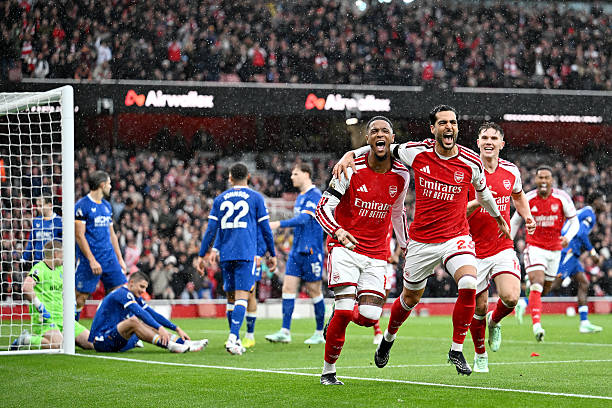

- Champions Arsenal Show Depth and Discipline as City’s Lead Disappears
Arsenal’s 2-0 victory over Everton carried the appearance of a routine home win, but its importance extended far beyond the scoreline. On a weekend when Manchester City finally stumbled, Mikel Arteta’s side responded with the composure of champions, moving level with their principal rivals on 21 points and tightening the Premier League title race.
Goals from defenders Ezri Konsa and Gabriel Magalhães secured the points at the Emirates Stadium. The scorers reflected Arsenal’s defensive authority, set-piece strength and ability to produce important decisive contributions from across the squad.
Arsenal entered the match knowing City had suffered their first league defeat of the season, losing 2-1 at Aston Villa. Such opportunities can create pressure as easily as motivation. Title challengers are often judged by their response when a rival unexpectedly opens the door. Arsenal stepped through it without allowing the occasion to distort their football.
Konsa opened the scoring inside seven minutes, registering his first goal for the club. Martin Ødegaard’s corner created uncertainty, Gabriel’s header was pushed onto the crossbar by Jordan Pickford and Konsa reacted sharply to convert from close range.
The early breakthrough altered the contest. Everton arrived with a conservative structure intended to frustrate Arsenal and restrict space around the penalty area. Conceding so quickly forced David Moyes’s side to consider a more ambitious approach, yet they lacked the creativity and sustained possession required to trouble the champions consistently.
For Arsenal, the goal also ended a run of 13 matches without scoring from a set piece. That sequence was unusual for a team that has turned dead-ball situations into a major competitive weapon. The breakthrough demonstrated that even when the original delivery does not produce a clean finish, Arsenal’s physical presence and positioning generate second-ball opportunities.
Arteta had made five changes following Arsenal’s demanding Champions League assignment against Bayern Munich. Rotation inevitably carries risk, particularly when a side must respond immediately to a rival’s defeat. Yet the altered team retained its organisation and controlled the majority of the game.
That capacity to rotate without surrendering structure may become one of Arsenal’s most valuable advantages over a long season. Title races are rarely decided only by the strongest starting eleven. Injuries, European travel and compressed schedules test whether replacements understand the same principles and can maintain the required intensity.
Everton occasionally threatened to punish Arsenal’s failure to extend the lead during the first half. Thierno Barry had the visitors’ clearest opportunity, while Eberechi Eze and Noni Madueke missed chances that could have made the contest comfortable earlier.
The narrow margin created tension but not panic. Arsenal continued moving the ball patiently, protected themselves against counterattacks and avoided turning the match into an uncontrolled exchange. That emotional discipline distinguished the performance from occasions in previous title challenges when urgency became haste.
Gabriel eventually settled the match midway through the second half. Introduced from the bench, the Brazilian needed less than a minute to meet Ben White’s excellent cross with a commanding header. The goal, scored on his 200th Premier League appearance for Arsenal, underlined both his personal importance and the depth available to Arteta.
Few central defenders influence Arsenal’s attacking identity as strongly as Gabriel. His movement at set pieces, aggression in the opposition penalty area and willingness to attack deliveries make him a recurring scoring threat. Against Everton, he demonstrated that influence from open play immediately after entering the contest.
The second goal allowed Arsenal to manage the closing stages with authority. Everton struggled to build sustained attacks, and Pickford’s interventions prevented the scoreline from becoming more damaging. The visitors worked diligently, but effort could not compensate for their limited attacking invention.
Arsenal’s defensive control deserves as much attention as their goals. Clean sheets reduce the need for dramatic attacking performances and provide a stable platform when fatigue affects fluency. A title contender capable of winning without operating at maximum intensity becomes difficult to dislodge over 38 matches.
The broader significance lies in the table. Manchester City remain ahead on goal difference, but their aura of inevitability has been weakened. Aston Villa demonstrated that City can be disrupted, while Arsenal showed they are positioned to exploit any further errors.
Being level after eight matches does not determine the championship, but it shapes the psychology of the contest. City can no longer build momentum without feeling Arsenal’s presence, while Arteta’s players have tangible confirmation that their consistency is applying pressure.
Arsenal must nevertheless resist reading too much into one weekend. City’s first defeat does not signal collapse, and the season will demand responses to injuries, poor results and difficult away fixtures. The champions’ task is to ensure this victory becomes part of a sustained sequence rather than a temporary reaction.
Bukayo Saka’s absence provides an immediate concern, with Arteta indicating the winger could be sidelined for several weeks. Arsenal’s depth will therefore face a more prolonged examination. Replacing Saka’s creativity, direct running and productivity cannot fall to one player alone.
The performance against Everton offered encouragement in that regard. Madueke provided width, Ødegaard continued to dictate possession and defenders supplied both goals. Arsenal were not dependent on a single attacker to rescue them, even if greater efficiency in front of goal will be required against stronger opposition.
Everton leave north London with another defeat and questions about how they create chances against elite opponents. Defensive commitment kept them within reach for long periods, but survival through resistance alone becomes difficult once the first goal is conceded.
Arsenal leave with a clean sheet, two goals and the most valuable reward: the knowledge that City’s advantage has disappeared. The victory was not spectacular, but championships are often constructed through afternoons when opportunity is recognised and professionally converted.
The developing race now presents a simple challenge. City must prove their Villa defeat was an interruption, while Arsenal must demonstrate that drawing level is not their destination. On this evidence, Arteta’s side possess the discipline, defensive power and squad depth to remain beside City long after the significance of this weekend has faded.

