

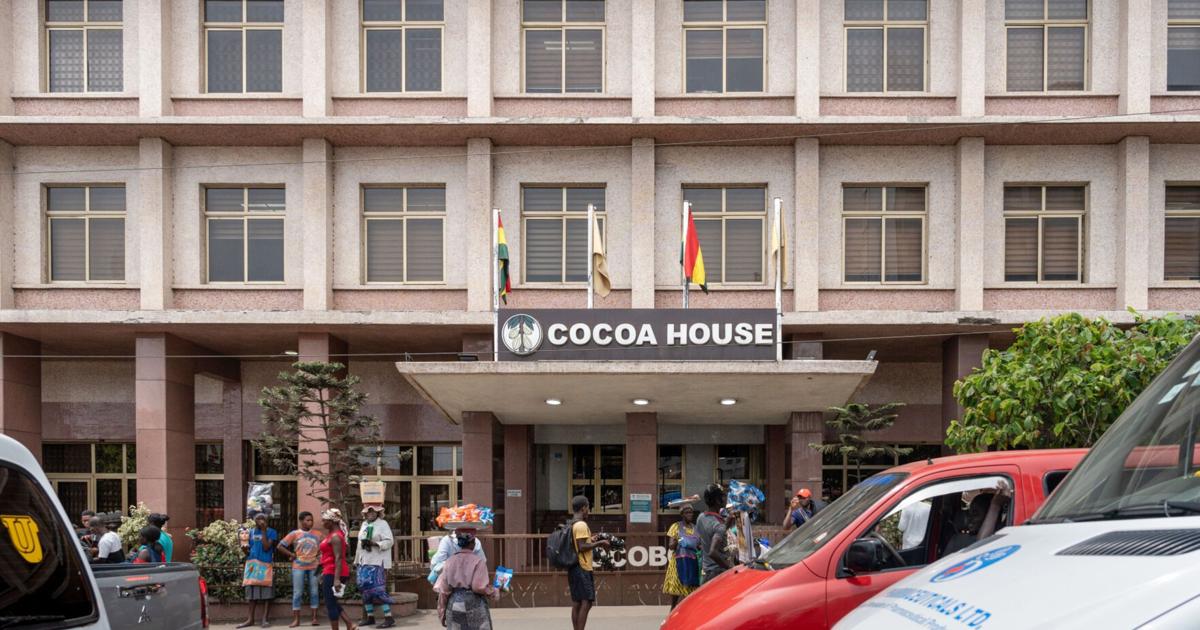

- Cocoa Capital Admits GH¢3.40bn Commercial Paper to Ghana Fixed Income Market
Cocoa Capital PLC, the special-purpose financing company established by the Ghana Cocoa Board, has admitted GH¢3.40bn of commercial paper to the Ghana Fixed Income Market, marking the first completed issuance under a wider GH¢16.3bn domestic cocoa financing programme.
The security, issued under Series 01, Tranche 01, has an allotted amount of GH¢3,395,783,000 and a tenor of 266 days, according to an admission notice published by the Ghana Stock Exchange.
The senior unsecured fixed-rate commercial paper was issued on October 5, 2026, and will mature on June 28, 2027. It trades under the symbol CCPL01 and carries the International Securities Identification Number GHCCCPL00065.
Market sources previously indicated that the paper was issued at an interest rate of 11 per cent.
The admission transforms the paper from a successful primary-market fundraising exercise into a security eligible for secondary-market trading, giving investors an avenue to buy or sell their holdings before maturity.
The GH¢3.40bn allotment represents about 84.9 per cent of the GH¢4bn initially sought under the first commercial-paper tranche, leaving a gap of approximately GH¢604.22mn.
The amount raised nevertheless constitutes one of the largest corporate or quasi-sovereign commercial-paper transactions undertaken in Ghana’s domestic capital market.
It accounts for about 24.3 per cent of the GH¢14bn that Cocoa Capital intends to mobilise through commercial paper and approximately 20.8 per cent of the entire GH¢16.3bn Domestic Cocoa Notes Programme.
Cocoa Capital is wholly owned by COCOBOD and was established solely to raise financing for approved cocoa-sector requirements and administer the resulting payment and reporting obligations.
The wider programme divides the financing into GH¢14bn of short-term commercial paper for cocoa purchases during the 2026/27 season and GH¢2.3bn of medium- to long-term bonds to refinance legacy COCOBOD obligations.
The Ministry of Finance has described the arrangement as “a more sustainable financing model” intended to support timely cocoa purchases, address inherited financial obligations and strengthen the sector.
The issuance represents a significant change in how Ghana finances its cocoa crop.
For several years, COCOBOD relied heavily on annual syndicated loans from international banks to purchase beans from farmers through licensed buying companies. That model weakened after the long-running syndicated facility collapsed during the 2023/24 season.
A subsequent attempt to secure pre-financing from international commodity traders also encountered difficulties, contributing to delays in paying licensed buyers and increasing uncertainty across the cocoa supply chain.
Cocoa Capital’s programme seeks to replace part of that external financing with funds from Ghana’s domestic capital market.
Eligible investors include banks, pension funds, insurance companies, securities dealers, high-net-worth individuals and international cocoa buyers.
This shift could reduce COCOBOD’s immediate exposure to foreign-currency borrowing for domestic cocoa purchases. It could also deepen Ghana’s corporate debt market by creating a large, regularly issued commercial-paper instrument.
But the structure transfers part of the cocoa sector’s financing demand to domestic investors, who must assess the credit risk, repayment arrangements and opportunity cost of committing funds to COCOBOD-related securities.
Repayment under the programme is expected to be supported primarily by receivables from selected cocoa export contracts assigned to Cocoa Capital.
The proceeds from those sales are intended to flow through designated collection, escrow and debt-service accounts before payments are made to noteholders.
This structure seeks to create a clearer separation between cocoa-export proceeds and COCOBOD’s wider operational cash flows.
However, the newly admitted instrument is described as senior and unsecured. Investors therefore rank ahead of subordinated creditors but do not hold a conventional security interest over specific physical assets.
The programme’s effectiveness will depend on whether sufficient export receivables are generated, properly assigned and transferred through the controlled accounts on schedule.
Cocoa production, international prices, forward-sale volumes and operational discipline will consequently remain important to the paper’s repayment profile.
The reported 11 per cent interest rate appears relatively competitive when considered against Ghana’s prevailing policy rate of 14 per cent and yields on some government securities.
For Cocoa Capital, the pricing limits the cost of raising short-term funds for crop purchases. For investors, it offers exposure to a COCOBOD-sponsored financing vehicle with a defined maturity and repayment structure.
The rate also raises an important market question: whether investors accepted the pricing because they consider the receivables structure sufficiently strong or because they assume the state would ultimately stand behind a strategically important cocoa-sector obligation.
Cocoa Capital is legally distinct from COCOBOD and the Government of Ghana. Yet its sole shareholder, programme purpose and economic importance give the paper characteristics that may lead investors to treat it as carrying quasi-sovereign significance.
That perception may help the issuer raise funds at a lower rate than an ordinary private company. It also makes transparency over the legal obligations, assigned receivables and repayment waterfall particularly important.
Admission to the GFIM is only the first test of the programme.
The larger challenge will be raising the remaining commercial-paper requirement without crowding out private-sector borrowers or placing excessive concentration risk on banks and pension funds.
Cocoa Capital must also demonstrate that funds reach licensed buying companies quickly enough to support purchases from farmers and that export proceeds return through the prescribed accounts before the paper matures in June 2027.
A successful repayment would strengthen confidence in the programme and potentially make subsequent tranches easier to place. Any delay could increase borrowing costs and undermine the domestic model before it is fully established.
The GH¢3.40bn admission therefore represents more than a new fixed-income security. It is a practical test of whether Ghana can replace an external cocoa-financing model with a transparent, market-based domestic structure without simply transferring old risks into a new vehicle.

