

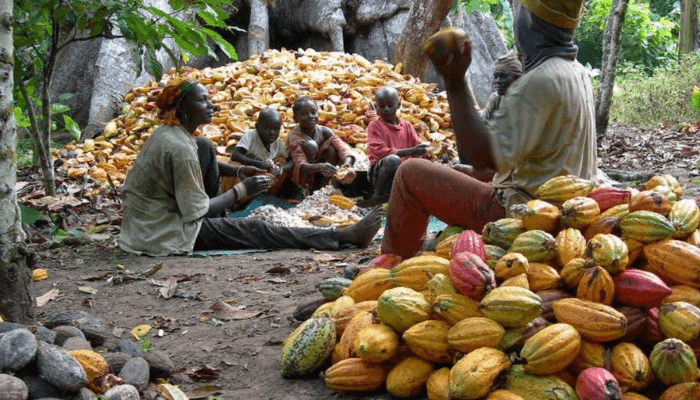

- Cocoa Farmers Raise Consultation Concerns as New Bill Moves Toward Implementation
The President of the Ghana National Association of Cocoa Farmers has challenged the consultation process surrounding Ghana’s proposed cocoa-sector reforms, arguing that organised farmers were brought into discussions only after key legislative decisions had already been taken.
Anane Boateng, speaking on JoyNews’ PM Express, said farmers were not adequately involved in shaping the bill even though they are the primary economic actors affected by rules governing cocoa production, pricing and farm protection. His criticism adds another layer to the debate over whether Ghana’s cocoa reforms have been sufficiently rooted in the experience of those who actually cultivate the crop.
“We are the key stakeholders in the cocoa industry, but they never ever consult us when it comes to such interventions,” Mr Boateng said. “They always do their work and submit.”
His argument is not that farmers oppose reform. On the contrary, Mr Boateng expressed support for some of the bill’s most important provisions, particularly the commitment to pay farmers 70.00% of the free-on-board price and stronger legal protection for cocoa trees.
That distinction matters because it shifts the dispute away from whether reform is necessary and towards how reform is designed. For Mr Boateng, the central issue is whether farmers are treated as participants in policymaking or merely briefed after decisions have effectively been made.
He disputed suggestions that meetings with individuals in cocoa-growing communities automatically amounted to meaningful consultation. “My brother, we have some people who are political farmers,” he said, arguing that recognised farmer organisations should have been engaged more deliberately.
Mr Boateng also said the problem predates the current government. He argued that previous administrations similarly struggled to include farmers adequately in policy development, suggesting that the consultation deficit is structural rather than partisan.
The most significant part of his criticism concerns timing. Mr Boateng said farmer associations were eventually invited to an engagement, but by then the legislative process had already advanced substantially.
“When we were called at the office, the first question I asked the executives was that the bill had already passed. So this engagement, what is the purpose of engaging we, the farmers?” he said. “The bill had already been done. It’s passed and approved. So our engagement there, for me, is not necessary.”
That concern has practical implications. Cocoa farmers make long-term investment decisions around planting, rehabilitation, labour and inputs, meaning policy certainty and confidence in the regulatory framework can influence future production.
Consultation is therefore not only a matter of political inclusion. It can improve implementation by identifying rules that may look workable administratively but prove difficult at farm level.
Mr Boateng nevertheless welcomed the commitment to ensure that farmers receive 70.00% of the FOB price. He said the new framework appeared to make the policy more binding than previous arrangements.
“What they told us was, one, the bill, the 70% FOB price, it’s now fixed that every year it will be, you know, every year they will make sure it will be paid to farmers,” he said. “And that bill, even before, it was there, but it was not strict. So this time around, they have made it strict.”
A more enforceable producer-price commitment could strengthen incentives for farmers to invest in their farms, particularly if it improves their ability to purchase fertiliser, pesticides and labour. It could also reduce pressure for cross-border smuggling where price differentials make neighbouring markets more attractive.
But the economics remain complex. A statutory percentage does not eliminate the need to define how the FOB price is calculated, how financing costs are treated and how COCOBOD balances farmer payments against wider industry obligations.
Mr Boateng was even more supportive of provisions protecting cocoa trees from indiscriminate destruction, particularly in areas affected by illegal mining. “The area which I’m much, much happy about was the cocoa tree protection act area. That one, I like it very well because we had a lot of problems when it comes to galamsey issues,” he said.
He argued that farmers are sometimes blamed for releasing land to miners when, in some cases, traditional authorities or landowners may have taken those decisions. “Nananom are normally the people who do that, but they always apportion the blame onto us. And we know it’s unfair,” he said.
That points to a deeper land-tenure problem. Farmers can invest years in cocoa production without necessarily holding full control over the land beneath the crop, leaving them vulnerable where chiefs, families or other owners decide to sell or repurpose the land.
Mr Boateng also described situations where farmers discover that land under cocoa cultivation has been sold for development. “Before you realise the chief sells the land to the owner, and then they start cutting our cocoa. You cannot complain to anybody,” he said.
Stronger cocoa-tree protection could therefore provide farmers with greater economic security, but Mr Boateng cautioned against rules that could become too restrictive. He said farmers should retain flexibility to remove diseased or damaged trees as part of normal farm management.
“When we are doing pruning, the disease affect our cocoa. That one is not — that one we did not accept it,” he said. “But cutting the cocoa without permission, that is where I think it should be good.”
Perhaps the most striking part of his intervention was his admission that he had not received a copy of the bill despite heading a national cocoa farmers’ association. “Actually, I haven’t gotten the copy of the bill,” he said.
Asked how that was possible, he said farmers had been given explanations but not the document itself. “We haven’t been given a copy. So we don’t know,” he said.
That presents a clear implementation challenge. If organisations expected to explain and help enforce new rules among farmers do not have access to the legislation, translating policy into compliance across dispersed rural communities becomes significantly harder.
The controversy therefore exposes a trust problem at the centre of Ghana’s cocoa reforms. Farmers such as Mr Boateng appear willing to support measures that protect trees and strengthen producer pricing, but they also want greater influence over the rules governing their livelihoods.
For policymakers, that distinction should matter. The success of the new cocoa framework will ultimately depend not only on what Parliament has approved, but on whether farmers understand the provisions, believe they were treated as genuine stakeholders and consider the rules workable.
Mr Boateng’s intervention suggests the next challenge is no longer simply passing the law. It is closing the gap between legislative reform and farmer ownership of the process.

