

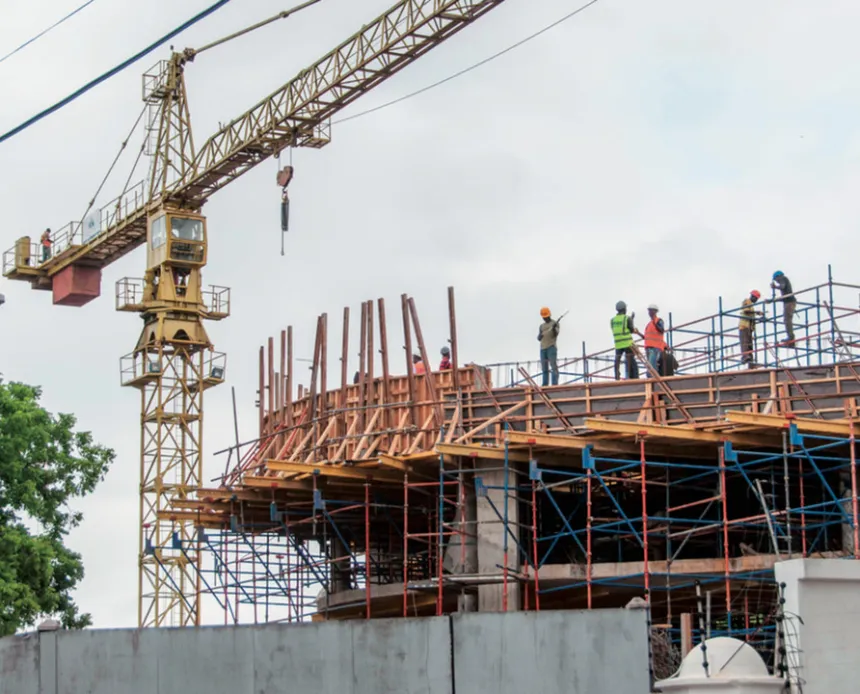

- Construction Growth to Ease to 4.50% by 2028 After 2026 Rebound — Fitch Solutions
Ghana’s construction industry is expected to record a sharp rebound in 2026 before losing momentum over the following two years, as higher energy costs and broader global uncertainty weigh on one of the country’s most important productive sectors.
Fitch Solutions forecasts that Ghana’s construction gross value added will expand by 5.20% in real terms in 2026, up from growth of 3.10% in 2025. The expansion is, however, projected to moderate marginally to 5.10% in 2027 before slowing more noticeably to 4.50% in 2028.
Gross value added measures the contribution made by a sector to the wider economy after deducting the cost of goods and services used in production. In construction, it captures the economic value generated through residential and commercial developments, roads, bridges, utilities and other infrastructure projects.
The figures suggest that Ghana will maintain comparatively strong construction activity despite the expected moderation. The country is ranked seventh among Sub-Saharan African economies with the highest construction growth outlook, placing it ahead of larger markets including Nigeria, Angola and South Africa. Ethiopia leads the regional ranking, followed by Côte d’Ivoire and Uganda.
The expected acceleration in 2026 is likely to be supported by stronger public investment and renewed activity across infrastructure and building projects after several years in which fiscal pressures, elevated borrowing costs and exchange-rate instability constrained project execution.
Ghana’s 2026 budget allocated GH¢30.00 billion to the government’s Big Push infrastructure programme, more than double the GH¢13.80 billion contained in the revised 2025 budget. The programme includes large transport projects such as the Accra-Kumasi Expressway and the Eke Amanfrom-Adawso Bridge.
The additional spending could provide opportunities for local contractors, engineering firms, cement producers, steel manufacturers, equipment suppliers and financial institutions. Construction activity also has extensive links to employment and household income because of its reliance on both skilled professionals and large numbers of informal and semi-skilled workers.
However, the projected slowdown from 2027 indicates that the initial impact of increased government expenditure may not be sufficient to sustain an accelerating growth trajectory over the medium term.
The outlook will depend partly on the government’s ability to release funding consistently, avoid the accumulation of payment arrears and attract private capital into commercially viable infrastructure projects. Delays in procurement, compensation payments and contractor certification have historically affected the pace at which public projects are completed.
Fitch’s projection for Ghana forms part of a broader revision to the construction outlook for Sub-Saharan Africa following the economic and energy-market consequences of the United States-Iran conflict.
The research firm now expects construction gross value added across the region to grow by 4.30% in 2026, below its April 2026 forecast of 4.60% and the 5.40% projection issued in December 2025. Regional growth is therefore expected to ease from the 4.50% expansion recorded in 2025.
Higher oil and fuel prices can affect construction through increased transportation, power, machinery and raw-material costs. Contractors operating under fixed-price agreements may face particular pressure when the cost of cement, steel, bitumen and imported equipment rises faster than anticipated.
For governments, more expensive fuel and imported construction materials can raise the final cost of public projects, creating pressure for contract variations, supplementary allocations or reductions in project scope.
Despite the downward revision, Fitch maintains a broadly positive assessment of the region’s medium-term prospects. It expects Sub-Saharan Africa’s construction industry to expand by an annual average of 5.10% between 2026 and 2030, reflecting the continent’s substantial deficit in transport, energy, water, housing and social infrastructure.
The firm expects Sub-Saharan Africa to remain the fastest-growing construction market globally in 2026 and over the medium term. Its forecast is significantly above projected global construction growth of 1.20% in 2026 and an annual average of 2.50% between 2026 and 2030.
Latin America is projected to record the second-highest regional construction growth rate in 2026, at 1.70%, while Asia-Pacific is expected to post the second-strongest medium-term performance, averaging 3.10% annually between 2026 and 2030.
For Ghana, the construction outlook remains stronger than the regional average in 2026. The central challenge will be converting the projected rebound into sustained activity while maintaining fiscal discipline and ensuring that infrastructure expenditure produces measurable improvements in productivity.
The gradual slowdown to 4.50% by 2028 does not point to a contraction. It instead suggests that the sector will continue expanding, but at a progressively slower rate unless fresh investment, reliable project financing and improved execution provide a stronger foundation for growth.

