
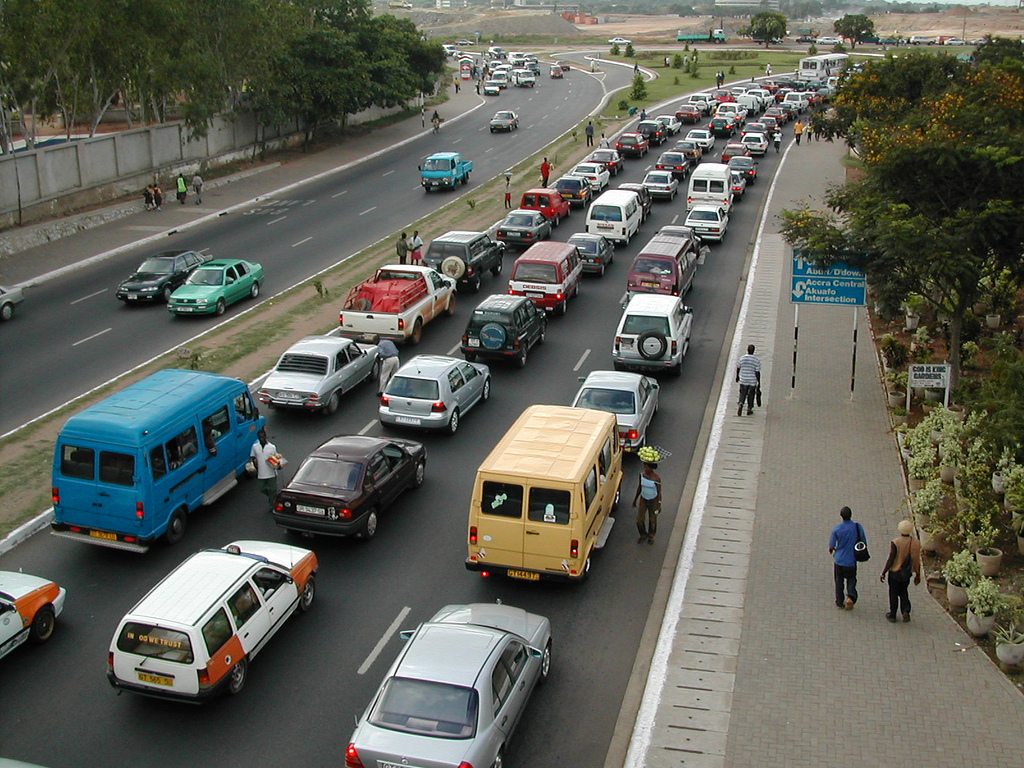

CUTS Calls for Establishment of Accra City Transportation Authority to Address Urban Mobility Crisis
Leading research and public policy think tank, CUTS International Accra, has urged the government to set up an Accra City Transportation Authority to oversee the regulation, planning and coordination of transport services across the capital.
The recommendation comes amid rising commuter difficulties, intensifying rush-hour congestion and weak coordination following the fragmentation of the former Accra Metropolitan Assembly into several municipal and sub-metropolitan assemblies.
CUTS argues that while Accra continues to operate as a single urban economy, governance is now dispersed among more than 20 assemblies functioning independently. Critical infrastructure such as roads, drainage networks, housing developments and transport corridors cut across multiple jurisdictions, a situation the think tank says has undermined planning, weakened accountability and complicated effective transport management.
“You cannot run a single city with multiple transport decision centres working in isolation,” said Appiah Kusi Adomako, Esq, Director of the West Africa Regional Centre of CUTS International. “Urban movement does not respect political boundaries. Planning must follow how people live and commute.”
Between 1989 and 2017, Accra transitioned from a single assembly to about 24. CUTS maintains that decentralisation itself is not the core issue, but rather the absence of a citywide mechanism to coordinate transport policy in a metropolis where daily commuting largely converges on a central business district.
“The creation of multiple assemblies was not a mistake,” Mr Adomako explained. “The mistake was failing to establish a city-level transport authority to coordinate planning after the fragmentation.”
According to CUTS, the current challenges are the result of prolonged policy drift. In the 1970s, the Omnibus Service Authority provided structured and predictable urban transport. Its decline created a vacuum. Metro Mass Transit, introduced in 2001, gradually shifted from intra-city services to long-distance routes. The Ayalolo bus system, launched in 2015, initially raised expectations but suffered setbacks after buses were reassigned to other cities and institutional uses.
As a result, commuters now face daily difficulties securing transport after work, while some private operators split routes into segments, forcing passengers to pay multiple fares.
CUTS also linked the situation to weak enforcement of the Road Traffic Regulation, 2012 (LI 2180). Regulation 121 mandates that private operators function under clearly defined, route-based systems with specified service standards. However, the framework remains largely unenforced. Assemblies issue general permits rather than route-specific licences, allowing drivers to concentrate on high-return corridors while leaving other routes underserved.
“In practice, transport unions allocate routes based on influence rather than planning data,” Mr Adomako said. “You now have a city where transport supply responds to lobbying power instead of commuter demand.”
Government has announced plans to procure more than 350 buses for Metro Mass Transit, with assurances from the Vice President that high-occupancy buses will help ease congestion. CUTS welcomed the move but cautioned that fleet expansion alone will not deliver lasting solutions.
“Procurement is necessary, but procurement alone will fail,” Mr Adomako warned. “Without policy reform, coordination and strong institutions, the same crisis will resurface within a few years, and many of these buses will end up as scrap.”
The think tank stressed that Accra’s transport challenges stem from a dysfunctional system characterised by weak policy design and poor infrastructure management. It noted that major cities globally adopt centralised transport planning models. London, for example, operates through 32 boroughs, yet Transport for London coordinates the entire network.
“No serious city leaves urban transportation entirely to private operators,” Mr Adomako said. “When transport fails, the city fails.”
CUTS is therefore calling for the establishment of an Accra City Transportation Authority with legal authority to plan routes, terminals and services across all assemblies. It also advocates strict enforcement of route-based licensing under LI 2180, using census and mobility data to determine optimal fleet sizes.
In addition, CUTS wants sustained public investment in dedicated lanes, terminals and modern public transport systems, alongside the retooling of assemblies and strengthening of enforcement capacity across the metropolitan area.
“Accra does not suffer from a shortage of buses alone,” Mr Adomako concluded. “It suffers from a shortage of planning, coordination and political commitment to treat transportation as the lifeline of the city.”

