


- Data Cannot Improve Lives If Public Institutions Do Not Use It
Ghana’s public institutions collect information on poverty, health, education, water, sanitation and local services. Yet the country’s latest data forum has identified a basic weakness in the national system: much of that information is fragmented, underused and not consistently funded.
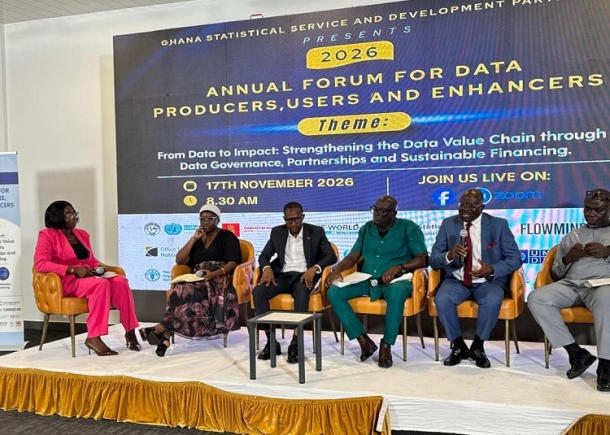
The 2026 Annual Forum for Data Producers, Users and Enhancers, held in Accra on November 17, concluded that gathering data is only the beginning. Statistics matter when they are credible, accessible and used to improve decisions and public services.
That principle is easy to endorse. The harder question is whether ministries, district assemblies and other public bodies have the resources, skills and incentives to act on the evidence they already possess.
The communiqué records progress since the first forum in 2025. Three of nine priority actions have been firmly established, while six are still in progress.
The Ghana Statistical Service has signed 33 memoranda of understanding: 28 with ministries, departments and agencies, and five with academic and other partners. It has also launched Ghana in Numbers 2025 and an artificial intelligence-assisted dashboard intended to make national statistics more accessible.
There are examples of data informing policy. The forum cited increased health insurance enrolment in Afigya Kwabre North District, a higher allocation for persons with disabilities under the District Assemblies Common Fund, and multidimensional poverty fact sheets covering all 261 districts. These examples show what the data agenda can deliver when information is connected to decisions.
But they also sharpen the question of scale. If data can influence enrolment, resource allocation and local planning in individual cases, why is its routine use still limited across public institutions?
The forum’s answer points to a system with weaknesses at several stages: unreliable financing, disconnected records, uneven technical capacity and insufficient trust between data producers and the people who provide information.
The proposed Statistics Bill and a National Statistics Fund are still awaiting approval. Meanwhile, many ministries and district assemblies lack dedicated budgets for statistical work.
That can leave data collection dependent on short-term projects or external support, making it difficult to maintain quality, update records or build expertise over time.
The communiqué calls on the Ghana Statistical Service to expedite submission of the bill to Cabinet and Parliament. It also urges ministries and assemblies to include dedicated budget lines for statistical activities in their annual budgets.
This is a practical proposal, but it raises a wider issue: statistical systems cannot be treated as a reporting expense that public bodies fund only when money is available. Without reliable statistics, governments risk allocating scarce resources on incomplete or inconsistent information.
The communiqué says administrative records held by public institutions are underused for statistics. In water and sanitation, it notes, institutions apply inconsistent definitions and methods, weakening data quality and interoperability.
This is more than a technical inconvenience. If agencies define access, service quality or beneficiaries differently, national figures may fail to add up. Officials may struggle to compare performance between districts or identify where resources are most urgently needed. Fragmented systems can also lead to duplicated collection, wasted public funds and conflicting accounts of the same problem.
The forum’s recommendation that water and sanitation institutions harmonise methods and metadata is therefore a test case for the wider data system. If agencies can agree on definitions, standards and validation in one sector, the approach could offer a model for other areas of public administration.
The forum also sets a deadline for turning cooperation into action. By December 2027, every institution with a signed memorandum of understanding should appoint a statistics focal person and share at least one dataset with the Ghana Statistical Service to agreed standards.
That is a measurable commitment. Its success will depend on whether the data are relevant, timely and safe to share and whether the receiving institutions use them.
Trust is part of the infrastructure. The communiqué says data providers receive limited feedback on how their information affects decisions and need stronger assurances that it will remain confidential. It calls on data producers to apply the confidentiality and data-protection provisions of the Statistical Service Act, 2019, and to print a plain-language confidentiality pledge on every data collection instrument.
That recommendation recognises a basic reality: people are less likely to provide accurate information if they do not understand why it is being collected, how it will be used or who will see it. Confidentiality is not just a legal requirement; it affects the quality of the information on which public policy depends.
The promise to provide feedback is equally important. Communities and businesses asked to share information should be able to see how it informed a plan, budget or service. Without that feedback, data collection can feel extractive an obligation placed on citizens with no visible public return.
The communiqué also identifies gaps in participation. Young people and persons with disabilities face barriers to accessing data and are not sufficiently involved in its production and use.
The forum urges that young people participate in shaping research, collecting information, interpreting findings and contributing to the governance of the statistical system. It also calls for more accessible formats, including local-language materials and interactive visualisations.
These proposals matter because access is not achieved simply by publishing a dashboard. Information must be understandable and usable by people outside government and academic circles. A statistic that cannot be interpreted by a local business, community group or district planner may be technically available but practically inaccessible.
The final test is whether evidence changes budgets and services. The forum calls for stronger capacity among ministries and assemblies to use data in budgeting, planning and tracking results. It also asks data users to show how they have used evidence in decision-making.
That is a useful shift in accountability. Public institutions should not be judged only by whether they collect or publish data, but by whether they can explain how evidence changed a decision and what happened as a result.
A poverty fact sheet, for example, becomes more valuable when it can be linked to a local spending choice and a measurable improvement in living conditions.
The forum’s progress is real: partnerships have been signed, statistical products launched and examples of policy impact identified. But most of the nine priority actions are still in progress, and the foundations of financing, governance, interoperability and trust remain unfinished.
Ghana’s data agenda will be judged not by the volume of information collected but by whether public institutions can turn it into better choices. That requires funding the system, making records compatible, protecting contributors and giving citizens a way to see what their information achieved.
Until evidence routinely changes how money is allocated and services are delivered, the country’s data will remain a resource with too much potential and too little power.

