

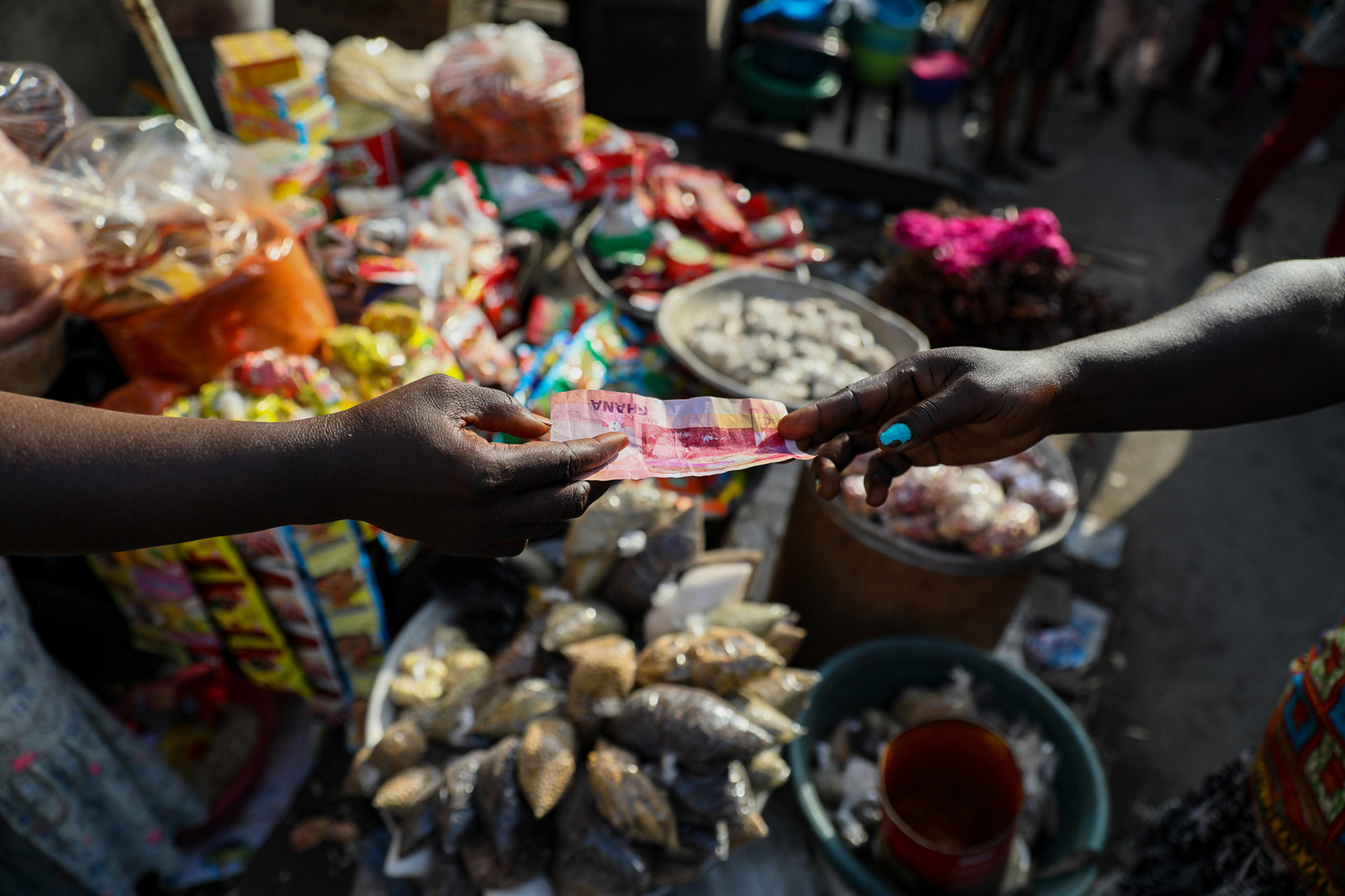

- Dirty And Damaged Cedi Notes Increase Public Health and Currency Costs – BoG
The Bank of Ghana has stepped up its public education campaign on the proper handling of cedi notes, warning that poor treatment of the national currency carries both public health risks and economic costs.
Governor of the Bank of Ghana, Dr Johnson Pandit Asiama, said the mishandling of banknotes through practices such as crumpling, excessive folding, stapling, writing on notes and keeping cash in unhygienic conditions accelerates the deterioration of currency in circulation.
Speaking to traders during a clean-up exercise at the Agbogbloshie Market, Dr Asiama said the cedi must be treated as a national asset, noting that damaged notes force the central bank to commit additional resources to currency replacement.
The campaign formed part of the Bank’s participation in the Government’s National Clean-Up Exercise and was used to draw attention to the link between sanitation, responsible currency handling and public health.
According to the Bank of Ghana, preserving the quality of banknotes is not only about maintaining the physical appearance of the currency. It is also a matter of reducing avoidable replacement costs, improving the efficiency of cash circulation and safeguarding confidence in the monetary system.
Frequent replacement of worn-out or badly damaged notes increases the cost of printing, transporting, sorting and distributing currency. These costs ultimately place pressure on public resources and the operational budget of the central bank.
The Bank said extending the lifespan of currency notes would help reduce replacement expenditure and improve efficiency in the cash economy, particularly in markets, transport terminals and other high-volume cash-handling environments.
Dr Asiama also raised concern about the public health implications of dirty and poorly handled banknotes. He noted that research has shown that bacteria and other harmful microorganisms can be present on banknotes when they are not properly handled.
“We want our banknotes to always be clean, because research has shown that bacteria can be present on banknotes if they are not properly handled,” the Governor said.
The concern is particularly relevant in busy commercial centres such as Agbogbloshie, where cash changes hands frequently among traders, transport operators, shoppers, food vendors and informal-sector workers.
The central bank said contaminated notes can become a channel for spreading harmful organisms, especially when cash is handled alongside food, kept in unhygienic places or exchanged repeatedly without proper hand hygiene.
Dr Asiama urged the public to adopt better cash-handling practices, including keeping notes clean, avoiding unnecessary folding, refraining from writing on banknotes, and not using pins, staples or other sharp objects that damage currency.
He said cleanliness must be understood as both a personal responsibility and a national obligation.
“The Bible says cleanliness is next to godliness, but I think cleanliness is godliness! So it is mandatory, even as individuals, to ensure that we are clean and that our environment is clean,” he said.
The Bank of Ghana’s message comes at a time when currency management is becoming an important operational issue for central banks globally. Although digital payments continue to expand, cash remains a major medium of exchange in Ghana, especially among traders, transport operators, small businesses and informal-sector workers.
This means the condition of banknotes remains important to everyday commerce. Dirty, torn or defaced notes can slow transactions, create disputes between buyers and sellers, and increase the burden on banks and the central bank to sort and replace unfit currency.
The Bank said responsible handling of cedi notes would support smoother cash circulation and reduce the frequency with which damaged notes must be withdrawn from the system.
The central bank also urged traders, transport operators and the general public to avoid treating banknotes casually, stressing that the cedi represents national value and must be preserved.
For Ghana’s cash-heavy economy, the issue goes beyond individual behaviour. Poor currency handling across markets, retail shops, commercial vehicles and informal trading points creates a system-wide cost. When millions of notes deteriorate faster than expected, the replacement burden rises.
The Bank of Ghana’s campaign therefore links public education to cost management. By encouraging citizens to keep banknotes clean and intact, the central bank hopes to reduce avoidable expenditure while promoting safer cash usage.
The clean-up exercise at Agbogbloshie also reinforced the Bank’s broader commitment to environmental sanitation and sustainability. Dr Asiama pledged the Bank’s continued support for future clean-up initiatives and other programmes that promote public health and responsible civic behaviour.
The Bank said it remains committed to supporting initiatives that promote environmental sanitation, public health and responsible currency handling for the benefit of all Ghanaians.
Its message to the public is clear: the cedi is more than a medium of exchange. It is a national asset whose proper handling protects public health, reduces replacement costs and strengthens the efficiency of Ghana’s cash economy.

