

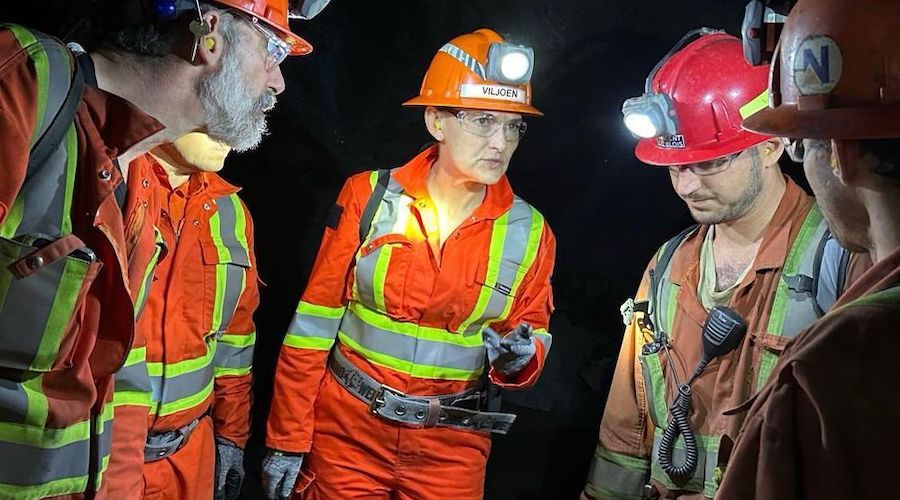

- Higher Gold Prices Must Translate into Wider Margins, Not Reckless Investment — Newmont
Newmont chief executive Natascha Viljoen has urged gold producers to resist the temptation to pursue expensive projects and acquisitions as elevated bullion prices strengthen balance sheets across the mining industry.
Speaking at a mining conference in Johannesburg, Ms Viljoen said the favourable gold-price environment should allow shareholders to benefit from wider margins, rather than encourage companies to relax their investment standards.
“With the structural shift in gold prices, we see that there is an opportunity for stakeholders to get the benefit of increasing margins,” she said.
“The biggest mistake we can make is losing discipline in terms of capital allocation because it really becomes very attractive.”
The warning from the head of the world’s largest gold producer reflects growing concern that the bullion rally could trigger a familiar cycle of aggressive expansion, inflated asset valuations and poorly timed transactions.
Gold rose sharply in 2025 on safe-haven demand and reached a record US$5,595 an ounce in January 2026. Although bullion has since fallen and is down about 4.7 per cent this year, analysts expect geopolitical uncertainty and structural demand from governments and institutional investors to keep prices historically elevated.
High commodity prices can make marginal deposits appear commercially attractive. They can also encourage mining companies to approve projects based on optimistic assumptions that become difficult to sustain when prices retreat or operating costs increase.
Ms Viljoen said maintaining cost discipline would help producers preserve the benefits of higher prices and avoid decisions that could weaken their businesses when the commodity cycle eventually turns.
Her intervention comes as merger and acquisition activity accelerates across the gold industry. Strong cash generation and higher equity valuations have provided miners with greater capacity to pursue rival companies, undeveloped deposits and operating assets.
Yet completing such transactions has become more difficult because buyers and sellers frequently disagree over the appropriate long-term gold price to use when valuing assets. Gold Fields’ rejected US$27bn approach for Australia’s Northern Star Resources is among the deals illustrating that valuation divide.
For Newmont, the emphasis on discipline is also intended to ensure that a larger share of the gold-price windfall reaches investors.
The company generated a record US$5.3bn in free cash flow during the first half of 2026, supported by higher commodity prices, cost controls and productivity improvements. Newmont has said its capital-allocation framework seeks to balance investment in its existing mines and growth projects with dividends, share repurchases and balance-sheet protection.
Its second-quarter results demonstrated the financial leverage available to large producers when gold prices rise faster than costs. Newmont realised an average gold price of US$4,414 an ounce during the period and generated US$2.2bn in free cash flow.
However, miners continue to face pressure from higher energy prices, wage demands, royalties and increasingly assertive governments seeking a larger share of mineral revenues. These costs can quickly erode the apparent benefit of stronger commodity prices if companies allow operating and capital expenditure to rise unchecked.
Ms Viljoen described gold as “a store of long-term value” in an environment of geopolitical and economic uncertainty.
“Gold is a low-risk investment,” she said, pointing to increased physical holdings by governments, fund managers and individual investors.
The more difficult question for gold producers is whether they can demonstrate the same restraint that investors associate with the metal itself.
Previous commodity booms have shown that record prices do not automatically produce durable shareholder returns. Companies can generate substantial cash at the top of the cycle while simultaneously destroying value through overpriced acquisitions, excessive borrowing and investments in technically weak projects.
Newmont’s message is therefore straightforward: the present rally should be used to strengthen margins, improve existing operations and return capital to shareholders not to justify expansion at any price.
For an industry benefiting from one of the strongest gold markets in its history, the real test may not be how much money miners can generate, but how carefully they decide to spend it.

