

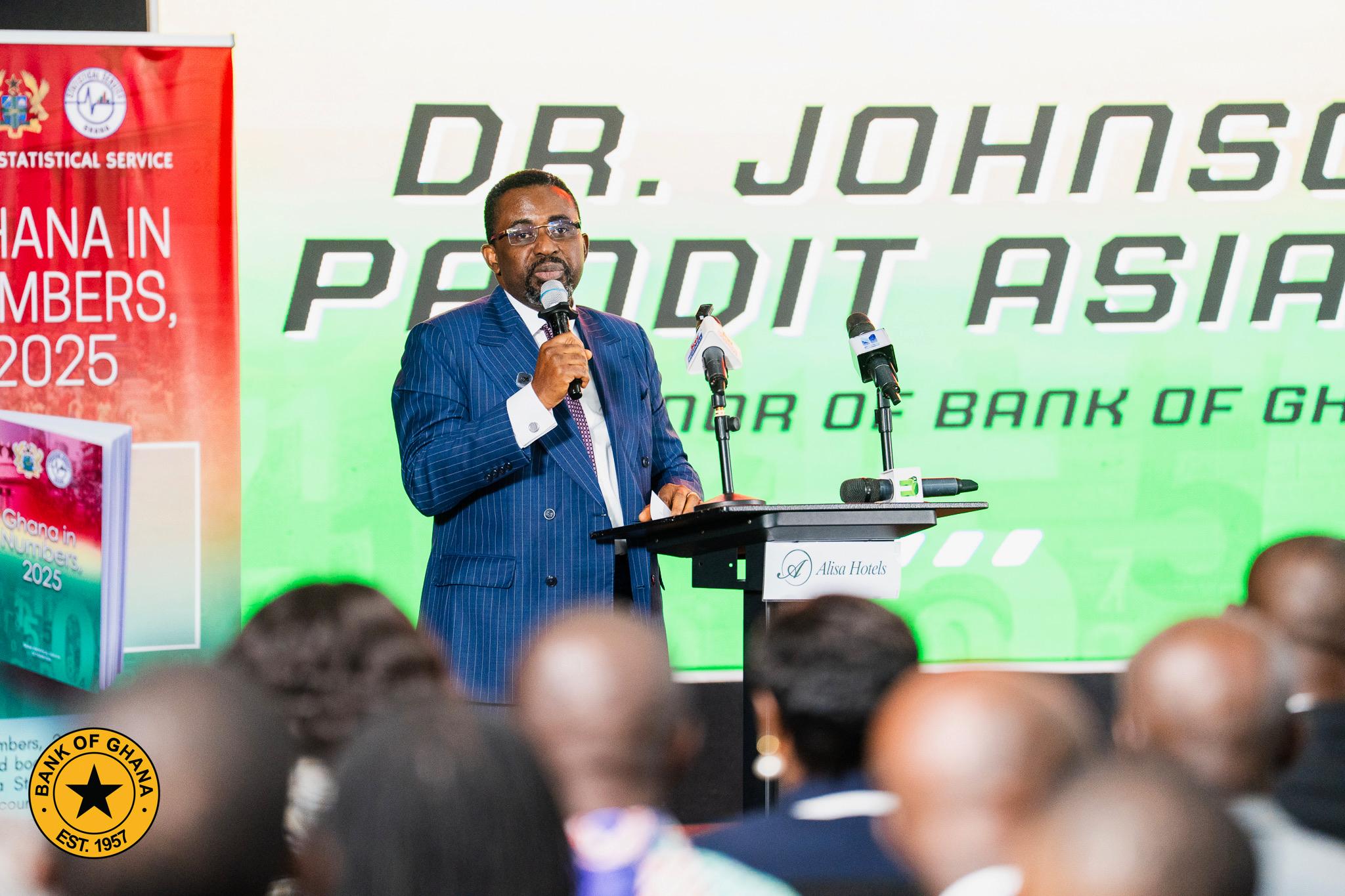

- Dr Asiama Calls for Machine-Readable National Data to Strengthen Economic Decision-Making
The Bank of Ghana is developing a directive to regulate the use of artificial intelligence in the financial sector, as banks and other financial institutions increasingly deploy emerging technologies across lending, customer service, risk assessment and operational decision-making.
Governor of the Bank of Ghana, Dr Johnson Pandit Asiama, disclosed the initiative at the launch of the maiden edition of the Ghana in Numbers 2025 report in Accra on Thursday, October 29, 2026.
The proposed directive is expected to provide a regulatory framework that encourages responsible innovation while addressing potential risks associated with the growing use of artificial intelligence in financial services.
“We are also developing a directive to regulate the use of Artificial Intelligence in the financial sector, in line with our policy to promote innovation while at the same time addressing emerging risks,” Dr Asiama said.
Although the Governor did not give a timetable for releasing the directive, the announcement signals that the central bank is preparing for a financial system in which algorithms could play an increasingly important role in credit decisions, fraud detection, customer identification and the delivery of financial products.
The challenge for the regulator will be to ensure that the efficiency promised by artificial intelligence does not weaken consumer protection, data privacy, institutional accountability or financial stability.
An automated lending system, for example, may process applications more quickly than conventional assessment methods. However, poorly designed algorithms could reproduce existing inequalities, exclude vulnerable borrowers or make decisions that customers and regulators cannot easily explain.
The Bank’s initiative therefore raises an important policy question: how can Ghana capture the productivity benefits of artificial intelligence without allowing technology to create new and less visible financial risks?
Dr Asiama said advances in data science, artificial intelligence and machine learning were creating opportunities to identify economic patterns, improve forecasts, assess risks and extract insights from increasingly large and complex datasets.
These technologies, he explained, could complement conventional economic analysis and strengthen the Bank’s capacity to respond to changing economic conditions.
The central bank has established a Data Analytics and Artificial Intelligence Department as part of a broader programme to strengthen data governance, improve institutional analytical capacity and promote the responsible use of emerging technologies in policymaking.
Dr Asiama also urged the Ghana Statistical Service to extend the value of the Ghana in Numbers report by creating a dedicated electronic portal through which its underlying data could be made available in accessible and machine-readable formats.
Such a platform, he argued, would allow researchers, universities, policymakers and other users to apply artificial intelligence, machine learning and advanced analytical tools to official data.
This could help users identify relationships and trends that may not be immediately visible in published tables and charts.
At the heart of the Governor’s argument was the principle that economic policy can only be as credible as the data supporting it.
As an inflation-targeting institution, the Bank of Ghana relies on accurate and timely information to understand the interaction among inflation, exchange rates, economic activity, credit conditions and developments in the international economy.
“Reliable statistics do more than inform policy. They strengthen transparency, enhance accountability and promote public confidence in institutions,” Dr Asiama said.
“They also help businesses and investors assess economic conditions, manage risks and make informed investment decisions.”
The speech also provided fresh evidence of changes in Ghana’s credit environment following recent improvements in macroeconomic conditions.
According to Dr Asiama, the average lending rate declined from 30.25% in December 2024 to 15.78% in September 2026. This represents a reduction of 14.47 percentage points over the period.
Growth in real private-sector credit also strengthened from 0.20% in December 2024 to 26.42% in September 2026.
The figures suggest that the benefits of lower inflation and relative currency stability are beginning to extend beyond headline economic indicators into borrowing conditions and access to credit.
“These gains are also reflected in improved credit conditions, among others,” the Governor said.
However, lower average lending rates do not necessarily mean that every business can obtain affordable financing. Small and medium-sized enterprises may still face collateral requirements, limited financial records and risk assessments that prevent them from accessing formal credit.
The next test is therefore whether the improvement in aggregate credit conditions translates into productive financing for businesses capable of creating employment.
Dr Asiama said inflation had remained in single digits for 13 consecutive months, the exchange rate was relatively stable despite external pressures, and banking-sector resilience had improved significantly.
He linked these developments to the creation of an environment in which enterprises, particularly those owned or operated by young people, could invest, expand and generate employment.
The maiden report focuses on “Youth and the Demographic Transition,” an issue the Governor described as fundamental to Ghana’s long-term development.
Ghana’s youthful population could become a source of innovation, enterprise and economic expansion, but that outcome will depend on skills development, access to finance and the creation of an enabling environment for investment.
The Bank is consequently pursuing initiatives to promote financial inclusion, financial health and responsible innovation. These interventions are intended to make formal financial services more accessible and affordable for young people, women, micro, small and medium-sized enterprises and underserved communities.
Dr Asiama ultimately called for Ghana in Numbers to be treated as more than a statistical publication.
It should become an enduring national reference through which citizens and institutions can understand Ghana’s circumstances, evaluate its progress and make better decisions.
For that ambition to be realised, official data must not merely be collected. It must be credible, accessible and capable of supporting meaningful scrutiny. In an economy increasingly influenced by artificial intelligence, the value of data will depend as much on how it is governed and used as on how much of it is produced.

