

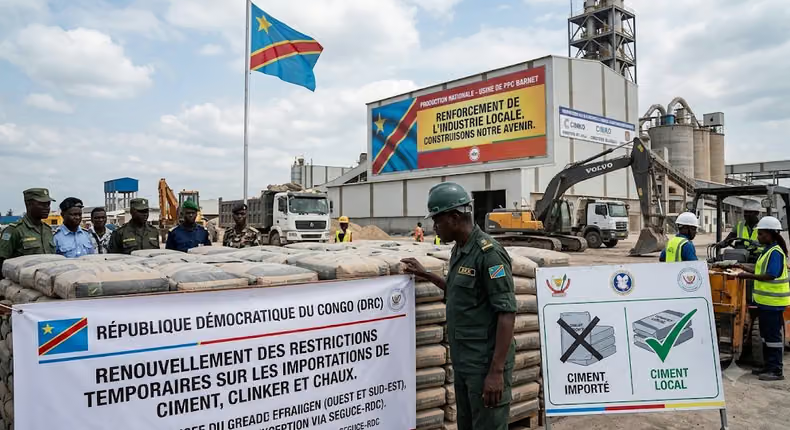

- DR Congo Extends Cement and Lime Import Curbs to Shield Local Producers
The Democratic Republic of Congo has renewed temporary restrictions on imports of cement, clinker and lime in selected regions, extending a protectionist trade policy aimed at supporting domestic manufacturers and reducing dependence on imported construction materials.
The measures, signed on July 29 by Foreign Trade Minister Julien Paluku Kahongya, maintain restrictions on grey cement and clinker imports into western and southeastern parts of the country, while lime imports remain restricted in the southeast.
The policy stops short of a blanket import ban. Companies will still be permitted to seek exemptions where domestic production cannot adequately meet industrial or consumer demand, providing the government with a mechanism to prevent shortages and excessive price increases.
Importers seeking waivers must submit documentation validated through SEGUCE-RDC, the country’s single-window foreign trade platform.
The latest decision extends safeguards first introduced in July 2024, when Kinshasa moved to protect domestic cement and lime producers from lower-priced foreign products while encouraging investment in local manufacturing.
The approach is consistent with the government’s broader industrialisation strategy, which seeks to retain more value within the Congolese economy by expanding local production rather than relying heavily on imported finished goods.
Cement has become increasingly strategic to the DRC as public and private investment expands across roads, housing, mining infrastructure and other major construction projects.
That demand gives the government a strong incentive to develop local capacity, particularly in an economy where large distances and infrastructure bottlenecks can make imported construction inputs costly and unpredictable.
Domestic production capacity has expanded in recent years.
Western DRC is served by producers including PPC Barnet, CIMKO, Cimenterie de Lukala and CINAT, while southeastern operations include Grande Cimenterie du Katanga and a cement and lime facility associated with China’s Zijin Group in Lualaba.
The expansion means the country theoretically has greater capacity to replace imported material with domestic output.
But production capacity alone may not solve the supply problem.
The DRC is one of Africa’s largest countries geographically, and weak transport infrastructure, long distances between production centres and consumers, and high logistics costs make it difficult to distribute cement efficiently across provinces.
Those constraints explain why the government has retained an exemption system rather than completely closing the market to imports.
A factory may have sufficient production capacity nationally, but that does not necessarily mean cement can be delivered economically and reliably to every region where construction activity is increasing.
The trade-off is significant.
Import restrictions could improve utilisation rates for domestic plants, encourage additional investment and protect industrial employment. Local producers may also gain greater certainty over demand, making expansion projects easier to justify.
Greater domestic cement production could also reduce foreign-exchange demand associated with imported construction materials and strengthen local supply chains.
However, restricting imports can create risks if domestic competition is weak.
If local producers are unable to increase output sufficiently, reduced competition from imports could lead to higher cement prices, shortages or wider regional price disparities.
Those costs could eventually feed into the price of housing, roads, mines and public infrastructure.
The effectiveness of the policy therefore depends on whether protection translates into new investment, greater productivity and lower production costs rather than simply insulating existing manufacturers from competition.
The Congolese government has already demonstrated a wider willingness to use temporary import controls as an industrial-policy tool. Earlier in 2026, the Foreign Trade Ministry said it had renewed several temporary restrictions for 12 months as part of efforts to protect local industry.
This mirrors a wider African policy debate over how governments should balance industrialisation with open trade.
Nigeria and other economies have used import restrictions or tariffs in sectors including cement, food processing and consumer goods to create space for domestic manufacturers to scale.
Such policies can generate investment where countries have sufficient demand and production potential. But their success depends heavily on competition, energy availability, transport infrastructure, regulatory predictability and access to financing.
For the DRC, the cement market carries particular significance because of the scale of infrastructure required to support its mining-driven economy.
Copper and cobalt production in the southeast requires roads, processing facilities, power infrastructure and housing, all of which increase demand for cement and lime.
The renewed restrictions therefore go beyond protecting individual manufacturers. They form part of an attempt to create a deeper domestic industrial base around the country’s infrastructure and mining expansion.
Whether that strategy succeeds will ultimately depend on supply.
If Congolese manufacturers can provide sufficient volumes at competitive prices, imports could decline while local industrial activity and employment increase. If they cannot, exemptions will continue to play a large role, limiting the policy’s impact on import dependence.

