
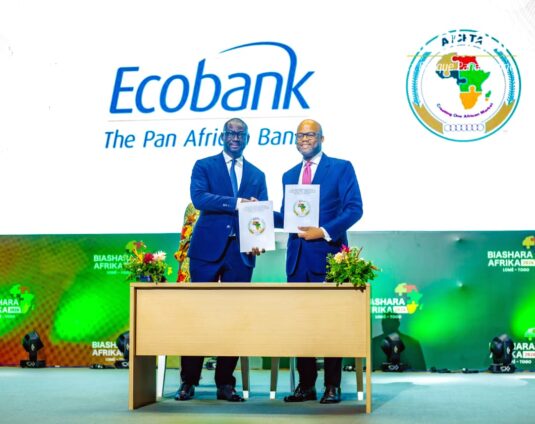

- Ecobank, AfCFTA Move to Put $3 Billion Behind African Trade
Ecobank Group and the African Continental Free Trade Area Secretariat have signed a landmark Memorandum of Understanding aimed at expanding access to trade finance for African businesses, with a particular focus on small and medium-sized enterprises, women-led firms and young entrepreneurs.
The agreement establishes a strategic framework to support implementation of the AfCFTA, which seeks to create a single African market of more than 1.3 billion people with a combined gross domestic product of about $3.4 trillion.
The partnership builds on Ecobank’s recent $3 billion trade finance commitment, announced at the Africa-Forward Summit in Nairobi, to be deployed over the next three years in partnership with development finance institutions.
Under the new arrangement, the AfCFTA Secretariat is expected to help direct the facility toward businesses that have traditionally struggled to access affordable trade finance, including large corporates, SMEs and small-scale cross-border traders.
Wamkele Mene, Secretary-General of the AfCFTA Secretariat, said access to trade and affordable finance remains critical to unlocking the full potential of the continental free trade framework.
“Through this partnership with Ecobank, we are strengthening the support available to African businesses, particularly SMEs, women-led enterprises, and young entrepreneurs, to enable greater participation in intra-African trade and value chains across the continent,” he said.
The deal comes at a critical time for African trade integration. Although the AfCFTA became operational in 2021, implementation has been slowed by limited access to trade finance, payment bottlenecks, regulatory mismatches and non-tariff barriers.
For Ecobank, the partnership strengthens its positioning as one of the few African banking groups with the geographic footprint to support cross-border trade at scale. The lender operates in 34 African markets, giving it reach across several trade corridors central to the AfCFTA agenda.
Michael Larbie, Group Executive for Corporate and Investment Banking at Ecobank, said the agreement reflects the bank’s long-standing ambition to support Africa’s economic and financial integration.
“For 40 years, Ecobank has been built on a singular vision: to advance the economic development and financial integration of Africa,” he said.
“With our unmatched presence across 34 African markets and our digital capabilities, we are uniquely positioned to serve as a catalyst for the AfCFTA. This MoU formalises our commitment to connecting African businesses to the markets, finance, and knowledge they need to thrive,” he added.
The partnership will focus on six priority areas: SME capacity building, closing the trade finance gap, strengthening the use of Ecobank’s Single Market Trade Hub, business referrals, policy advocacy and thought leadership on AfCFTA protocols.
A key element will be the promotion of Ecobank’s Ellevate Programme, which targets women-led businesses in both formal and informal sectors. The two institutions will also use the AfCFTA Trading Companies database and Ecobank’s network to connect buyers and sellers across the continent.
The Single Market Trade Hub is expected to help reduce information gaps among African traders, one of the persistent challenges limiting intra-African commerce.
The agreement will also support joint advocacy with regulators to address non-tariff barriers and cross-border payment friction, two issues that continue to undermine the cost and speed of doing business across African borders.
For African SMEs, the partnership could be significant. Many smaller firms face difficulty securing working capital, letters of credit, guarantees and other trade instruments needed to participate in regional supply chains. Without affordable finance, the AfCFTA’s promise of a single market risks being captured mainly by larger companies with stronger balance sheets.
The Ecobank-AfCFTA agreement seeks to narrow that gap by linking finance, market access, business information and policy support within one framework.
No detailed rollout timeline for specific programmes under the MoU has been disclosed, but both parties said implementation would begin immediately.
For Ghana, where the AfCFTA Secretariat is headquartered, the deal reinforces Accra’s role as a coordination hub for Africa’s trade integration agenda. It also presents potential opportunities for Ghanaian SMEs, exporters, women-led enterprises and fintech-enabled traders seeking access to regional markets.
The broader test, however, will be execution. Africa has no shortage of trade integration commitments; what businesses need is practical access to finance, faster payment settlement, predictable customs processes and lower non-tariff barriers.
If implemented effectively, the Ecobank-AfCFTA partnership could help move the continental trade agenda from policy ambition to business reality — by putting capital, networks and market intelligence behind firms that have long been priced out of cross-border growth.

