

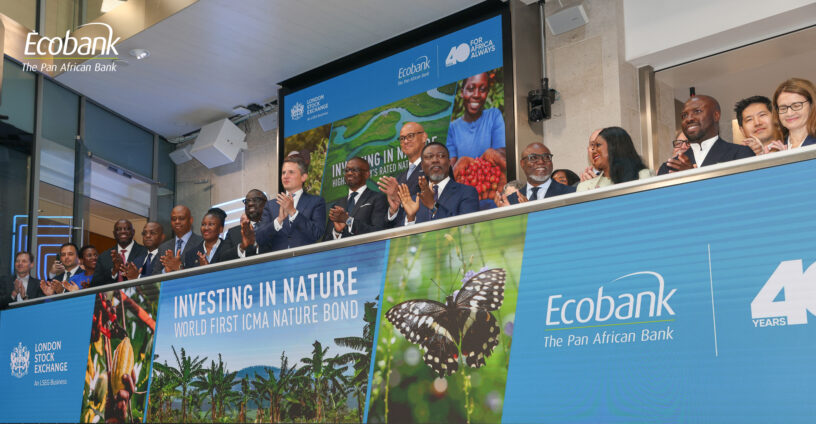

- Ecobank Turns Natural Capital into Investable Asset with Historic London Bond Listing
Ecobank has listed the world’s first commercial bank-issued Nature Bond on the London Stock Exchange, raising US$450 million in a landmark transaction that positions the pan-African lender at the forefront of sustainable finance innovation.
The Sustainable Agriculture & Natural Capital Bond marks the first commercial bank issuance to receive the International Capital Market Association’s Nature Bond designation. It is also the first use-of-proceeds green bond globally to secure ICMA’s secondary Nature Bond label, setting a new benchmark for how financial institutions can raise capital for projects tied to biodiversity, sustainable agriculture and natural capital.
For Ecobank, the transaction is more than a funding exercise. It is a statement about the future of African finance.
The proceeds will be deployed across 24 African markets where Ecobank operates, with lending expected to support sustainable primary production, agri-processing, natural capital restoration, water supply and sanitation infrastructure. These are sectors that sit at the centre of Africa’s long-term development challenge: how to feed growing populations, protect ecosystems, build climate resilience and expand productive capacity without destroying the natural resources on which many economies depend.
The market response was strong. Ecobank initially sought to raise US$350 million, but investor demand rose to more than US$1.36 billion, representing about 3.89 times the original target. The oversubscription allowed the bank to increase the final issuance size to US$450 million while tightening pricing by 50 basis points, reducing its funding cost.
That level of demand is significant. It suggests that global investors are increasingly willing to treat African environmental and agricultural assets as serious investment opportunities, not merely development concerns. It also shows that sustainable finance linked to nature, food systems and water security is moving closer to mainstream capital markets.
European investors accounted for 55.00% of allocations, while African investors took 38.00%. Investors from the Middle East, the United States and Asia also participated. Dutch development bank FMO joined the transaction as anchor investor, providing additional institutional backing to the issuance.
The bond also received strong market validation from Moody’s, which assigned it its highest Sustainability Quality Score of SQS1, classified as Excellent. That rating strengthens confidence in the credibility of the framework and the environmental integrity of the use of proceeds.
The transaction was structured as a Tier 2 capital instrument with a maturity of 10.25 years and a call option after 5.25 years. This means the bond does not only support Ecobank’s sustainability agenda; it also strengthens the group’s regulatory capital base, giving the lender greater capacity to finance businesses and projects across its African footprint.
This dual purpose is important. African banks face the challenge of supporting economic growth while also meeting capital requirements and responding to climate-related risks. By raising sustainability-linked capital that also qualifies as regulatory capital, Ecobank is showing how African financial institutions can align balance sheet strength with environmental and developmental priorities.
The listing was commemorated with a Market Open Ceremony at the London Stock Exchange attended by Ecobank Chairman Papa Madiaw Ndiaye, Group Chief Executive Jeremy Awori, Chief Financial Officer Ayo Adepoju, and Group Head of Sustainability Rachael A.O. Antwi.
The symbolism of the London listing matters. African institutions have often been seen as recipients of global climate and development finance. Ecobank’s transaction reverses part of that narrative by showing that African banks can originate, structure and place innovative sustainable finance instruments in major international capital markets.
The bond also comes at a time when the concept of natural capital is gaining greater relevance in global finance. Nature is increasingly being recognised not only as an environmental concern but as an economic asset. Healthy soils, forests, wetlands, water systems and biodiversity support agriculture, food security, livelihoods, climate stability and trade.
For Africa, this is especially important. The continent’s economies are highly exposed to climate change, land degradation, water stress and food insecurity. Yet Africa also holds significant natural capital that can support growth if managed responsibly. Financing that links capital markets to sustainable land use, agriculture and water infrastructure could therefore become a critical tool for long-term development.
Sustainable agriculture is a particularly important focus. Africa’s food systems require more investment in productivity, storage, processing, irrigation, logistics and value addition. Without such investment, the continent will continue to face food import dependence, post-harvest losses, rural poverty and vulnerability to climate shocks.
By supporting sustainable primary production and agri-processing, the bond could help strengthen agricultural value chains and increase the ability of African economies to capture more value from their own resources.
Water infrastructure is another key area. Access to reliable water supply and sanitation remains a major development issue in many African markets. Investment in water security is also becoming more urgent as climate variability increases pressure on communities, cities and agricultural systems.
The inclusion of biodiversity and natural capital restoration also shows how sustainable finance is broadening. Green bonds have traditionally focused heavily on renewable energy, energy efficiency and clean transport. Nature Bonds widen the lens to include ecosystems, land, water, agriculture and biodiversity.
That evolution is relevant for Africa because many of the continent’s most important climate and development challenges are nature-linked.
The success of Ecobank’s issuance may encourage other African financial institutions to explore similar instruments. It could also deepen investor interest in African sustainable finance products if proceeds are transparently allocated and impact is clearly reported.
A successful bond issuance is only the first step. Ecobank will now need to demonstrate that the proceeds are deployed into credible, measurable and environmentally sound projects. Investors and observers will be looking for clear reporting on allocation, impact, project selection and environmental outcomes.
The bank’s ability to deliver on those commitments will determine whether this transaction becomes a one-off success or the beginning of a deeper market for African nature finance.
The wider message, however, is already clear. Africa’s green transition will not be financed by public funds alone. It will require commercial banks, development finance institutions, institutional investors, capital markets and private-sector borrowers working together to direct capital into sustainable growth sectors.
Ecobank’s US$450 million Nature Bond shows that such capital can be mobilised when the structure is credible, the framework is strong and the development story is compelling.
For Africa, the transaction offers a useful signal at a time when the continent needs investment in food security, climate adaptation, water systems and natural resource resilience. It also highlights the role African banks can play in connecting local development needs with global pools of capital.
The significance of the deal is therefore not only that Ecobank raised US$450 million. It is that the bank has helped create a new template for financing nature, agriculture and resilience through African financial institutions.
If replicated carefully, such instruments could become an important part of how the continent funds its next phase of sustainable growth.
Ecobank’s Nature Bond has put African sustainable finance on the global stage. The real test now is whether the capital raised will help protect the natural systems that Africa’s future growth depends on.

