

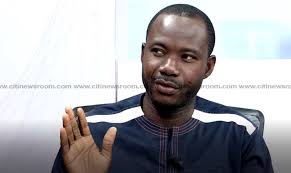

- Economist Calls for Balanced State-Private Model in Extractive Sector
Economist Adu Owusu Sarkodie has cautioned against calls for Ghana to pursue full state ownership of mining assets, warning that such a model could create serious operational, governance and management risks if not properly structured.
Speaking at the JoyBusiness Roundtable on the theme, “To Nationalise or Transform: Rethinking Ghana’s Approach to Gold Mining, Oil and Critical Minerals,” Dr Sarkodie said Ghana must avoid reducing the mining debate to ownership alone. Instead, he argued, the country should focus on building a balanced model that increases state benefits while preserving private-sector efficiency, capital and technical expertise.
“100 per cent government ownership is very risky. Our management is questionable because politicians will employ party foot soldiers, so a state ownership and private management is okay,” he stated.
His warning comes as Ghana’s extractive sector faces renewed scrutiny over resource nationalism, local participation, mining lease renewals and whether the state should take a more dominant role in controlling strategic mineral assets.
The economist’s argument is not against greater national benefit from mining. Rather, it is a caution that ownership without management discipline, capital investment and governance safeguards may not deliver the revenue gains many expect.
Dr Sarkodie said public-private participation could help Ghana protect operational efficiency, maintain investor confidence and keep the sector competitive while still ensuring that the state captures greater value from its mineral resources.
For Ghana, the issue is becoming increasingly important. Gold remains one of the country’s most critical sources of export earnings, foreign exchange and fiscal revenue. But public frustration has grown over whether mining communities and the wider economy receive enough benefit from decades of extraction.
That frustration has strengthened calls for more local ownership, deeper Ghanaian participation and tougher state oversight of mining assets.
But Dr Sarkodie’s intervention suggests that the better policy question is not whether the state should own everything, but how Ghana can structure ownership and management to deliver value without weakening productivity.
Mining is capital-intensive and technically complex. Exploration, mine development, production, environmental management, safety systems and community obligations require large investment and specialist expertise. If the state assumes full ownership without strong commercial governance, the burden of financing and operational risk shifts directly onto government.
That could expose public finances to losses, political interference and inefficient management.
The warning is especially relevant at a time when Ghana is seeking to attract investment into gold, oil and critical minerals. Investors are likely to watch policy signals closely. Any move interpreted as a shift toward blanket nationalisation could raise risk concerns, delay investment decisions and increase the cost of capital for future projects.
Dr Sarkodie therefore called for governance structures and accountability mechanisms that maximise national benefits rather than a narrow focus on ownership.
Such an approach could include stronger royalty enforcement, improved tax compliance, transparent state equity participation, local listing requirements, supplier development, value addition and a clearer framework for community benefit-sharing.
It could also involve models where the state retains strategic ownership stakes while private firms manage operations under strict performance, transparency and local content obligations.
This hybrid model may offer Ghana a more realistic path: greater national control without sacrificing the efficiency and investment discipline that private-sector participation can bring.
The wider debate is no longer theoretical. Ghana is already facing questions over mining lease renewals, local content expectations, unratified mining agreements and how to ensure mining revenues translate into visible development in host communities.
Industry players have warned that uncertainty around mining rights could weaken Ghana’s competitiveness as an investment destination. At the same time, civil society actors and communities are demanding that the country secure more value from its mineral wealth.
Dr Sarkodie’s comments place him in the middle of that debate. His message is that Ghana should neither surrender its mineral wealth to weak bargaining arrangements nor rush into full state ownership without the capacity to manage complex mining operations.
The country’s challenge is to design a system that protects the national interest, reassures investors, strengthens local participation and builds domestic industrial capacity around mining.
For policymakers, nationalisation may sound attractive in a period of high gold prices and public anger over limited local benefits. But without governance discipline, technical competence and insulation from political patronage, full state ownership could create new problems rather than solve old ones.
Ghana’s mining future may therefore depend less on who owns the mine on paper — and more on whether the country can build a model that delivers revenue, jobs, accountability, local value and long-term productivity.

