


- ECOWAS Links Border Reform to 1,028km Highway in Bid to Deepen Regional Trade
ECOWAS is stepping up efforts to turn West Africa’s decades-old free movement framework into a more effective engine of regional commerce, as the bloc combines border reforms with plans for a six-lane highway linking some of the region’s largest economies.
The Economic Community of West African States has intensified engagement with border communities along the Abidjan–Lagos Corridor, bringing together stakeholders from Ghana, Togo, Benin and Nigeria at the Akanu-Noepe Joint Border Post between Ghana and Togo.
The discussions focused on implementation of the ECOWAS Protocol on the Free Movement of Persons, Goods and Services, but the economic significance goes well beyond public education.
The deeper challenge is whether West Africa can finally convert regional agreements into lower trade costs.
Despite decades of integration efforts, intra-ECOWAS commerce remains relatively weak. In February, Nigerian Deputy Speaker and ECOWAS parliamentarian Benjamin Kalu put intra-community trade at around 11.50%, highlighting the gap between the size of the regional market and the volume of business actually conducted among member states.
That weakness cannot be explained by tariffs alone. For businesses moving goods across West Africa, delays at borders, documentation requirements, inconsistent administrative procedures and unofficial barriers can sometimes be more damaging than formal customs duties.
A truck carrying goods from Accra to Lagos may cross several jurisdictions before reaching its destination. Every additional inspection, queue or documentation dispute adds time and cost. The result is an economic contradiction: countries that are geographically close can sometimes remain commercially distant.
ECOWAS Vice-President Mrs Damtien L. Tchintchibidja urged border communities to make greater use of the opportunities provided under the free movement framework, arguing that the protocol can support trade, investment, tourism and stronger economic links between member states.
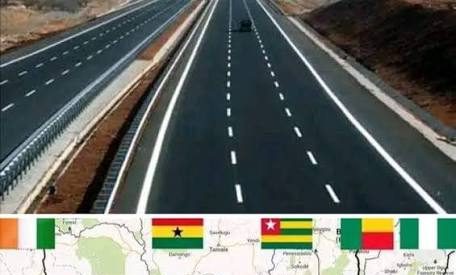
The message is particularly important along the Abidjan–Lagos axis. The corridor connects Côte d’Ivoire, Ghana, Togo, Benin and Nigeria, linking major commercial centres including Abidjan, Accra, Lomé, Cotonou and Lagos. That makes it one of West Africa’s most economically important transport routes.
It connects ports, manufacturing centres, agricultural markets and some of the region’s largest concentrations of consumers. Improving the movement of goods along the corridor could therefore have effects extending well beyond transport.
Agricultural products could reach regional markets more quickly. Manufacturers could source inputs from neighbouring countries more efficiently. Smaller traders could expand beyond domestic markets without absorbing disproportionate transport and border costs.
For Ghana, the opportunity is particularly significant. The country sits near the geographical centre of the corridor and could benefit from stronger transit trade, logistics investment and improved links between its ports and neighbouring markets.
But free movement does not mean unmanaged borders. Mr Samuel Basintale Amadu, Comptroller-General of the Ghana Immigration Service, stressed the need for border communities and travellers to remain security-conscious while benefiting from the regional mobility regime.
That highlights one of the central policy tensions. ECOWAS needs borders to become easier for legitimate trade while remaining difficult for smuggling, trafficking and other illicit activity.
The solution is not necessarily more physical inspections. Modern border management increasingly depends on intelligence, information sharing, digital systems and risk-based screening capable of identifying higher-risk transactions without delaying every trader and traveller.
Madam Nana Birago Owusu-Ansah, Deputy Commissioner responsible for the Suspense Regime, Free Zones, Warehousing and Transit at the Customs Division of the Ghana Revenue Authority, urged traders and travellers to ensure they carry the required documentation before crossing borders.
That may sound administrative, but documentation is part of the economics of regional trade.
If traders do not understand requirements, border authorities spend more time resolving deficiencies and businesses face longer delays.
Greater awareness can therefore produce real commercial gains. The institutional reforms are taking place alongside a much larger physical infrastructure ambition.
ECOWAS is advancing the proposed 1,028-kilometre, six-lane Abidjan–Lagos Corridor Highway, connecting Abidjan, Accra, Lomé, Cotonou and Lagos.
The project is intended to become more than a road. Plans surrounding the corridor include logistics hubs, industrial and manufacturing zones and other infrastructure designed to support commercial activity along the route.
If delivered effectively, the highway could become the backbone of a more integrated coastal West African economy.
A modern six-lane motorway loses much of its economic advantage if trucks spend hours waiting at borders. That is why the current border engagement matters. The physical infrastructure and regulatory reforms are two parts of the same integration strategy.
West Africa needs faster roads, but it also needs faster borders. The distinction is crucial because infrastructure spending alone cannot create regional integration.
A road reduces the physical cost of distance. Harmonised customs procedures reduce the institutional cost of crossing jurisdictions.
Both are needed. The broader economic prize is the creation of regional value chains.
A manufacturer in Ghana could source inputs from Côte d’Ivoire, process them domestically and sell finished products into Nigeria. A Beninese agricultural producer could reach markets in Accra more efficiently. Logistics companies could build regional networks around predictable corridor traffic.
Such integration would allow businesses to think beyond national markets. That is particularly important under the African Continental Free Trade Area.
AfCFTA offers African businesses access to a much larger continental market, but its success depends partly on whether regional blocs such as ECOWAS can make cross-border trade work efficiently in practice.
The Abidjan–Lagos Corridor could become one of the clearest demonstrations of that principle. It is already home to major ports and consumer markets. What it lacks is the seamless movement required to turn those individual economies into a functioning commercial corridor.
Financing the highway will remain a major challenge, as will land acquisition, construction, maintenance and coordination across five countries.
Yet institutional barriers may prove equally difficult. Different agencies, regulations and enforcement cultures must operate with enough consistency that businesses can predict the time and cost involved in moving goods. That predictability is valuable in itself.
Companies can manage a known cost. What is harder to manage is uncertainty. When a truck may clear a border in one hour on one journey and eight hours on another, businesses must build additional time and working capital into supply chains.
Those costs ultimately reach consumers. Regional integration can therefore help tackle not only trade volumes but prices. Lower logistics costs can reduce the cost of imported inputs and finished goods, while stronger competition across neighbouring markets can improve efficiency.
The benefits could be particularly important for small and medium-sized businesses that do not possess the financial capacity to absorb prolonged border delays. Large companies can hold additional inventory and hire specialised customs agents. Smaller traders often cannot.
This is why the free movement regime has a strong inclusive-growth dimension. For many border communities, regional trade is already part of everyday economic life. The policy objective should be to make that activity more formal, predictable and secure rather than simply more regulated.
ECOWAS officials have consequently called for sustained sensitisation of traders, transport operators and travellers about both the rights and responsibilities created under the regional framework.
That should help reduce disputes at border posts, but the bloc will ultimately need measurable results. The real indicators of progress will be shorter border clearance times, fewer unnecessary stops, greater use of digital documentation, reduced unofficial charges and lower logistics costs.
That is how traders will judge integration. The Abidjan–Lagos highway could become one of the most important infrastructure projects in West Africa.
But its economic value will depend on what happens when vehicles reach each national frontier.
ECOWAS therefore faces a simple but demanding test: build the road, reform the borders and make the two work together.
If it succeeds, the Abidjan–Lagos Corridor could evolve from a collection of national transport routes into a genuine regional economic artery. If it fails, West Africa could end up with faster highways leading to the same old queues.
For traders and businesses, regional integration will ultimately be judged not by protocols signed in conference rooms, but by how quickly, predictably and affordably they can cross the next border.

