


- Enterprise Posts 35.10% Profit Growth as Efficiency Gains Strengthen Investor Case
Enterprise Group PLC has reported a sharp improvement in first-half profitability, with profit before tax rising 35.10% even as net revenue grew by a slower 21.70%, pointing to stronger operating leverage across the diversified financial-services group.
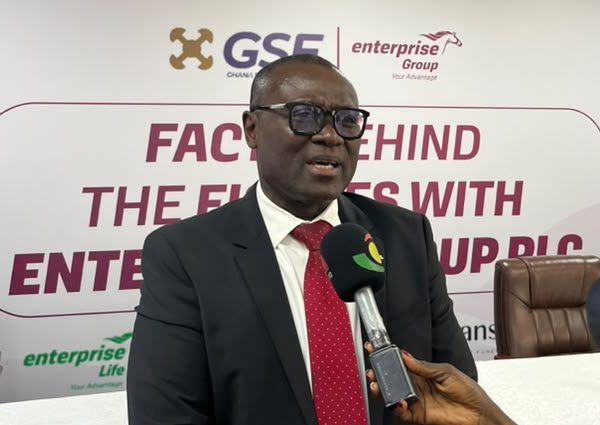
The company disclosed the performance at the Ghana Stock Exchange’s “Facts Behind the Figures” forum in Accra, where management outlined a strategy centred on cost discipline, automation and a turnaround of its Nigerian operations.
Operating expenses increased by only 5.20%, creating a significant gap between income growth and the expansion of the cost base.
“The first half results reflect not only growth, but the quality of that growth,” Group Chief Financial Officer Michael Tyson said.
He added that the combination of stronger revenue, faster profit expansion and contained operating costs demonstrated “disciplined execution, prudent capital management and sustainable profitability.”
The numbers suggest Enterprise is beginning to generate more income without allowing expenses to grow at the same pace, a development that could become increasingly important for shareholders if it proves sustainable.
The bigger question now is whether those efficiency gains can be sustained through the second half of the year. Insurance businesses can record strong premium growth while simultaneously facing rising claims, distribution costs and administrative expenses, meaning top-line expansion alone does not necessarily translate into stronger returns.
Enterprise’s focus on what management described as healthier revenues and improved margins therefore puts the quality of the underlying business mix at the centre of its 2026 strategy.
Technology will play a significant role in that effort. Enterprise plans to use automation and fit-for-purpose digital tools to improve operational efficiency, with potential benefits extending across underwriting, claims processing, customer service, administration and internal controls.
The challenge is that digital transformation requires upfront investment, meaning management must ensure that technology spending produces measurable productivity gains rather than eroding the earnings improvement it is intended to support.
Group Chief Executive Officer Daniel Larbi-Tieku said the first-half performance showed that Enterprise remained financially solid while continuing to invest for longer-term growth.
“Our H1 2026 performance demonstrates that Enterprise Group remains solid, has a strong brand and continues to meet its obligations to its customers and stakeholders,” he said.
He added that the group had continued to invest in people, customers, digital transformation and the long-term sustainability of the business.
The timing of the results is significant because Enterprise is approaching the final phase of its three-year strategic plan, which management expects to complete in 2027.
That means the latest figures provide an early test of whether investments made under the strategy are beginning to produce stronger financial outcomes rather than simply adding cost.
Mr Larbi-Tieku said the company remained on track and stressed that management’s objective was to build “enduring businesses that create value for customers, shareholders and society.”
One of the most important tests of that strategy lies outside Ghana. Enterprise has identified moving its Nigerian operations towards break-even as a specific priority for 2026, reflecting a shift from geographic expansion towards financial sustainability.
Losses or weak returns from overseas subsidiaries can dilute strong performance in the group’s Ghanaian operations, making Nigeria a material capital-allocation issue for shareholders.
The Nigerian market offers a large potential customer base and significant long-term opportunity, but Enterprise’s emphasis on break-even suggests management is no longer treating expansion itself as sufficient evidence of success.
A turnaround would both reduce the drag from underperforming operations and potentially create an additional source of earnings growth.
That makes Nigeria one of the clearest operational markers investors can watch as the company moves through the second half of the year.
Mr Tyson said management expected the year to end with stronger financial performance. “All in all, we expect 2026 to conclude with improved revenues and profits,” he said.
Delivering on that outlook will require Enterprise to maintain its current revenue momentum while keeping expenses under control and continuing to fund technology and other strategic priorities.
The company’s presentation also highlighted the growing importance of investor communication as Ghana’s capital market becomes more active.
GSE Managing Director Abena Amoah said listed companies needed to engage shareholders beyond formal financial statements and praised Enterprise for its approach to disclosure.
“Such engagements strengthen investor confidence and contribute to the continued development of Ghana’s capital market,” she said.
The forum gave investors, analysts and media representatives direct access to management through an interactive session moderated by Jerry Boachie-Danquah, the GSE’s Marketing and Public Relations Manager.
That kind of engagement is becoming increasingly important as companies seek to explain not only headline earnings but the drivers behind margins, costs and strategic investment.
For Enterprise, it also provides an opportunity to establish whether the current improvement reflects structural change rather than a favourable six-month period.
The first-half numbers point to a business whose profitability is currently growing faster than both revenue and costs.
Profit before tax rose 13.40 percentage points faster than net revenue, while expense growth remained considerably below both measures, strengthening the case that operating efficiency improved during the period.
The challenge now is to convert that advantage into a durable earnings profile rather than allow claims, transformation spending or underperforming subsidiaries to narrow the gap.
That will make capital allocation increasingly important. Enterprise must simultaneously fund technology, support customer-facing businesses, preserve balance-sheet strength and manage its Nigerian turnaround, all while maintaining profitability and shareholder confidence.
These objectives can compete for resources, meaning management’s ability to prioritise investment will become more important as the current strategic plan approaches completion.
For investors, the significance of the H1 performance therefore lies less in the 35.10% headline profit increase than in whether the forces behind it can be sustained.
Stronger earnings, controlled costs, automation and restructuring provide a favourable starting point, but the second half will determine whether Enterprise is genuinely moving into a higher-quality growth phase. Management believes the foundation has been laid; the next test is whether that foundation can support consistently stronger returns.

