

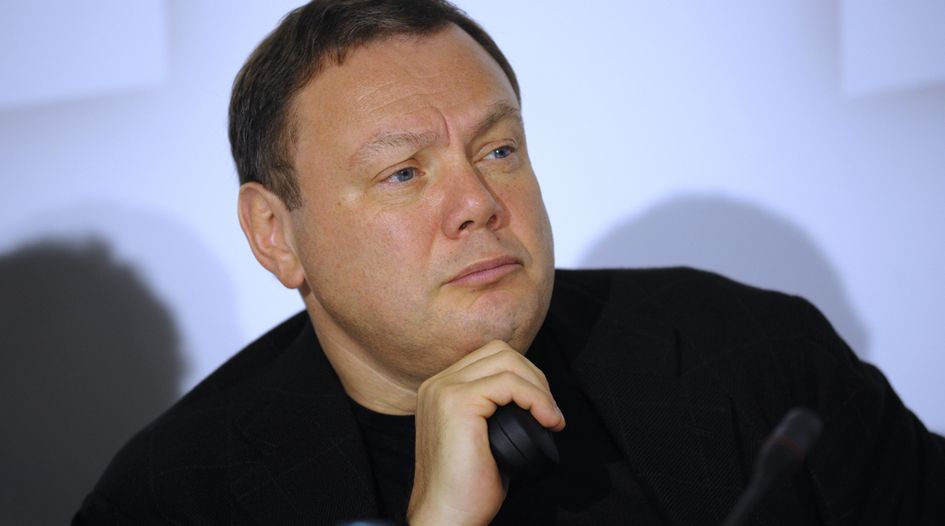

- EU Drops Fridman from Sanctions List as US$16bn Arbitration Pressure Shadows Luxembourg
The European Union has removed Russian-Israeli businessman Mikhail Fridman from its sanctions list, ending one of the bloc’s most closely watched individual designations while leaving unresolved a US$16bn investment treaty claim he is pursuing against Luxembourg over assets frozen under the measures.
The decision was adopted on September 22 as part of a wider compromise that renewed sanctions against roughly 3,000 other Russia-linked individuals and entities for three years.
Fridman’s delisting therefore closes one chapter of the sanctions dispute but potentially complicates another: whether Luxembourg can still defend the treatment of his assets against a multibillion-dollar arbitration claim.
Global Arbitration Review reported that the EU had agreed to lift sanctions on Fridman, who has been pursuing investment treaty claims against western states that froze his assets following Russia’s invasion of Ukraine.
The EU’s implementing regulation, adopted in Brussels on September 22, formally deleted Fridman’s entry from the sanctions annex alongside Alisher Usmanov and several others. The legal act confirms that the delisting is no longer merely a diplomatic proposal but an operative change to the bloc’s sanctions regime.
Fridman had been under EU sanctions since 2022, when the bloc imposed an asset freeze and travel restrictions and said he had supported actions or policies undermining Ukraine’s territorial integrity, sovereignty and independence.
He has consistently contested that characterisation and mounted legal challenges against the restrictions in several jurisdictions. In one of the most consequential cases, he turned to investment arbitration against Luxembourg, where significant assets were frozen.
The arbitration is valued at at least US$16bn, making it one of the largest treaty claims arising from sanctions imposed after Russia’s invasion of Ukraine.
Fridman is challenging Luxembourg’s implementation of the EU measures under a 1989 investment treaty between Belgium-Luxembourg and the former Soviet Union, arguing that the freezing of his assets amounted to unlawful treatment of protected investments.
GAR has reported that a tribunal is already in place, with South Korean academic Joongi Kim presiding over the dispute
The scale of the claim helps explain why Fridman’s delisting carries significance beyond the immediate question of whether he may now travel or regain control over previously frozen property.
Luxembourg had argued during EU negotiations that removing sanctions from Usmanov while leaving Fridman listed could weaken its litigation position in the arbitration, according to diplomats cited by Reuters.
That means the sanctions decision became entangled not only with foreign policy but with the potential legal exposure of an EU member state.
The political compromise was contentious. France and Slovakia had pushed for Usmanov’s removal, while Luxembourg sought the same treatment for Fridman, prompting resistance from Latvia and other Baltic states that argued delisting the businessmen sent the wrong signal while Russia’s war against Ukraine continued.
Latvia initially opposed the arrangement but ultimately abstained, allowing the EU to renew the broader sanctions package for an unusually long 36-month period.
Latvian Prime Minister Andris Kulbergs had described the proposed trade-off as unacceptable before the final agreement was reached. “Extending sanctions for 36 months would be the right step.
However, the price for it must not be simply striking both individuals from the sanctions list,” he said, according to Reuters. The dispute illustrates how individual sanctions cases can become bargaining chips in broader negotiations where unanimity among the EU’s 27 member states is required.
Ukraine also criticised the delisting. Its government has argued that easing restrictions on individuals previously sanctioned over links to Russia risks weakening the deterrent effect of the EU regime while attacks on Ukraine continue.
Those objections do not alter the legal effect of the September 22 regulation, but they underscore the political sensitivity surrounding any sanctions relief involving wealthy Russia-linked business figures.
For Fridman, the legal strategy has already extended beyond Luxembourg. GAR reported in July that he had brought another investment treaty claim against the Netherlands over asset seizures based on EU sanctions, adding to disputes involving Luxembourg and the United Kingdom.
The broader pattern suggests that sanctions litigation is becoming an increasingly important area of investor-state arbitration as wealthy individuals and companies challenge state measures imposed for geopolitical reasons.
That trend creates difficult questions for governments. Sanctions are adopted as public-law foreign-policy instruments, yet the way they are implemented can still trigger obligations under investment treaties covering expropriation, fair and equitable treatment and discrimination.
A state may therefore regard an asset freeze as a legitimate security measure while an investor argues that the same act unlawfully destroys the economic value or use of a protected investment.
Fridman has also achieved partial success before the EU courts. GAR notes that the EU General Court previously held that his 2022 designation should be annulled, although subsequent relistings kept restrictions in place and became part of his broader complaint that legal victories had not produced effective relief.
His arbitration case therefore sits at the intersection of two legal systems: judicial review of EU sanctions and treaty-based claims against the individual states implementing them.
The September delisting does not, by itself, determine the outcome of the US$16bn arbitration.
A tribunal would still need to examine whether Luxembourg’s past conduct breached applicable treaty protections, whether Fridman held qualifying investments, what losses can be attributed to the state’s actions and what defences Luxembourg can raise.
Removing him from the sanctions list may affect the factual and legal landscape, but it does not automatically erase claims concerning measures already taken.
That distinction could become central to the next phase of the dispute. Luxembourg may argue that its actions were taken pursuant to binding EU law and legitimate sanctions policy, while Fridman can maintain that the duration, implementation or consequences of those measures violated independent treaty obligations owed to him as an investor.
The question is therefore no longer simply whether sanctions should continue, but whether their prior application created compensable liability.
The case could also become a precedent for a growing category of disputes involving sanctions and investment protection.
GAR has identified sanctions-related claims as an emerging feature of treaty arbitration, with investors increasingly testing whether geopolitical measures that freeze, seize or restrict assets can be challenged under older bilateral investment treaties.
If tribunals accept jurisdiction and award substantial damages, governments may face pressure to consider investment-law exposure when designing future sanctions regimes.
For the EU, the Fridman decision resolves an immediate unanimity problem and secures a three-year renewal of sanctions against thousands of other designated persons and entities.
For Luxembourg, however, the removal may not end the legal consequences of the years in which Fridman’s assets were restricted. The US$16bn arbitration ensures that even after his name disappears from the sanctions list, the financial and legal legacy of the designation may remain very much alive.

