

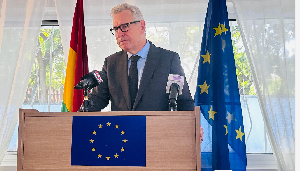

- EU Urges Ghana to Preserve Stability to Sustain Investor Confidence
The European Union has urged Ghana to preserve its political and macroeconomic stability if the country is to remain a preferred investment destination in West Africa, warning that foreign capital could shift to competing markets if business conditions weaken.
Speaking at a youth engagement programme at the Kwame Nkrumah University of Science and Technology, the EU Ambassador to Ghana, Rune Skinnebach, said sustained investor confidence would depend on Ghana’s commitment to sound governance, economic reforms and a business-friendly environment.
His remarks come as Ghana works to rebuild investor trust after a difficult period marked by fiscal stress, debt restructuring, high inflation, currency volatility and tighter financing conditions.
Mr Skinnebach said Ghana continues to stand out as one of the more stable democracies in the region but cautioned that stability cannot be taken for granted. He noted that rising insecurity across the Sahel and neighbouring states presents broader risks to peace, trade and investment flows.
For investors, Ghana’s comparative advantage has often rested not only on market opportunity but also on democratic continuity, relative peace and institutional predictability. The EU envoy’s warning suggests that these strengths must now be reinforced by deeper reforms in the real economy.
He said democratic freedoms should strengthen public accountability and institutional trust, both of which remain critical to long-term investment attraction.
The ambassador noted that the EU remains Ghana’s largest investor, export destination and development partner, underscoring Europe’s strategic interest in the country’s economic future.
He pointed to the EU’s €150 billion Global Gateway Investment Package for Africa as a major opportunity for Ghana to attract blended financing from development institutions, private investors and international financial bodies.
The Global Gateway initiative is designed to support investment in infrastructure, energy, digital connectivity, transport, education, health and climate-resilient development. For Ghana, the programme could offer an important source of long-term capital at a time when access to traditional external financing remains constrained.
Mr Skinnebach said Ghana’s competitiveness would increasingly depend on the quality of its infrastructure, legal systems and broader business climate.
He cautioned that European investors would redirect capital to neighbouring countries if Ghana failed to maintain an attractive and predictable investment environment.
The warning is significant because Ghana is seeking to position itself as a regional hub for trade, logistics, financial services, industrial production and infrastructure investment. The country hosts the secretariat of the African Continental Free Trade Area, giving it diplomatic and commercial visibility in Africa’s integration agenda.
But regional hub status cannot be sustained by geography and symbolism alone. Investors will judge Ghana by the cost of doing business, tax predictability, regulatory clarity, contract enforcement, energy reliability, port efficiency, exchange-rate stability and the credibility of policy execution.
The EU envoy’s comments therefore speak to a broader investment challenge confronting Ghana after debt restructuring. Macroeconomic stabilisation may restore confidence, but it does not automatically unlock investment. Capital will flow where investors see policy consistency, enforceable rules, manageable risks and commercially viable opportunities.
For Ghana, this means the next phase of recovery must move beyond headline stabilisation into structural competitiveness.
The country must show that inflation reduction, fiscal discipline and debt repair are being matched by reforms that improve private-sector productivity, ease infrastructure bottlenecks and reduce uncertainty for both local and foreign businesses.
The regional context makes the issue even more urgent. Insecurity across parts of West Africa has disrupted trade routes, weakened investor sentiment and increased the premium placed on countries seen as stable, open and predictable.
Ghana can benefit from that positioning, but only if it protects the institutional and economic foundations that make it attractive.
The EU’s message is, therefore, both endorsement and warning. Ghana has an investment edge because of its democratic record and relative stability. But that edge can narrow quickly if reforms stall, business costs rise or policy uncertainty deepens.
In a region where uncertainty is rising, Ghana’s stability remains an asset. The challenge is to ensure it becomes more than a political virtue and is translated into a clear economic advantage.

