


- Europe Tightens Border Processing for African Visitors as Biometric Exemptions Expire
African travellers entering Europe could face longer queues and more consistent biometric processing after temporary flexibility surrounding the continent’s Entry/Exit System expired on September 6, marking a tougher phase in the implementation of Europe’s digital border-control regime. The system applies to eligible non-EU nationals travelling for short stays across the external borders of 29 European countries and records passport details, facial images, fingerprints and entry and exit information.
The change does not introduce a new system overnight, but it reduces the discretion that authorities previously had to suspend some biometric checks when congestion became severe. Airlines had reportedly sought an extension of those temporary powers after delays caused some passengers to miss flights and onward connections, but that request was unsuccessful.
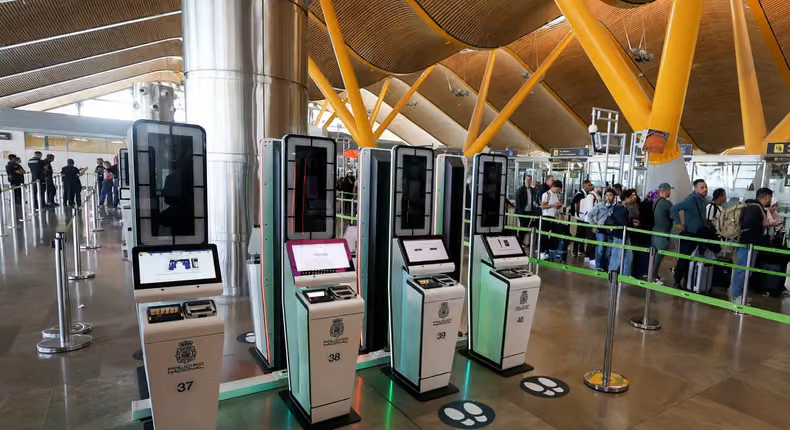
For African tourists, students, business travellers and people visiting relatives, the practical effect is that border processing may become more intensive, particularly for passengers registering in the system for the first time. Travellers may be required to provide biometric information at a self-service kiosk or directly to a border officer before being cleared to enter the participating European area.
The Entry/Exit System, or EES, became fully operational on April 10, 2026, replacing routine passport stamping for affected travellers. According to the European Commission, the automated system registers a traveller’s name, travel-document information, fingerprints, facial image and the date and location of entry and exit, while also recording refusals of entry.
The system is intended to make it easier for European authorities to identify people who remain beyond their authorised stay and detect travellers using false or forged documents. It also supports automated border gates and self-service facilities where suitable equipment is available, meaning the longer-term goal is greater automation even though the transition can initially create additional processing time.
Short-stay visitors are generally permitted to remain in the participating area for up to 90 days within any 180-day period, unless their specific immigration status provides otherwise. The EES does not replace a Schengen visa, so African nationals who require a visa must still secure one before travelling even though their border movements will also be recorded electronically.
Many African travellers will already have submitted fingerprints while applying for a Schengen visa, but that does not automatically exempt them from EES registration at the border. Previous biometric submissions may affect which information needs to be collected again, while subsequent journeys should normally become faster because officials can compare the traveller’s passport and facial image against an existing digital record.
The system is not targeted specifically at Africans. It applies more broadly to eligible short-stay nationals from outside the European Union, including both travellers who need visas and those who enjoy visa-free access, making it part of a wider effort to digitise Europe’s external border controls.
For African travellers, however, the operational consequences could be particularly important because many journeys into Europe involve long-haul flights and onward connections through major hubs. Additional minutes spent at immigration can become significant when several international flights arrive simultaneously, particularly if kiosks malfunction, passengers are unfamiliar with the procedure or airports have limited processing capacity.
That explains concerns raised by airlines and travel organisations about the risk of congestion. Industry groups have argued that full biometric processing can create bottlenecks during peak periods, and reports indicate that some countries, including France, continue to experience technical challenges at certain entry points.
Implementation is therefore unlikely to be completely uniform despite the expiry of the temporary flexibility. Individual airports may manage queues differently and technical problems could still affect how thoroughly procedures are applied at particular borders, meaning travellers should not assume that an experience at one European airport will necessarily be replicated at another.
The wider economic implications extend beyond immigration control. Europe remains a major destination for African business travel, education, tourism and diaspora-linked visits, so border-processing delays can affect airline schedules, connecting flights, airport operations and the overall attractiveness of particular transit hubs.
For travellers, the safest approach is to prepare for the full biometric process rather than relying on the lighter checks they may have experienced previously. Arriving with adequate connection time, ensuring travel documents are readily available and following airport instructions around kiosks and border-control procedures could become increasingly important as enforcement becomes more consistent.
Europe’s shift away from manual passport stamping also reflects a broader transformation in international mobility. Borders are increasingly becoming data systems in which identity, travel history and immigration compliance are checked electronically, reducing reliance on physical stamps but increasing the importance of biometric infrastructure and interoperable databases.
For African travellers, the end of temporary EES flexibility therefore marks more than an administrative change. It signals that entry into much of Europe is moving decisively towards a biometric-first model in which fingerprints, facial recognition and digital travel records are central to border control, with the immediate trade-off likely to be tighter verification in exchange for the promise of faster and more automated processing over time.

