

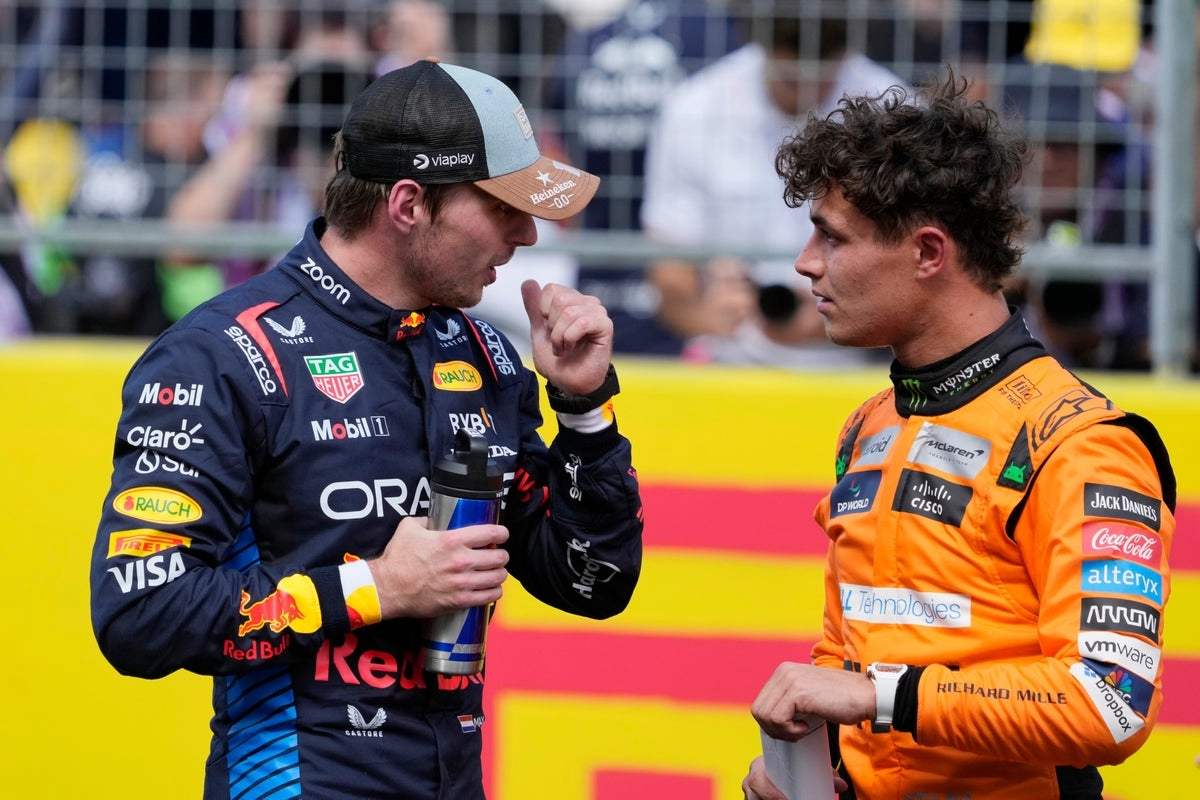

- F1 Driver Market Could Still Erupt Despite Verstappen and Norris Locking in Futures To 2030
Formula 1’s driver market appears to have entered a period of relative stability after Max Verstappen and Lando Norris committed their long-term futures to Red Bull and McLaren, but several unresolved competitive and contractual pressures could still trigger another major reshuffle within the next two seasons.
Verstappen ended months of speculation by extending his Red Bull contract until at least the end of 2030, while reigning world champion Norris followed by signing a McLaren extension through the same season, with options to continue beyond that date.
On the surface, those deals remove two of the most valuable drivers from the immediate market.
Mercedes also appears committed to championship leader Kimi Antonelli, while George Russell has repeatedly expressed his desire to remain with the team. Ferrari extended Charles Leclerc’s deal in June, and Lewis Hamilton has indicated that retirement is not immediately on his agenda.
That leaves the line-ups of Formula 1’s established leading teams looking unusually settled.
One of the biggest potential sources of movement is the growing internal pressure on drivers who risk becoming regarded as secondary figures within elite teams.
At McLaren, Oscar Piastri faces the challenge of re-establishing himself alongside Norris after the Briton beat him to the 2025 world championship and adapted more quickly to Formula 1’s new-generation 2026 cars.
At Mercedes, Russell entered the season among the championship favourites but has been outperformed by Antonelli, whose rapid progress has reinforced his position as one of the sport’s most important long-term assets.
Neither Russell nor Piastri is likely to accept being permanently cast as a second driver.
Both will believe they can reverse the competitive balance within their teams.
But if either continues to be consistently beaten over the next 12 to 18 months, the calculation could change.
Formula 1 careers are relatively short, and elite drivers ultimately require more than a competitive car. They need a realistic route to becoming the team’s championship focal point.
A driver who believes that path has become blocked may begin to view a move as the stronger long-term option, even if the current team remains capable of winning races.
That dynamic could become one of the most important forces shaping the next phase of the driver market.
Hamilton’s future creates another potentially significant opening. The seven-time world champion has repeatedly indicated that he intends to continue racing, but at 41, the question of how much longer he remains in Formula 1 inevitably hangs over Ferrari’s medium-term planning.
Hamilton is understood to have an option that could keep him at Ferrari through the end of 2028, when he would be approaching his 44th birthday.
Fernando Alonso’s continued presence on the grid at 45 demonstrates that elite drivers can remain competitive well into their forties.
But such longevity remains unusual.
If Hamilton were to retire at the end of 2028 or earlier one of Formula 1’s most coveted seats would immediately become available.
The British driver remains part of Ferrari’s junior structure while racing for Haas, giving Ferrari an established pathway if it chooses to promote from within.
But a vacant Ferrari seat would almost certainly attract interest from many of the leading drivers on the grid. That could produce a chain reaction in which one move creates vacancies elsewhere.
The Verstappen situation also remains more intriguing than his 2030 contract might initially suggest.
Red Bull has secured the four-time world champion’s signature, ending speculation over an immediate switch to Mercedes or McLaren.
But neither Verstappen nor Red Bull has confirmed whether the new agreement contains performance-related exit clauses similar to those that generated uncertainty around his previous contract.
That matters because contracts in Formula 1 do not always eliminate movement. Competitive performance often determines whether long-term agreements remain as stable as they appear.
Red Bull currently trails Mercedes, Ferrari and McLaren, and Verstappen is unlikely to be satisfied indefinitely if the team cannot return to championship contention.
The new contract gives Red Bull time. It does not remove the performance obligation. If the Milton Keynes-based team remains off the pace through 2027, speculation over Verstappen’s future could return ahead of the 2028 season.
Mercedes and McLaren have already demonstrated interest in him. Verstappen’s camp held discussions with McLaren earlier this year, while Mercedes team principal Toto Wolff has previously explored the possibility of bringing the Dutchman to the Silver Arrows.
A future Ferrari vacancy could create an additional option. That means the most important variable in Verstappen’s future may no longer be his contract expiry date.
It may be whether Red Bull can build a car capable of convincing him that another world championship remains achievable.
The arrival of the 2026 regulations has intensified that performance battle. New chassis and power-unit rules were widely viewed as an opportunity for teams outside the established leaders to alter Formula 1’s competitive hierarchy.
So far, the leading four teams have retained their advantage. Aston Martin was among the teams expected to benefit most from the regulations, particularly following the arrival of Adrian Newey and its works partnership with Honda.
Instead, the team has struggled, while Honda’s power unit has yet to deliver the performance required to bring Aston Martin consistently into the leading group.
If Honda improves significantly and Newey produces a chassis capable of challenging for victories, Aston Martin could become an additional destination for drivers currently concentrated within Formula 1’s strongest teams.
The sport’s current driver structure is partly stable because there are only a limited number of cars regarded as realistic championship-winning options.
Mercedes, McLaren, Ferrari and Red Bull occupy most of those seats. Add another genuine contender and the bargaining power of drivers immediately changes.
A driver frustrated by internal hierarchy at McLaren or Mercedes would suddenly have an alternative that does not require accepting a less competitive car.
The same applies to Verstappen if Red Bull’s performance does not recover. That is why Formula 1’s driver market cannot be assessed through contract lengths alone.
Competitive hierarchy, team-mate performance, retirement decisions and the emergence of new front-running teams can all make supposedly secure line-ups unstable.
For now, Norris looks firmly embedded at McLaren after extending his relationship with the team that has carried him through his entire Formula 1 career and delivered his first world championship.
Verstappen has similarly given Red Bull another opportunity to demonstrate that it can return him to regular title contention. Antonelli appears central to Mercedes’ long-term plans, while Leclerc remains tied to Ferrari.
But underneath that stability sit several pressure points.
Piastri must show that he can challenge Norris consistently.
Russell must respond to Antonelli’s emergence.
Red Bull must convince Verstappen that its competitive decline is temporary.
Hamilton must eventually decide how long he wants to continue.
And Aston Martin must prove whether its enormous investment can finally create another destination for elite drivers.
Any one of those developments could destabilise the market. Several occurring at the same time could transform it.
The major contracts signed this summer may therefore have postponed Formula 1’s next great driver-market battle rather than eliminated it. The biggest names are locked in on paper. What happens on the track over the next 18 months will determine how secure those contracts really are.

