


- Ferrari Must Set Clear Limits After Hamilton and Leclerc Collide Again
Ferrari’s latest clash between Lewis Hamilton and Charles Leclerc has revived a question the team has yet to settle: how much freedom should its drivers have to race each other when the team’s wider ambitions are at stake?
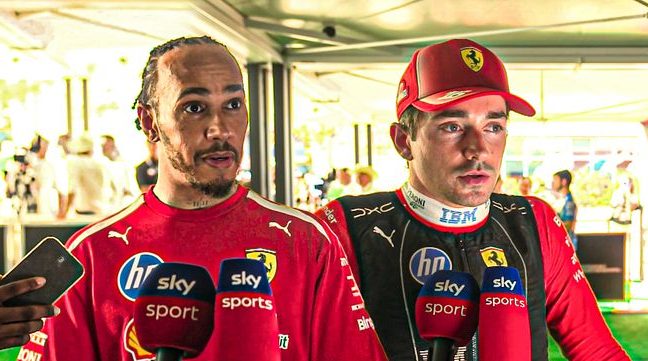
The opening-lap fight at the Mexico City Grand Prix ended with Leclerc penalised and Max Verstappen taking advantage of Ferrari’s internal contest to win. Hamilton called for “serious talks” afterwards. Ahead of this weekend’s Sao Paulo Grand Prix, both drivers have met team principal Frederic Vasseur, but the substance of those discussions remains private.
The incident matters because it is not an isolated disagreement. Hamilton and Leclerc have raced as Ferrari team-mates since 2025, and their close pace has repeatedly put them on the same piece of track.
Their battles have produced exciting racing, but also moments that threaten to turn a contest between two drivers into a loss for the team.
Former Formula One strategist Bernie Collins argues Ferrari needs rules that carry consequences. A private discussion or an informal promise may not be enough when drivers are making decisions at speed, under pressure and with a podium or victory in reach.
“There needs to be some sort of repercussion,” she said, proposing measured penalties such as losing a qualifying preference at the next race.
That distinction is important. Ferrari does not necessarily need to prohibit its drivers from competing. It needs to make clear what conduct is acceptable, how the drivers should handle close wheel-to-wheel situations and what follows if either crosses an agreed line.
The team has precedent to work with. Hamilton and Leclerc fought closely at the Chinese Grand Prix earlier this season, even making brief tyre-to-tyre contact. Hamilton described that contest as “the best racing I’ve ever experienced in Formula 1”. The episode showed that close competition between team-mates can be thrilling without becoming a crisis.
But their Monza encounter in September was more contentious. They went side by side into the first chicane, Hamilton ran through the gravel on the exit and Leclerc left little room.
Hamilton then sought “clearer rules of engagement”, while Leclerc later acknowledged: “I didn’t behave the way I should have.” Mexico has made the question harder to postpone.
Ferrari’s challenge is not simply to decide which driver was more at fault in Mexico. It must identify the team’s own failure to establish expectations before the cars left the grid.
Vasseur said the drivers had not shown enough respect in their battle, but did not assign blame to either. That may preserve room for reconciliation, yet it leaves the operational issue unresolved: what should happen next time?
For a team, the cost of a collision or compromised race can extend well beyond the two drivers. Engineers, strategists and mechanics have spent months preparing a car capable of competing at the front.
A single first-lap dispute can undo that work and hand an advantage to rivals. Martin Brundle noted that the drivers are the final link in a much larger chain, while also recognising how difficult it is to restrain a racer when an opportunity opens.
Ferrari must therefore balance two priorities. Excessive intervention could undermine the competitive instincts that make elite drivers successful.
But leaving every decision to the drivers risks a repeat of Mexico, where an internal fight allowed a rival to benefit. Team orders imposed too early or too often could also damage trust; rules applied inconsistently could do more harm.
A graduated system would give Ferrari a middle path. The team could define standards for overtaking, space, contact and the use of strategic instructions. A first breach might bring a warning or a disadvantage in qualifying priority.
Repeated or dangerous conduct could prompt stronger action. The point would not be punishment for its own sake. It would be to make the cost of ignoring an agreement clear before the drivers are back in their cars.
The rules must apply to both drivers. Chandhok has argued that Leclerc may need to take a calmer approach when racing his team-mate, but a policy aimed at only one driver would be difficult to defend and could intensify tensions. Hamilton, despite his experience of clearer guidelines at Mercedes, would also have to accept the same boundaries. Consistency will matter more than the severity of any single penalty.
There is a human complication: drivers are competitive by design, and a team-mate is both colleague and direct rival.
Brundle’s point is that the team operates through collective effort while the sport measures and rewards individuals. That tension cannot be removed. Ferrari can only manage it by setting expectations that withstand the heat of a race.
The coming Sao Paulo weekend gives the team an immediate test of whether its conversations have produced something concrete. The drivers are due to face the media in Brazil, but public assurances alone will not settle the issue. What matters is whether Ferrari has agreed a usable framework before the next start, and whether both drivers believe it is fair.
If Ferrari does not act, another flashpoint is plausible. The drivers are closely matched, the stakes are high and the incentives to seize a gap remain powerful.
Collins and Brundle both suggest that incidents between team-mates are part of racing’s recurring risks. Ferrari cannot prevent every close call, but it can decide how its drivers are expected to handle one.
The central test for Vasseur is whether Ferrari can preserve the rivalry’s sporting value without allowing it to compromise the team’s results.
The answer is unlikely to be a blanket ban on fighting. It is more likely to depend on explicit rules, consistent enforcement and a shared understanding that a driver’s freedom to race ends where avoidable damage to the team begins.
Mexico has made the price of ambiguity visible. Ferrari’s next step should be to turn its private talks into a clear agreement, before the next battle on track forces the team to improvise again.

