


- FIA Grants Mercedes Extra Engine Upgrades Despite Rivals’ Complaints Over 2026 Performance Gap
Formula 1’s new engine-equalisation framework has come under fresh scrutiny after the FIA confirmed that Mercedes is entitled to additional power-unit development opportunities, despite the manufacturer’s strong competitive record and objections from rival teams.
The decision was made under Formula 1’s Additional Development and Upgrade Opportunities, or ADUO, system, which was introduced as part of the 2026 power-unit regulations to help manufacturers close significant performance gaps and prevent one supplier from gaining a lasting technical advantage.
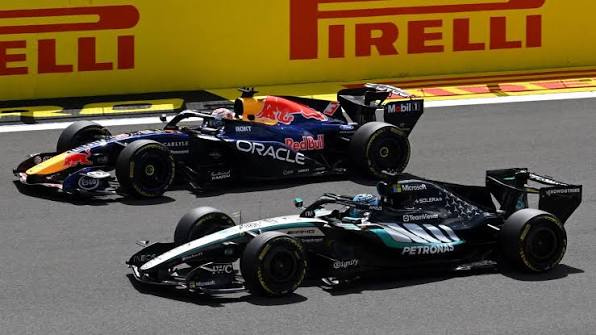
Under the FIA’s first assessment period, Mercedes was judged to be between 2.00% and 4.00% behind the benchmark power unit, identified as Red Bull’s.
That classification gives Mercedes one additional engine homologation in 2026 and another in 2027, alongside expanded dyno-testing allowances and additional cost-cap headroom linked to the development programme.
The ruling has become controversial because Mercedes had won the first six grands prix of the season, creating an apparent disconnect between on-track results and the FIA’s technical assessment of engine performance.
That discrepancy has prompted questions from rivals over whether the ADUO methodology is measuring true competitive disadvantage or simply isolated power-unit parameters that do not fully capture the performance of a complete Formula 1 car.
ADUO is designed to help weaker manufacturers catch up. Yet Mercedes has already demonstrated race-winning competitiveness.
That has led rivals to question whether a manufacturer capable of dominating the early part of the season should also receive additional development rights.
The FIA’s position, however, is based on measured engine performance rather than championship results.
Under the first review, Red Bull was deemed the benchmark manufacturer. Mercedes fell within the 2.00% to 4.00% deficit band, while Ferrari, Audi and Honda were judged to be more than 4.00% behind.
As a result, Ferrari, Audi and Honda were each granted two additional homologation opportunities in both 2026 and 2027.
The distinction is important because the FIA is not assessing which team has the fastest overall car. It is assessing the relative performance of the power units under a specific technical framework.
A strong chassis, aerodynamics package, tyre management or operational execution can therefore allow a team to win races even if its engine is not technically rated as the benchmark.
Red Bull’s Max Verstappen was among those to question how Mercedes could qualify for additional development opportunities given its early-season competitiveness.
His criticism reflects a broader concern that the equalisation mechanism may produce unintended consequences.
If a manufacturer with a highly competitive package is still permitted extra development because its power unit narrowly falls below the FIA benchmark, it could potentially strengthen an already successful team.
That raises a governance question for Formula 1: should equalisation be based purely on isolated engine measurements, or should overall competitive performance also be considered?
Mercedes team principal Toto Wolff added another layer to the debate by later saying that Mercedes had “the most powerful power unit”.
That comment appeared to sit awkwardly alongside the FIA’s technical conclusion that Mercedes remained behind Red Bull by between 2.00% and 4.00%.
The contradiction has fuelled scepticism over how the performance calculations are being made and how accurately they reflect real-world conditions.
Under the FIA methodology, Red Bull is the benchmark against which other manufacturers are measured.
Yet that does not mean Red Bull has necessarily been the strongest team on track.
The gap between engine performance and total car performance is critical.
Formula 1 performance is the product of multiple systems working together: aerodynamics, chassis efficiency, suspension behaviour, tyre usage, energy deployment, reliability and race operations.
A power-unit benchmark therefore does not automatically translate into championship dominance.
That distinction explains why Red Bull can be rated as the strongest engine supplier while Mercedes remains more successful in race results.
For Red Bull, however, the system offers little upside. As the benchmark, it receives no additional development allowances under ADUO, while rivals are permitted extra homologations and testing.
This means the team judged to have the strongest engine effectively becomes the reference point others are allowed to chase.
The FIA’s broader policy goal is to prevent the 2026 engine regulations from creating long-term performance disparities. Formula 1 has previously experienced eras in which one power-unit manufacturer established a significant advantage that took rivals years to close.
The ADUO system attempts to prevent a repeat by creating a structured mechanism for additional development where measurable gaps emerge.
In theory, that should improve competitive balance. But the Mercedes case exposes the difficulty of designing such a framework.
If the threshold is too generous, already competitive manufacturers may receive an additional advantage.
If it is too restrictive, genuinely underperforming suppliers may be unable to recover.
The credibility of the system therefore, depends heavily on how accurately the FIA measures performance and how transparently it explains its methodology.
The first assessment also granted Ferrari, Audi and Honda greater development freedom than Mercedes.
Each was judged to be more than 4.00% behind the benchmark and therefore qualified for two additional homologation opportunities in 2026 and two more in 2027.
That potentially gives the three manufacturers significant scope to improve their power units over the next two seasons.
Mercedes, by comparison, has one additional homologation opportunity available in each year.
The second assessment period did not produce further development allowances for any manufacturer.
That suggests the performance gaps had either narrowed or remained within the limits that prevented additional concessions.
Mercedes has not yet used its first authorised 2026 upgrade, while Ferrari, Audi and Honda are understood to have already deployed one of their available homologations.
That means Mercedes still holds an important development option in reserve.
For Mercedes, the decision provides strategic flexibility. An additional homologation allows the manufacturer to introduce meaningful changes to its power unit outside the normal development restrictions.
That could become increasingly valuable as the season develops and teams identify weaknesses in reliability, energy deployment, combustion efficiency or electrical systems.
The corresponding increase in dyno time and cost-cap allowance also gives Mercedes more room to test and refine those changes.
If Mercedes is already winning races before using the additional opportunity, rivals will inevitably worry about what could happen if the upgrade delivers a meaningful performance gain. That is why the issue extends beyond technical regulation. It directly affects competitive confidence.
For Red Bull, the decision presents the opposite strategic challenge. As the benchmark manufacturer, it cannot use ADUO to expand development in the same way.
Instead, it must rely on the development scope available within the standard regulations while watching rivals receive additional opportunities to close the gap.
The system therefore deliberately disadvantages the benchmark in order to promote convergence.
That may be defensible from a sporting perspective, but it becomes harder to justify politically when the benchmark manufacturer is not dominating races.
Red Bull could reasonably argue that it is being penalised for an engine advantage that has not translated into equivalent overall performance.
The controversy ultimately places the FIA’s methodology under examination.
Formula 1’s 2026 regulations were designed not only to introduce a new generation of power units but also to produce closer competition.
ADUO is central to that ambition.
Yet the Mercedes case demonstrates how difficult it is to separate technical equality from sporting equality.
A manufacturer can have an engine classified as weaker while operating a faster overall car.
A rival can have the benchmark power unit while struggling to convert that advantage into race victories.
The system therefore depends on a narrow technical definition of performance rather than the competitive picture visible to fans.
That may be scientifically defensible, but it is also harder to explain.
For the FIA, the challenge will be to demonstrate that the system is robust enough to encourage convergence without distorting competition.
For Mercedes, the ruling offers an additional development opportunity that could strengthen an already formidable package.
For Red Bull, it means defending its benchmark position while rivals receive greater scope to improve.
And for Formula 1 as a whole, the controversy has created an early test of whether the sport’s new engine regulations can deliver the competitive balance they were designed to achieve.

