

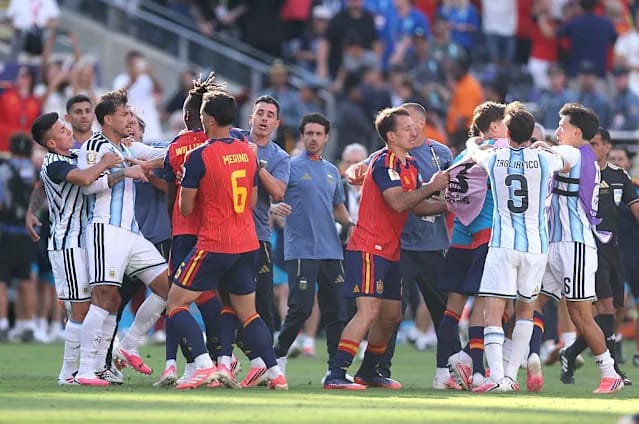

- FIFA Opens Investigation Into Fiery Spain-Argentina Brawl After World Cup Final
The drama of the 2026 FIFA World Cup final did not end with Ferran Torres’ extra-time winner. Less than 24 hours after Spain lifted the trophy in East Rutherford, New Jersey, FIFA confirmed it has launched a formal investigation into the post-match brawl that marred the conclusion of football’s biggest event.
World football’s governing body has appointed a disciplinary and ethics prosecutor to examine the ugly scenes that unfolded immediately after the final whistle following Spain’s 1-0 victory over Argentina. The investigation will determine whether players or officials from either side breached FIFA’s disciplinary code and whether further sanctions are warranted.
The ill-tempered ending overshadowed what had been a historic night for Spain, who claimed their second FIFA World Cup title thanks to Torres’ decisive strike in the 106th minute. The Barcelona forward came off the bench to score the only goal of the contest, ending Argentina’s hopes of retaining the trophy they won in Qatar four years earlier.
Tempers had been simmering throughout a fiercely contested final. Argentina, frustrated by Spain’s dominance in possession and their inability to create meaningful chances, resorted to a series of physical challenges as the match wore on. Midfielder Enzo Fernández was eventually dismissed in the 93rd minute after receiving a second yellow card, leaving Lionel Scaloni’s side to play extra time with ten men.
Despite their numerical disadvantage, Argentina defended resolutely until Torres finally broke the deadlock in the second period of extra time, sending the Spanish bench into wild celebrations.
However, emotions boiled over once referee Slavko Vinčić blew the final whistle.
Television footage showed Argentina midfielder Leandro Paredes confronting several Spain players, including Eric García and Gavi, before the exchange escalated into a mass confrontation involving players from both teams. Shoving and heated arguments quickly spread across the pitch, forcing teammates, coaching staff and match officials to intervene.
Argentina coach Lionel Scaloni was seen attempting to pull his players away from the melee as security personnel and officials worked to restore order.
The confrontation added another controversial chapter to a final already marked by aggressive challenges, persistent protests and disciplinary issues. Argentina finished the match without registering a single shot on target, while Spain controlled possession for long periods and repeatedly tested goalkeeper Emiliano Martínez before finally finding the breakthrough.
The post-match scenes contrasted sharply with Spain’s celebrations, as captain Rodri and his teammates lifted the World Cup trophy before beginning victory festivities that continued in Madrid on Monday. Thousands of supporters lined the Spanish capital’s streets to welcome the champions during an open-top bus parade, with players proudly displaying the trophy under banners proclaiming them “Kings of the World.”
Meanwhile, the defeat marked a heartbreaking end to Lionel Messi’s World Cup career. The 39-year-old failed to score in the final and was left in tears during the medal ceremony after seeing his dream of winning a second World Cup come to an end.
FIFA has not disclosed how long the disciplinary investigation will take, nor has it identified which individuals could face charges. The governing body is expected to review official match reports, broadcast footage and additional video evidence before deciding whether players, coaches or team officials should receive suspensions, fines or other disciplinary measures.
The investigation ensures that, even after Spain’s historic triumph and the close of the expanded 2026 FIFA World Cup, the tournament continues to generate headlines—this time for events that unfolded after the final whistle rather than the football itself.

