

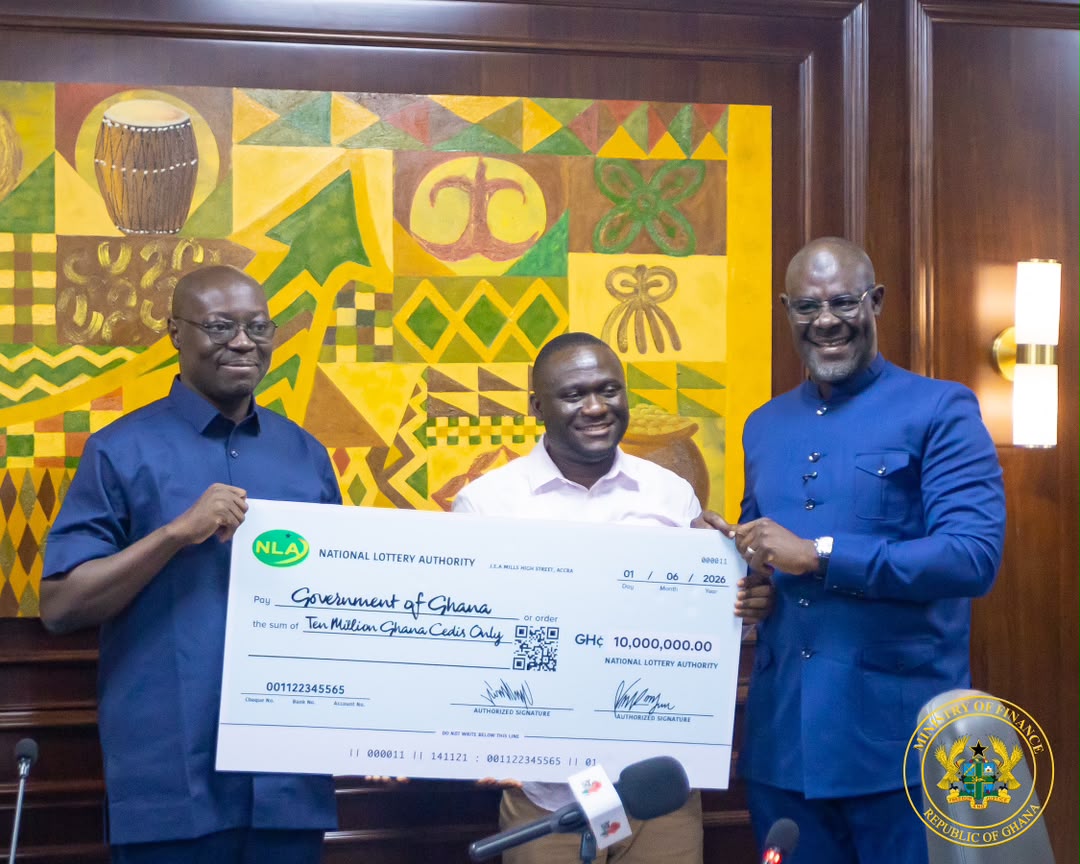

- Finance Minister Demands Higher NLA Returns After GH¢10m Dividend Presentation
Finance Minister Dr Cassiel Ato Forson has demanded substantially higher returns from the National Lottery Authority after the state-owned operator presented a GH¢10m dividend, its first contribution to the Ministry of Finance in several years.
Dr Forson described the payment as a welcome resumption of the NLA’s dividend obligations but said it fell short of the returns the state should expect from a national lottery monopoly.
“The taxpayer deserves more than GH¢10m from NLA, but this is a good step,” he said while receiving the payment from an NLA delegation led by board chairman Frederick Amissah and Director-General Mohammed Abdul-Salam.
The dividend marks the restoration of a payment practice that stopped after 2017. Before then, the Authority had made annual contributions to the government.
Its resumption raises a broader question about the commercial performance of state-owned enterprises and whether their revenues are being converted into meaningful returns for taxpayers.
For the NLA, the issue is not simply whether it has paid a dividend. It is whether GH¢10m represents an appropriate return after accounting for ticket sales, operating expenses, prize payments and revenues ceded to private partners.
“Let this not be symbolic. Ghana deserves better,” Dr Forson said.
The Finance Ministry is working with the NLA and the Office of the Attorney-General to review agreements that the government believes have restricted the Authority’s returns.
Dr Forson said the exercise would be completed within October.
According to the minister, some contracts transferred an “unreasonable” share of the NLA’s revenue to other entities, reducing the amount available to the state.
The disclosure shifts attention from the headline dividend to the contractual structure underpinning the lottery business.
If private suppliers, platform providers, agents or commercial partners receive a disproportionate share of revenues, the NLA could record high ticket sales while generating only limited distributable profit.
A proper assessment must therefore examine the full revenue chain: how much players spend, how much is paid out as prizes, what private intermediaries receive, the Authority’s operating costs and the amount ultimately transferred to the state.
The contract review could improve public revenue if it eliminates excessive margins or renegotiates terms that no longer reflect the NLA’s commercial position.
But it must also respect valid contractual rights. Abrupt changes could expose the state to litigation or disrupt the technology and distribution systems on which lottery operations depend.
The strongest outcome would be a transparent restructuring based on value for money, measurable performance and a clear separation between essential commercial services and arrangements that unnecessarily dilute public returns.
Dr Forson also urged the NLA to concentrate on its statutory responsibilities and avoid activities outside its core mandate.
The instruction suggests that the Ministry is concerned not only about external contracts but also about how the Authority deploys its own resources.
For a commercially oriented public institution, mandate expansion can appear attractive. New projects, sponsorships and partnerships may increase visibility, but they can also divert management attention and funding from revenue generation, responsible gaming and regulatory enforcement.
The NLA occupies an unusual position because it operates commercial lottery activities while also carrying public responsibilities. It must generate revenue, protect players, enforce industry standards and prevent illegal operators from eroding the regulated market.
This dual role makes accountability particularly important. A private lottery company is primarily judged by profitability. The NLA must also demonstrate that its income is managed in the public interest.
Mr Amissah said the GH¢10m payment marked the beginning of reforms and improvements at the Authority.
“This is just the beginning of the reforms and improvements in NLA,” he said, assuring the government that the organisation would deliver stronger returns in subsequent years.
That commitment will need to be supported by clear financial targets.
The government should establish expected dividend levels based on audited profits rather than treating each payment as a discretionary contribution. The NLA should also disclose the factors determining its dividend, including whether earnings are being retained for investment or absorbed by contractual and operating costs.
Without such disclosure, the public cannot determine whether GH¢10m represents prudent financial management or a small transfer from a much larger revenue pool.
This is part of a wider challenge facing Ghana’s state-owned enterprises. Many control valuable assets, licences or commercial privileges but contribute little to the national budget. Others accumulate debt that eventually becomes a liability for the state.
A dividend policy tied to profitability, investment requirements and transparent performance benchmarks would help distinguish commercially viable institutions from those surviving on statutory advantages.
The NLA’s payment is therefore significant because it restores a broken obligation. But its greater importance lies in the questions it raises about the revenue Ghana has forgone since 2017 and the contractual arrangements that may have contributed to that loss.
The government’s October review will be judged by whether it produces better contracts, clearer accounts and materially larger transfers to the state.
As Dr Forson indicated, the GH¢10m cheque may be a useful beginning. It should not become the measure of success.

