

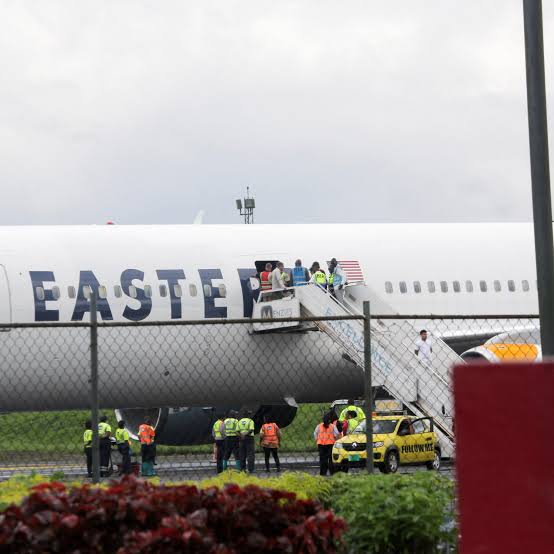

- Five US Deportees Diverted to Equatorial Guinea After Refusing to Disembark in Liberia
Five migrants the United States attempted to deport to Liberia were instead flown to Equatorial Guinea after refusing to leave the aircraft in Monrovia, exposing an early complication in one of the Trump administration’s largest third-country deportation arrangements in Africa.
The five to three Cuban men, one Brazilian man and one Cameroonian woman were among 20 deportees flown to Liberia this week under an agreement that could eventually see the West African country receive as many as 1,200 third-country nationals from the United States over the next year.
Only 15 of the deportees ultimately disembarked in Liberia, according to a Liberian official cited by Reuters. The remaining five refused to leave the plane and were subsequently taken to Malabo, the capital of Equatorial Guinea.
Sources familiar with the incident said the five were initially told they would be returned to the United States. Instead, the aircraft continued to Equatorial Guinea, where they were made to disembark.
The incident has drawn further attention to Washington’s expanding use of third-country deportations, under which migrants are removed to states other than their countries of nationality.
In many such cases, the deportees have obtained legal protection against removal to their home countries after US immigration judges determined that they could face torture, persecution or other serious harm if returned.
The five migrants are now being held alongside more than 30 other deportees previously sent by the Trump administration to Equatorial Guinea, according to Reuters.
The US State Department said it remained “unwavering in our commitment to end illegal and mass immigration and bolster America’s border security”.
Liberia announced its agreement with Washington earlier in the week, saying it would accept up to 1,200 deportees from third countries.
The arrangement is among the largest of a series of agreements the Trump administration has struck with governments in Africa and elsewhere as it intensifies its immigration enforcement programme.
The first flight arrived at Roberts International Airport outside Monrovia on August 20.
Liberian authorities had initially said 20 people were expected, predominantly nationals of Latin American countries including Venezuela and Cuba. The government has said deportees accepted under the arrangement would be received as “guests”, with the option to apply for asylum in Liberia or leave the country.
Immigration and human rights advocates have questioned whether transferring migrants to countries with which they have little or no connection adequately protects their legal rights, particularly where immigration courts have already determined that they cannot safely be returned to their countries of origin.
The Trump administration has increasingly used African states as partners in the policy.
Similar arrangements have involved countries including Rwanda, Uganda, Sierra Leone and Equatorial Guinea, part of a broader strategy aimed at expanding the number of destinations available for migrants whom US authorities say cannot readily be repatriated.
Liberia’s arrangement is particularly significant because of its proposed scale.
Human Rights First estimates that the Trump administration has reached third-country deportation arrangements with dozens of countries, while several African states have received groups of migrants under separate bilateral arrangements.
The financial dimension of such agreements has also attracted scrutiny. The United States awarded Liberia US$5 million this year for migration-management activities, although the Liberian government has rejected suggestions that accepting deportees amounted to a transactional exchange.
“The transfer of persons to Liberia is not a transaction with a quid pro quo,” Liberia’s Information Ministry said when the arrangement was announced, adding that the country had not demanded or received compensation in return for participating.
The government has instead characterised its participation as part of wider migration cooperation with Washington.
But the resistance by five members of the first group demonstrates the practical and legal challenges likely to accompany implementation.
Third-country removals differ substantially from conventional deportations because the destination state may have no previous connection with the migrant.
That creates questions around legal status, freedom of movement, asylum procedures, detention arrangements and eventual relocation or repatriation.
For Liberia, the programme could also become politically sensitive if the planned inflow of up to 1,200 deportees generates concerns over transparency, security, public expenditure or the government’s obligations towards those arriving.
The five migrants who resisted removal to Liberia were not returned to the United States, but instead transferred to a second African third country a sequence that is likely to intensify debate about the discretion available to US authorities when choosing destinations for deportees.
The episode therefore represents more than a logistical disruption to a single flight.
It illustrates the complexities behind Washington’s attempt to construct an international network of countries willing to receive migrants who cannot easily be returned home.
For Liberia, which has only begun implementing its agreement, the challenge will be demonstrating that the programme can operate transparently and within domestic and international legal safeguards.
For the United States, the immediate question is whether resistance such as that seen aboard the first Liberia flight becomes an isolated event or a recurring feature of a third-country deportation policy that is expanding rapidly across Africa.

