



- Five Years On, DBG Deepens Push for Long-Term Financing to Support Ghanaian Businesses
Development Bank Ghana has launched activities to commemorate its fifth anniversary, reaffirming its commitment to expanding access to long-term financing and supporting private sector-led economic transformation.
The Bank announced the milestone at a media launch held in Accra on Tuesday, June 16, 2026, ahead of a two-day anniversary celebration scheduled for November 16 and 17, 2026.
The commemoration will highlight DBG’s journey since its establishment in November 2021, its contribution to addressing financing gaps in the economy, and its future strategy for deepening support to businesses across Ghana.
DBG was set up as a development finance institution to provide long-term funding to partner financial institutions, enabling them to on-lend to businesses in key sectors of the economy.
Over the past five years, the Bank has focused on supporting enterprises in agriculture, manufacturing and services, sectors considered critical to job creation, productivity growth and economic resilience.
For many businesses in Ghana, access to patient capital remains one of the biggest barriers to expansion. Commercial bank lending is often short-term and expensive, making it difficult for small and medium-sized enterprises to invest in machinery, technology, working capital, processing capacity and market expansion.
DBG’s model is designed to respond to this challenge by working through partner financial institutions rather than lending directly to businesses.
Through this structure, the Bank provides wholesale funding to financial institutions, which then lend to eligible businesses under agreed development-focused terms.
The approach is intended to strengthen the capacity of the financial system to provide longer-term credit while improving access to finance for underserved segments of the market.
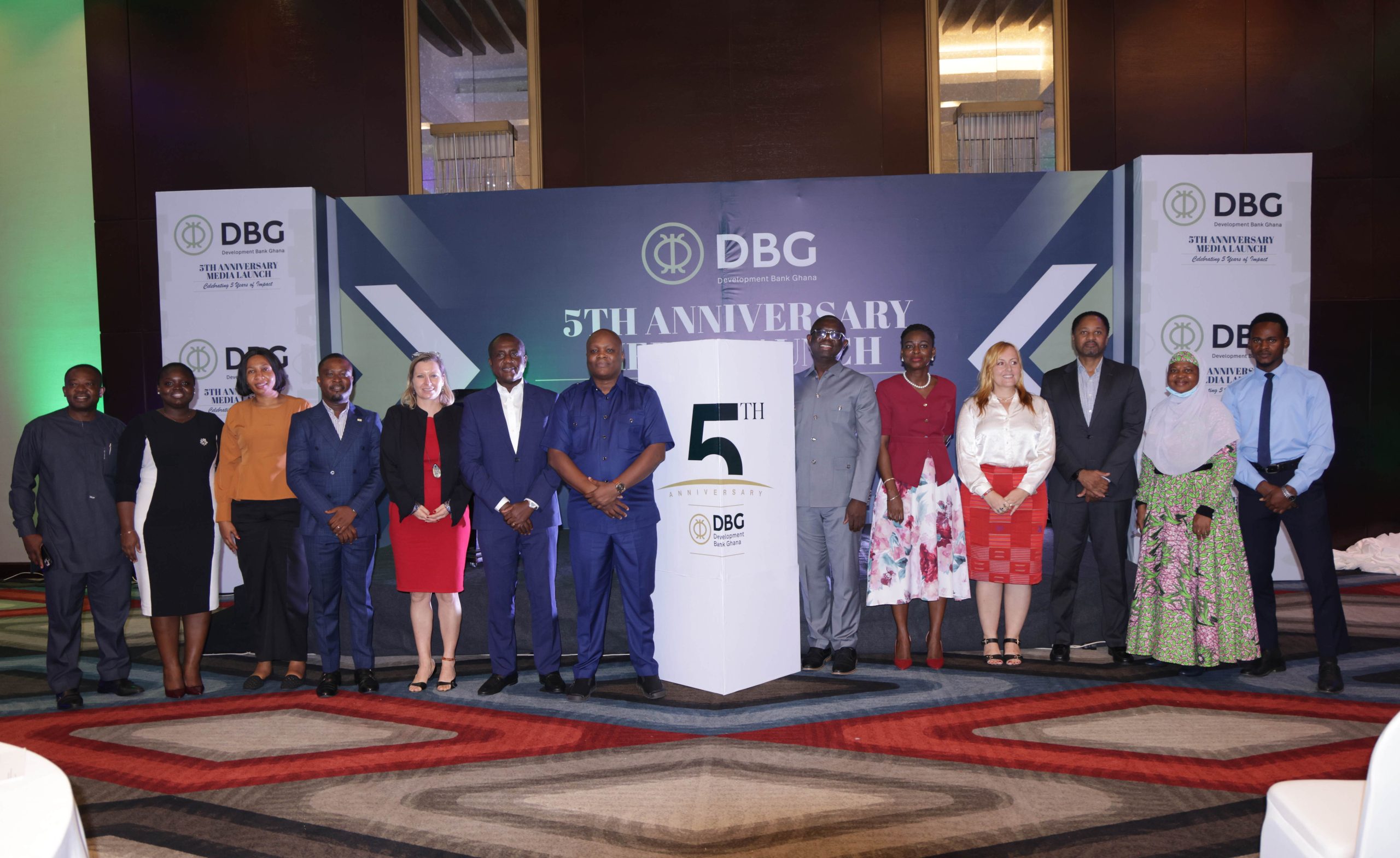
Speaking at the anniversary media launch, the Chief Executive Officer of DBG, Prof Randolph Nsor-Ambala, said the Bank’s work over the past five years has been anchored in sustainable and inclusive growth.
“At DBG, we are focused on enabling businesses to grow, scale, and contribute meaningfully to Ghana’s economic transformation,” he said.
“Our journey over the past five years reflects a strong commitment to impact and partnership.”
The anniversary launch also featured stories of entrepreneurs whose businesses have benefited from DBG-supported financing.
According to the Bank, these stories demonstrate how access to appropriate long-term funding can support business growth, improve productivity and create jobs.
DBG said it has continued to collaborate with financial institutions and development partners to expand access to credit, particularly for businesses that have historically struggled to secure suitable financing.
The Bank currently works with 21 partner financial institutions and five partner agencies spread across Ghana.
This growing network is expected to improve DBG’s reach and help channel funding to businesses across different regions and sectors.
The Bank’s support comes at a time when Ghana is seeking to strengthen the role of the private sector in economic recovery, industrialisation and job creation.
After years of macroeconomic pressure, including high inflation, currency volatility and tighter financing conditions, many businesses continue to face constraints in accessing affordable capital for growth.
Development finance has therefore become increasingly important in supporting enterprises that can drive production, exports, import substitution and employment.
DBG’s focus on agriculture, manufacturing and services aligns with Ghana’s broader development priorities, particularly the need to build productive capacity, support value addition and improve competitiveness.
In agriculture, long-term financing can help businesses invest in processing, storage, irrigation, mechanisation and value chain development.
In manufacturing, it can support acquisition of equipment, expansion of factory capacity, product development and improved distribution.
In services, access to finance can help businesses scale operations, adopt technology and improve market reach.
For policymakers, institutions such as DBG are expected to play a critical role in closing the financing gap that limits private sector growth.
While Ghana’s banking sector remains an important source of credit, many financial institutions are often cautious about longer-term lending because of liquidity, risk and balance sheet constraints.
DBG’s wholesale financing model seeks to reduce some of these constraints by providing funding through partner institutions with a development mandate.
The Bank said its fifth anniversary will not only celebrate past achievements, but also set the tone for its next phase of impact.
As part of its forward strategy, DBG aims to deepen its reach, strengthen partnerships and scale its support in priority sectors.
This is expected to include closer collaboration with financial institutions, development partners and public sector agencies to ensure that financing reaches businesses with strong growth potential.
The Bank’s next phase will be important because Ghana’s economic transformation agenda depends heavily on the ability of local enterprises to expand production, create jobs and compete regionally.
Access to long-term finance remains central to that ambition.
Without it, many businesses are forced to rely on short-term credit, retained earnings or informal financing, which limits their ability to make strategic investments.
DBG’s anniversary therefore comes at a significant moment for Ghana’s private sector.
The country is working to rebuild confidence, strengthen fiscal stability and create conditions for investment-led growth.
For businesses, the availability of patient capital could determine whether they survive, expand or remain constrained by high financing costs.
For the broader economy, stronger private sector financing could support industrial development, export growth and employment.
Prof Nsor-Ambala said DBG remains committed to working with its partners to deliver measurable impact and support businesses that contribute to Ghana’s economic transformation.
The Bank’s fifth anniversary will provide an opportunity to assess how far it has come and how it can deepen its contribution in the years ahead.

