

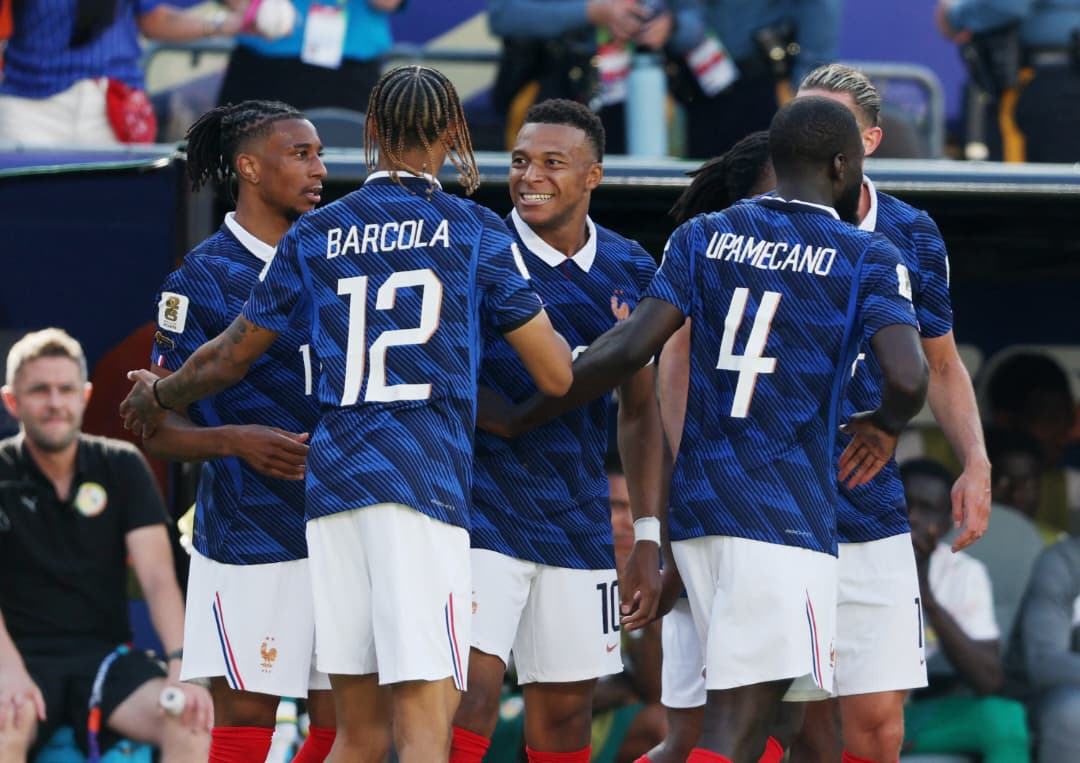

- France’s Golden Generation Faces Another Heartbreak as Zidane Era Beckons After World Cup Exit
France’s quest for a third FIFA World Cup title ended in bitter disappointment after a 2-0 semifinal defeat to Spain, bringing the curtain down on Didier Deschamps’ remarkable reign and paving the way for what is widely expected to be a new era under French legend Zinedine Zidane.
Les Bleus arrived in Dallas full of confidence after winning six consecutive matches and dreaming of a third straight World Cup final. Instead, they were comprehensively outplayed by a superb Spanish side that controlled possession, dictated the tempo and exposed France’s shortcomings on the biggest stage.
The defeat was particularly painful as it marked France’s third successive major semifinal loss to Spain, following disappointments at Euro 2024 and the UEFA Nations League. It also extended a frustrating run for one of the most talented generations in French football history.
Despite boasting a star-studded squad featuring captain Kylian Mbappé, Ousmane Dembélé, Michael Olise, Désiré Doué, Bradley Barcola and several other world-class talents, France failed to impose themselves when it mattered most.
Spain dominated both tactically and technically, while France struggled to create meaningful opportunities and committed too many unforced errors throughout the contest.
“We didn’t play the match we wanted to play, whether tactically or technically,” Mbappé admitted after the defeat.
“When you don’t do what you’re supposed to do in a World Cup semifinal, you don’t win.”
Substitute Rayan Cherki echoed his captain’s sentiments, insisting France’s downfall was self-inflicted rather than the result of external factors.
“We lost to ourselves. We didn’t lose because of the referee, and we didn’t lose to Spain,” Cherki said.
The defeat also signals the end of an extraordinary chapter in French football.
After Saturday’s third-place playoff, Didier Deschamps will officially conclude a 14-year spell in charge of the national team that transformed France into one of the world’s dominant football nations.
When Deschamps accepted the role in 2012, he inherited a fractured squad still recovering from the chaos of the 2010 FIFA World Cup, where player unrest and a training boycott plunged French football into crisis.
Over the next decade, he rebuilt the national team into a consistent global force, guiding France to the 2018 World Cup title, another World Cup final in 2022 and several deep runs in major international tournaments.
His pragmatic approach, built on discipline, defensive organisation and tournament management, delivered sustained success even if critics often argued it failed to maximise the immense attacking talent at his disposal.
Attention is now turning to Zinedine Zidane, who is widely expected to succeed Deschamps, although no official announcement has yet been made.
The former France captain and Real Madrid manager is regarded as the natural successor and will inherit one of the strongest player pools in international football.
His biggest challenge will not be finding talented footballers but building a tactical system capable of unlocking their collective potential on the biggest occasions.
There are encouraging signs for the future.
Michael Olise emerged as one of France’s brightest creative players during the tournament, while younger stars such as Désiré Doué and Bradley Barcola continued their development alongside established names.
With Mbappé still only 27 years old, much of this gifted generation should remain at its peak for UEFA Euro 2028 and the 2030 FIFA World Cup.
Yet the latest setback also serves as a reminder that talent alone guarantees nothing.
France lost the 2022 World Cup final on penalties and have now watched Spain eliminate them in three consecutive major tournaments, leaving another golden generation searching for the trophies many believe their ability deserves.
As one era comes to an end, another appears ready to begin.
The Deschamps years will be remembered for restoring France to the summit of world football and establishing a culture of consistently challenging for major honours. The task awaiting Zidane—should he take charge—will be to transform that immense individual talent into another world-beating team capable of converting potential into silverware rather than adding to a growing list of painful near misses.

