


- From Stability to Livelihoods: World Bank Says Ghana Must Make Recovery Work For Jobs
Ghana has made significant progress in restoring macroeconomic stability, but the recovery risks losing public meaning unless stronger growth is translated into quality employment, higher household incomes and wider improvements in living standards, the World Bank has warned.
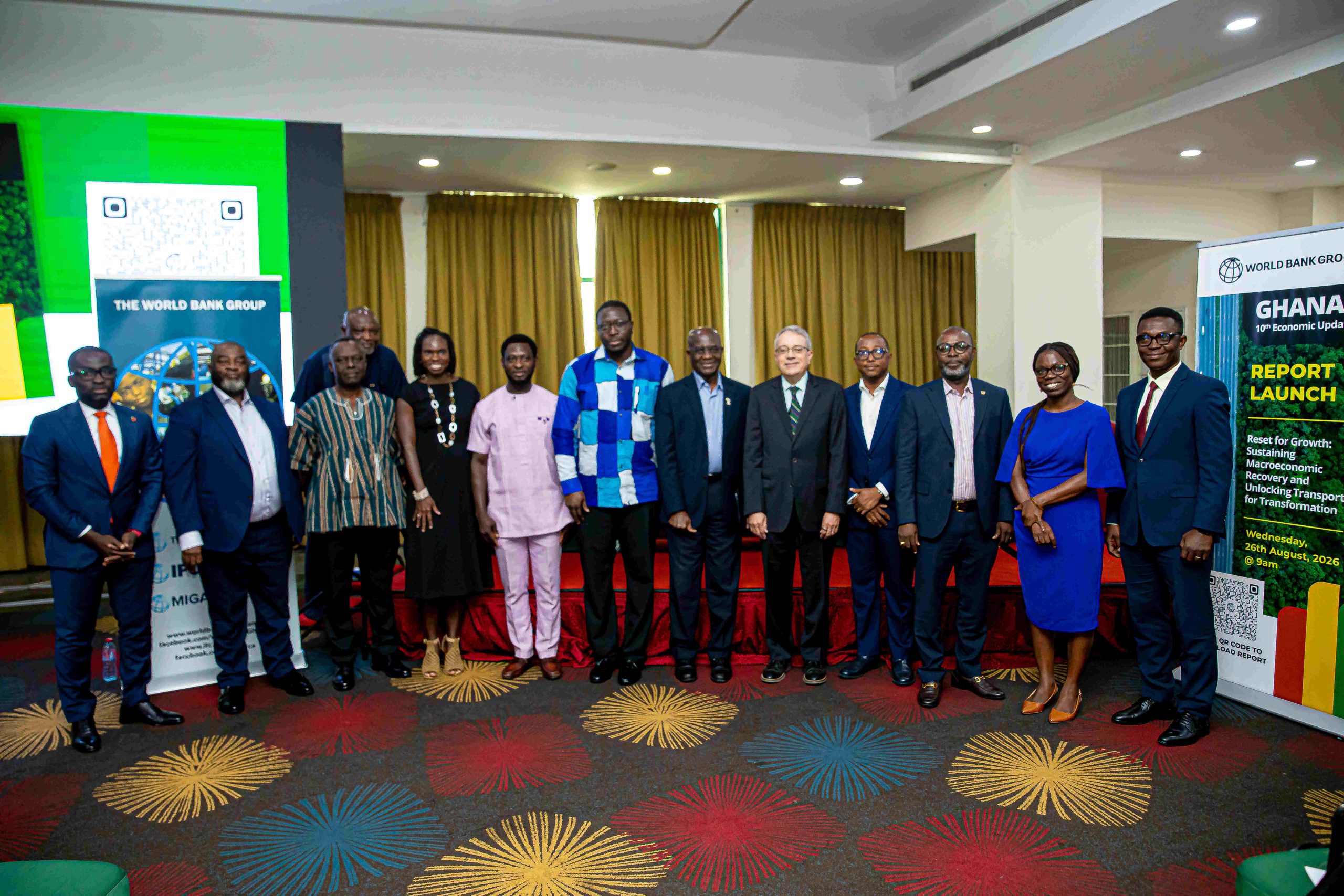
In its tenth Ghana Economic Update, Reset for Growth: Sustaining Macroeconomic Recovery and Unlocking Transport for Transformation, the Bank said the country has moved decisively away from the severe macroeconomic instability of recent years, with stronger growth, lower inflation, improved reserves and progress in debt restructuring.
Real gross domestic product expanded by 6.00% in 2025, supported principally by services and agriculture, while the fiscal position strengthened and the primary surplus exceeded programme targets. Public debt also declined substantially following progress with Ghana’s comprehensive debt restructuring.
But the World Bank says the next phase of economic management will be more difficult because stability by itself does not guarantee jobs.
Growth has not yet generated enough quality employment to absorb Ghana’s expanding working-age population, while poverty remains elevated in parts of the country. This creates a central accountability test for government: whether the improving macroeconomic indicators visible in official statistics can be converted into tangible improvements in the economic circumstances of households.
“Ghana has made important progress in restoring stability after a difficult period, but the next phase must be about making the recovery durable and more inclusive,” Robert Taliercio, World Bank Division Director for Ghana, Liberia and Sierra Leone, said.
The Bank argues that continued fiscal and monetary discipline will be critical, alongside stronger domestic revenue mobilisation and the protection of priority social and infrastructure expenditure.
Growth is projected to moderate to 4.80% in 2026 as some of the immediate post-crisis recovery effects fade and external pressures persist, before moving towards Ghana’s medium-term growth potential of around 5.00%.
Inflation is expected to remain within the Bank of Ghana’s target band, but the outlook assumes that monetary easing remains data-dependent and that external price shocks are carefully managed.
That qualification matters because Ghana remains exposed to developments it cannot control.
Commodity-price volatility, higher global energy and fertilizer costs, weaker growth among major trading partners and tighter international financing conditions could all place pressure on the recovery.
The challenge for policymakers is therefore to use the current period of relative stability to address structural constraints before the next external shock arrives.
The World Bank identifies transport as one of the most important of those constraints.
Roads carry more than 95.00% of Ghana’s passenger and freight traffic, making transport infrastructure central to almost every part of the economy. Farmers depend on roads to move produce to markets, manufacturers require reliable logistics to receive inputs and distribute goods, while workers depend on urban transport systems to access employment.
Yet the Bank identifies chronic under-maintenance, fragmented institutional governance, weak integration between different modes of transport and inadequate climate resilience as persistent barriers to productivity.
Akua Pokuaa Timpabi, World Bank Transport Specialist and co-author of the report, said transport must be viewed as part of Ghana’s growth, employment and inclusion agenda rather than merely as an infrastructure issue.
Better-maintained roads, improved rail and port connections, safer urban mobility and climate-resilient transport systems could reduce business costs, connect firms and farmers to markets and widen access to employment opportunities.
That creates an important link between Ghana’s infrastructure ambitions and its jobs challenge.
Government’s Big Push Infrastructure Programme could generate employment during construction, but its longer-term contribution to growth will depend on whether the resulting infrastructure lowers the cost of doing business and unlocks private investment after construction crews leave.
The World Bank identifies six priority areas for reform: sustainable financing for road maintenance, stronger coordination among transport institutions, revitalisation of rail freight along major trade corridors, treating road safety as an economic priority, integrating climate resilience into infrastructure planning and expanding digital logistics systems beyond Tema.
The emphasis on maintenance is particularly important because Ghana has historically invested heavily in constructing infrastructure without consistently providing resources to preserve it.
That creates a cycle in which public funds are used to build roads, those roads deteriorate because maintenance is deferred, and government later faces substantially higher rehabilitation costs.
For the Big Push to produce lasting economic returns, the Bank argues that new capital investment must therefore be accompanied by stronger maintenance systems, better project preparation, improved governance and credible financing arrangements.
This shifts the accountability benchmark from how much government spends to what that spending ultimately delivers.
A road project should not be judged solely by the amount invested or the number of kilometres constructed, but by whether it reduces travel times, lowers logistics costs, improves market access and supports productive employment.
A 6.00% growth rate may demonstrate that economic activity is expanding, but the durability of the recovery will increasingly be judged by whether businesses invest, workers find productive employment and households experience sustained improvements in purchasing power.
Tamoya Christie, World Bank Senior Economist and co-author of the report, said Ghana now has an opportunity to use its stabilisation gains to build a more diversified and employment-intensive economy.
Doing so will require reforms that preserve fiscal stability while removing obstacles to private-sector investment and market access. That is ultimately the more difficult phase of Ghana’s recovery.
Macroeconomic stabilisation was necessary to halt the crisis. But it was never the final objective.
The policy challenge now is to turn lower inflation, stronger reserves, improving public finances and renewed growth into an economy capable of producing enough quality jobs for a rapidly expanding workforce.
If Ghana succeeds, the current recovery could become the foundation for a more durable growth cycle.
If employment creation continues to lag behind headline economic performance, however, the country risks achieving stability in the national accounts without delivering a corresponding recovery in the lives of its citizens.

