


- Busia Legacy Must Produce Answers for Today’s Ghana – Napo
Dr Matthew Opoku Prempeh has called for Ghana’s political traditions to be judged less by nostalgia and partisan loyalty and more by the institutions they build, the opportunities they create and their capacity to solve the problems confronting citizens today.
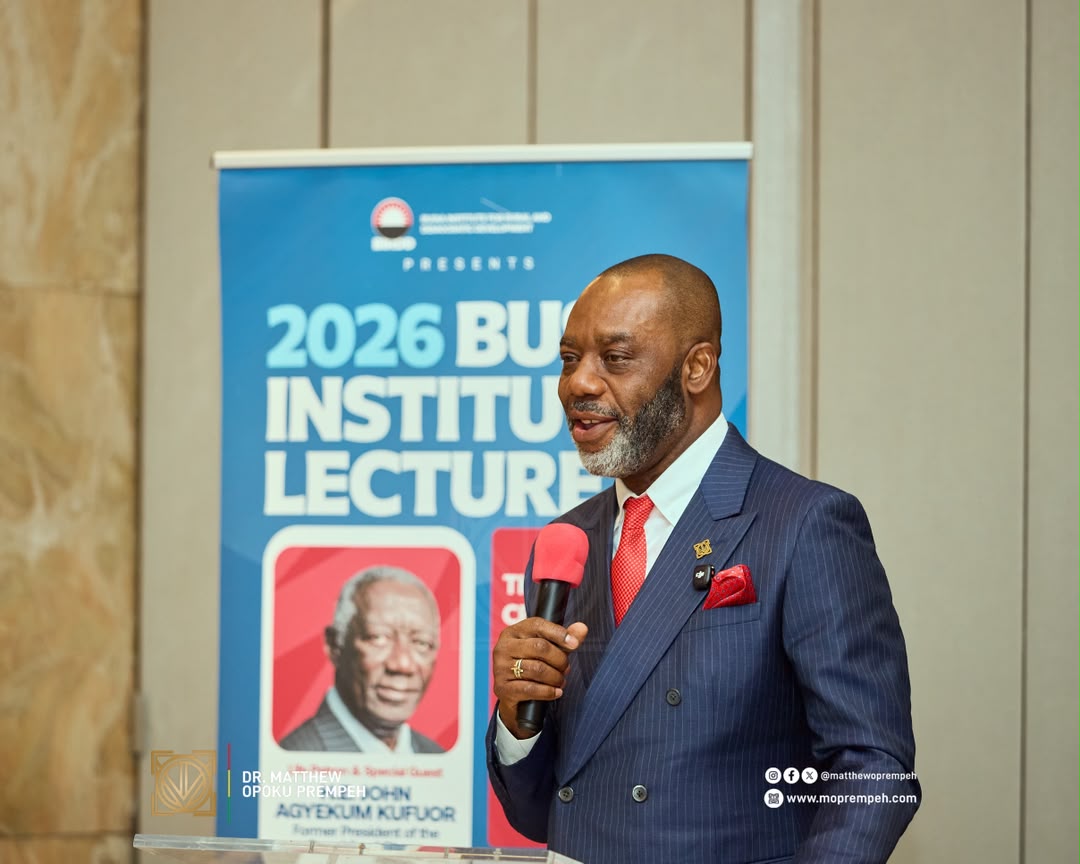
Delivering the keynote address at the 2026 Busia Institute Lecture in London, Dr Prempeh argued that political heritage has meaning only when inherited ideas continue to generate public value. He said neither admiration nor hostility towards a political tradition should substitute for an evidence-based assessment of how it governed, what it built and whether its principles remain relevant to a new generation.
“Belonging to a tradition does not oblige me to flatter it,” he told an audience of diplomats, Members of Parliament, Ghanaian professionals, members of the diaspora and other invited guests at the London Hilton on Park Lane on Sunday, August 9.
The lecture, held under the theme “Centre-Right Political Thought in Africa: The Ghanaian Experience,” marked the first edition of the Busia Institute Lecture outside Ghana. Dr Prempeh used the Second Republic and the administration of Professor Kofi Abrefa Busia as his principal case study, examining its constitutional philosophy, economic ambitions, development priorities and acknowledged shortcomings.
His central argument was that political traditions should not become museums of celebrated personalities. They must instead remain intellectually alive, capable of adapting their principles to changing economic, technological and social realities.
Dr Prempeh said the Busia administration should be remembered in part for restoring elected civilian government following military rule and operating within a constitutional system that recognised Parliament, judicial authority and restraints on executive power. He argued that these institutional choices deserved consideration alongside the government’s policy record.

He also rejected the proposition that the military overthrow of January 1972 could itself be treated as a legitimate judgement on the administration. In a constitutional democracy, he argued, governments should ultimately be judged through institutions, public accountability and the ballot box rather than military intervention.
Dr Prempeh said the continuing value of centre-right political thought in Ghana would depend on its ability to combine private enterprise with capable public institutions and ensure that economic opportunity extends beyond citizens who already possess capital, political influence or privileged access.
He pointed to rural development, education, indigenous enterprise and decentralisation under the Busia government as examples of attempts to translate political philosophy into practical policy. Markets, he argued, cannot operate effectively in a vacuum: the state still has a responsibility to provide infrastructure, predictable rules, skills and fair access to opportunity.
The distinction is particularly important outside Ghana’s major urban centres. Entrepreneurship may exist in rural and regional economies, but weak roads, unreliable infrastructure, inadequate education and limited access to finance can prevent talent from becoming productive economic activity.
For Dr Prempeh, that places a responsibility on the current generation of political leaders to reinterpret inherited principles around the challenges of the present — youth unemployment, technological disruption, modern agriculture, inequality and the effectiveness of public institutions.
“A political party earns its place not by winning offices, but by becoming an institution of memory, of ideas and of honest leadership,” he said.
That statement cuts to a broader weakness within democratic politics. Political parties can become highly effective machines for winning elections while investing far less in policy research, ideological development, leadership formation and the institutional memory required to govern consistently once in office.

Dr Prempeh’s argument suggests that the durability of a political tradition should therefore be measured not by how frequently it wins elections, but by whether it continues producing ideas capable of improving governance and economic opportunity.
Former President John Agyekum Kufuor, Life Patron of the Busia Institute, placed the discussion within the longer evolution of Ghana’s centre-right tradition, tracing its roots through the United Gold Coast Convention, United Party and Progress Party.
Mr Kufuor, who served as a young Deputy Minister under Professor Busia, identified constitutional government, liberty under law, a free press, private enterprise, social responsibility and decentralisation among the tradition’s enduring principles. He also highlighted Busia-era interventions in agriculture, smallholder support, healthcare, technical and vocational education and rural development.
But the former President’s intervention was not simply retrospective. He cautioned against excessive concentration of political power and urged political parties to defend Parliament, the judiciary, the media and independent constitutional institutions regardless of which party controls government.
“An opponent remains a fellow citizen, and a temporary majority does not own the republic,” Mr Kufuor said.
The remark carries particular significance in political systems where electoral victory can sometimes be interpreted as an unrestricted mandate to dominate institutions. His warning was that democratic legitimacy comes not merely from winning a majority but from respecting the constitutional limitations imposed on that majority.
Dr Prempeh also placed responsibility on Ghana’s diaspora, arguing that citizens abroad possess resources far beyond remittances. Professional experience, technical expertise, institutional knowledge and international networks could be channelled into universities, hospitals, businesses, technology, public policy and local communities if Ghana develops effective mechanisms for engagement.
That shifts the diaspora conversation from how much money Ghanaians overseas send home to how much knowledge and institutional capacity they can help transfer.
Bernard Owusu, a senior Ghanaian-British legal practitioner and Chairman of the Young Executive Forum UK who chaired the lecture, similarly argued that democracy ultimately depends on institutions capable of restraining excesses, protecting rights and enforcing the rule of law.
He also pushed the conversation towards emerging challenges, including artificial intelligence, digital finance, youth unemployment, agricultural modernisation, environmental degradation and intensified global competition areas where political traditions developed decades ago must now demonstrate their adaptability.
Dr Anane Agyei, Executive Director of the Busia Institute, said the London event was intended to subject political traditions to intellectual scrutiny rather than partisan celebration. Political traditions, he argued, “must be judged by the ideas they defend, the institutions they build, the manner in which they exercise public authority and their effect on the lives of citizens”.

That may be the most consequential theme running through the lecture. Ghana’s political debate frequently reaches backwards to founders, traditions, historical grievances and competing claims of ideological ownership. Dr Prempeh’s intervention asks a more demanding question: what do those inheritances produce now?
For those claiming the Busia tradition, the challenge is therefore not simply to preserve its history but to demonstrate its contemporary usefulness. If its principles can produce stronger institutions, wider economic opportunity, accountable leadership and credible answers to technological and social change, the tradition remains politically alive.
If it becomes principally a collection of revered names and historical achievements, however, its relevance will gradually become ceremonial.
That is why Dr Prempeh’s argument reaches beyond one political tradition. Ghana’s democracy ultimately benefits when every political movement is required to prove its value not by the prestige of its past, but by the quality of the institutions, opportunities and public outcomes it is capable of producing in the present.

