


- Africa’s 4.5% Growth Masks Debt, Jobs and Financing Pressures — IMF, African Caucus
Africa’s economy is expected to expand by 4.5 per cent in 2026, demonstrating resilience against geopolitical and financial shocks, but the continent’s ability to convert that growth into jobs and economic transformation is being constrained by high debt-service costs, declining development assistance and expensive access to capital.
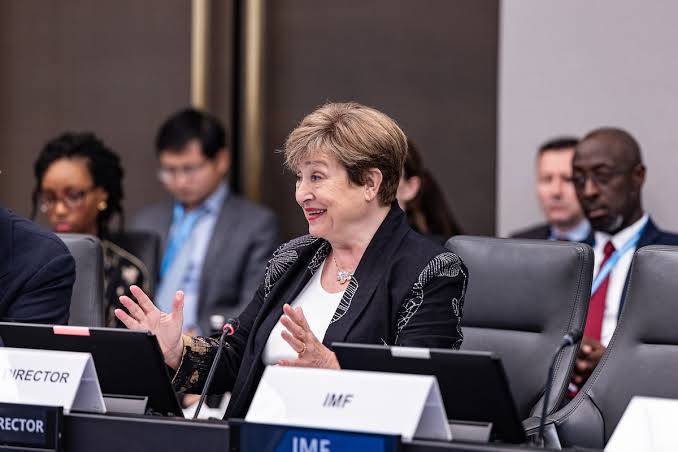
The African Caucus and the International Monetary Fund issued that assessment after discussions held during the 2026 IMF–World Bank Annual Meetings in Bangkok, Thailand.
The meeting brought together African finance ministers and the IMF around a policy agenda spanning macroeconomic stability, domestic revenue mobilisation, debt sustainability, regional trade and institutional reforms.
Seedy Keita, Chair of the African Caucus and Minister of Finance and Economic Affairs of The Gambia, and IMF Managing Director Kristalina Georgieva said the discussions focused on the policies and partnerships needed to strengthen Africa’s resilience and accelerate economic transformation.
“African economies have demonstrated notable resilience in recent years,” they said in a joint statement.
That resilience is reflected in the continent’s projected growth rate despite the spillovers from the war in the Middle East, elevated energy costs, tightening financing conditions and weakening external assistance.
Average inflation is expected to decline to 9.3 per cent. Although this represents progress from previous highs, it remains elevated and continues to erode household purchasing power, raise business costs and complicate monetary-policy decisions.
The headline numbers therefore describe a continent that is still growing, but not yet one that has escaped its structural constraints.
A 4.5 per cent growth rate compares favourably with the performance of several advanced economies. However, Africa’s rapidly expanding population means that aggregate economic growth does not automatically produce substantial improvements in income per person.
Growth must also be sufficiently job intensive to absorb the millions of young Africans entering the labour market each year.
The African Caucus and the IMF identified the continent’s entrepreneurial energy as a possible new engine of global growth. Yet entrepreneurship cannot deliver its full economic potential when businesses face unreliable electricity, expensive credit, fragmented markets, weak transport links and unpredictable regulation.
“Africa’s extraordinary entrepreneurial energy is where the world can find its next engine of global growth,” the statement said.
The critical policy question is whether African governments can create the conditions for that energy to expand beyond informal and survivalist enterprises into competitive companies capable of generating productive employment, exports and tax revenue.
The continent’s recent experience shows that resilience can prevent collapse without necessarily producing transformation. Economies may continue growing through commodity exports, household consumption and public spending while remaining vulnerable to external price movements and financing shocks.
Transformation requires a deeper change in what African economies produce, how they trade and where value is captured.
The effects of the current external environment are not uniform across the continent.
Resource-rich economies may benefit from terms-of-trade gains, particularly when higher commodity prices increase export earnings and government revenue. Oil and mineral exporters could therefore experience stronger fiscal and external positions.
For non-resource-rich countries, the same price movements can increase import bills, weaken currencies and intensify inflation. The joint statement noted that expansionary fiscal policy could help mitigate the shock in such economies.
That approach, however, presents a difficult trade-off.
Governments may need to support households and businesses facing higher fuel, food and transport costs. But countries already carrying high debt cannot indefinitely finance subsidies or tax relief through additional borrowing.
Poorly targeted interventions can consume scarce resources while providing significant benefits to higher-income households. Broad fuel subsidies, for example, may reduce immediate price pressure but create large fiscal obligations and weaken investment in healthcare, education and infrastructure.
Fiscal support must therefore be temporary, targeted and transparent. Countries need social-protection systems capable of directing assistance towards vulnerable households without destabilising public finances.
Debt vulnerability remains one of the most immediate threats to Africa’s development agenda.
The African Caucus and the IMF noted that debt-service costs were absorbing scarce public resources, while declining external assistance was further restricting development spending.
This creates a damaging fiscal cycle. Governments need to invest in infrastructure, education, healthcare and climate resilience to raise long-term growth. Yet a growing share of public revenue must first be used to service existing debt.
When borrowing costs rise, countries may be forced to delay development projects, accumulate arrears or borrow on increasingly expensive terms. The result is a reduction in the very investments needed to strengthen repayment capacity.
The concern is no longer simply the size of public debt. The composition, maturity and cost of that debt are equally important.
Short-term domestic borrowing can create frequent refinancing risks and put upward pressure on interest rates. Foreign-currency borrowing exposes governments to exchange-rate depreciation. Commercial external debt may provide large amounts quickly but can become difficult to manage when global financing conditions tighten.
The joint statement warned that tighter global financial conditions could intensify existing pressures.
Africa’s debt challenge therefore requires both domestic discipline and reforms to the international financial architecture. Governments must improve debt transparency, strengthen project selection and ensure borrowing supports investments capable of generating economic returns.
International institutions and creditors must also provide more predictable, affordable and timely financing, particularly for countries pursuing credible reforms but unable to access markets at sustainable rates.
The African Caucus reaffirmed its commitment to mobilising more of the continent’s resources.
“Africa’s resources must deliver more for its people,” the statement said, calling for modern, efficient and equitable tax systems that broaden the revenue base and strengthen compliance.
Domestic revenue mobilisation is becoming more urgent as aid declines and debt limits further borrowing. African governments cannot sustainably finance development while collecting low levels of tax relative to the size of their economies.
But raising revenue involves more than introducing additional taxes.
Overtaxing a narrow formal sector can undermine investment and encourage businesses to remain informal. Complex tax systems can also create opportunities for arbitrary enforcement, corruption and costly compliance.
The stronger approach is to widen the tax base, reduce unjustified exemptions, improve digital administration and strengthen the taxation of sectors that currently contribute below their economic potential.
Natural resources are particularly important. African countries frequently export minerals, oil and agricultural commodities while capturing a limited share of the value created along the production chain.
Better contract negotiation, transparent licensing, efficient royalty collection and domestic processing could allow governments and communities to retain more value without relying on excessive tax rates.
Revenue reforms must also be matched by better expenditure.
The joint statement called for “spending smarter” to protect vulnerable households, meet development needs and finance climate resilience.
Citizens are more likely to comply with taxation when they can see a credible connection between what they pay and the quality of public services they receive. Domestic revenue mobilisation is therefore also a question of trust, accountability and value for money.
The possibility of a severe El Niño event adds another layer of risk.
Climate shocks can weaken agricultural production, increase food prices, damage infrastructure and worsen pressure on government budgets. These effects are particularly severe in economies where agriculture employs a large share of the population and irrigation, insurance and storage systems remain limited.
Governments must often respond to climate disasters after they occur, diverting resources from planned investment towards emergency relief and reconstruction.
Building resilience beforehand is less costly, but it requires financing that many countries cannot obtain affordably.
The African Caucus therefore argued that continued international support through affordable financing and technical expertise remained essential.
This request should not be viewed simply as an appeal for aid. Africa contributes relatively little to historical global emissions yet faces substantial adaptation costs. Concessional climate financing can help countries protect agriculture, water systems, cities and infrastructure without adding unsustainable debt.
The joint statement identified deeper regional integration and full implementation of the African Continental Free Trade Area as central to job-rich growth.
AfCFTA promises to connect fragmented national markets, strengthen regional value chains and improve Africa’s global competitiveness.
Its success, however, will depend on implementation rather than declarations.
Reducing tariffs is only one part of the process. Businesses also need efficient border systems, compatible standards, reliable payment arrangements, transport infrastructure and predictable rules of origin.
African firms will struggle to build regional supply chains if moving goods between neighbouring countries remains more expensive and time-consuming than importing from outside the continent.
Effective implementation could allow businesses to reach larger markets, achieve economies of scale and attract investment into manufacturing and services. It could also reduce the continent’s dependence on exporting raw commodities and importing finished products.
The African Caucus welcomed the stronger voice created by the addition of a third sub-Saharan African chair at the IMF Executive Board but called for further progress towards greater representation.
Representation matters because IMF decisions on surveillance, programme design, debt sustainability and financing directly influence African economies.
A stronger African voice could help ensure that policy recommendations reflect the diversity of the continent’s economies and the social consequences of adjustment.
The IMF reaffirmed its commitment to supporting African members through policy advice, capacity development and financing where required.
That partnership will be judged by whether it helps countries rebuild policy buffers while protecting vulnerable populations and maintaining essential investment.
Africa’s 4.5 per cent growth outlook is encouraging, but it should not obscure the scale of the task. The continent remains resilient enough to withstand repeated shocks, yet constrained enough that each shock delays development.
The next test is whether governments and their international partners can convert resilience into structural transformation—creating jobs, raising domestic revenue, deepening trade and ensuring that Africa’s resources deliver substantially more for its people.

