

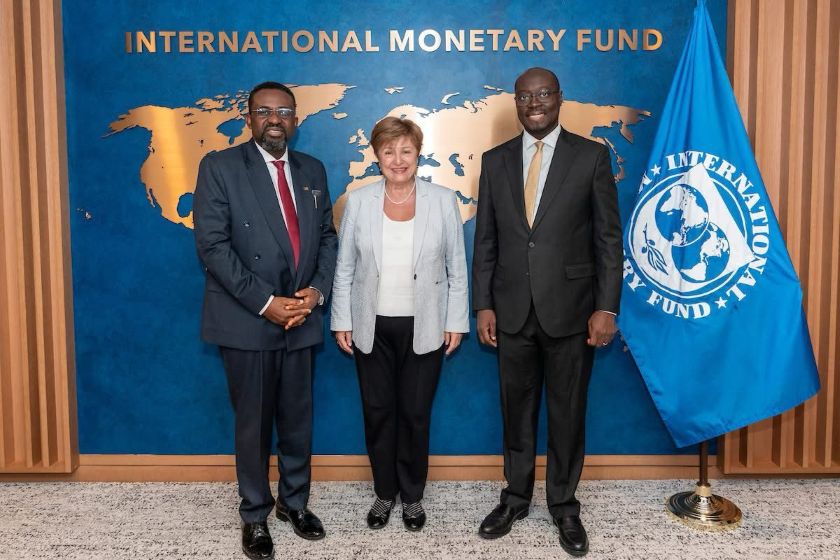

- Ghana Arrives in Bangkok with a Stronger Economy and a Case for Sustained Global Support
Finance Minister Dr Cassiel Ato Forson is leading Ghana’s delegation to the 2026 Annual Meetings of the International Monetary Fund and World Bank Group in Bangkok, Thailand, as the country seeks to consolidate its recent macroeconomic gains and deepen international support for its next phase of growth.
The delegation includes the Governor of the Bank of Ghana, Dr Johnson Pandit Asiama, bringing together the two principal officials responsible for Ghana’s fiscal and monetary management at one of the most consequential gatherings of global economic policymakers.
The meetings, scheduled for October 12–18, will bring together finance ministers, central bank governors, development institutions, private investors and civil society representatives from across the world. More than 15,000 participants from 191 countries are expected in the Thai capital.
Ghana’s participation comes at a critical point in its economic recovery. Having navigated a sovereign debt crisis, domestic debt restructuring, elevated inflation, significant exchange-rate pressures and the loss of access to international capital markets, the country is now attempting to move from stabilisation towards sustained private-sector-led growth.
For Dr Ato Forson, the meetings provide an opportunity to present Ghana’s fiscal-recovery programme to international financial institutions, development partners and investors while strengthening support for the government’s broader economic transformation agenda.
The Finance Minister is expected to use engagements in Bangkok to reinforce Ghana’s commitment to fiscal discipline, improved domestic revenue mobilisation, prudent debt management and the protection of essential social and development spending.
His leadership of the delegation also places Ghana’s public-debt experience at the centre of discussions expected to focus heavily on the financing constraints confronting emerging and developing economies.
Developing countries face an increasingly difficult environment characterised by high debt-service costs, reduced capital flows and limited fiscal space. Emerging and low-income countries are estimated to face about US$400 billion in debt payments during 2026, increasing the urgency of reforms to the international sovereign-debt architecture.
Ghana has firsthand experience of the delays, complications and economic costs associated with debt restructuring. The country’s participation should consequently extend beyond seeking financial assistance to helping shape the debate over faster, fairer and more predictable approaches to resolving sovereign debt distress.
New guidance published ahead of the meetings has sought to improve the participation of private lenders in restructurings, partly in response to bottlenecks experienced by countries such as Ghana and Zambia.
Dr Forson’s challenge will be to demonstrate that Ghana has learnt from its recent crisis and is building a fiscal framework capable of preventing a return to unsustainable borrowing.
That message will be important not only for the IMF and World Bank but also for investors assessing whether the country’s stabilisation can be translated into credible, long-term economic policy.
Dr Asiama’s presence gives Ghana’s delegation a complementary monetary and financial-sector dimension.
The central bank governor is expected to engage fellow governors, IMF officials, financial institutions and market participants on inflation, exchange-rate stability, reserve accumulation, banking-sector resilience and the restoration of the Bank of Ghana’s balance sheet.
His participation allows Ghana to present fiscal and monetary policy as parts of one co-ordinated recovery framework.
Fiscal discipline can reduce pressure on interest rates and government borrowing, while credible monetary policy can protect the purchasing power of households, improve business planning and support exchange-rate stability.
The meetings also offer the Governor an opportunity to explain the measures being taken to strengthen Ghana’s external buffers and improve the management of foreign-exchange inflows.
Dr Asiama has previously credited reforms in Ghana’s gold-purchasing and export arrangements with helping rebuild international reserves following their sharp deterioration during the 2022 economic crisis. He has also outlined plans to strengthen central-bank independence, repair the Bank of Ghana’s balance sheet and improve oversight of emerging areas such as virtual assets.
These interventions have become increasingly significant as high energy prices and renewed global financial volatility place pressure on African currencies and import-dependent economies.
For Ghana, a stable cedi is not simply a financial-market objective. Exchange-rate movements affect the cost of fuel, food, medicines, machinery and raw materials, meaning that monetary stability has immediate implications for inflation, household incomes and corporate profitability.
The Governor’s engagements in Bangkok could therefore help strengthen confidence in the central bank’s determination to preserve the gains achieved in inflation management and reserve accumulation while maintaining a sound banking system.
The joint presence of the Finance Minister and central bank governor sends an important institutional signal.
Countries emerging from economic crises recover more effectively when fiscal and monetary authorities operate within their respective mandates but maintain a coherent understanding of the risks facing the economy.
Ghana’s experience has shown that excessive government borrowing can complicate monetary policy, raise interest rates, weaken the currency and increase pressure on the financial system. At the same time, tight monetary conditions can constrain credit and slow economic activity if fiscal imbalances remain unresolved.
By presenting a unified but institutionally balanced message, Dr Forson and Dr Asiama can reassure development partners that Ghana’s recovery programme is being managed across both sides of economic policy.
The delegation is also positioned to argue for support that goes beyond short-term stabilisation.
Ghana requires investment in energy, transport, agriculture, digital infrastructure, industrial production and climate resilience. The World Bank Group and its private-sector arm can play a significant role in mobilising long-term financing, reducing project risk and attracting private capital into these sectors.
Dr Forson will need to make the case that Ghana’s fiscal consolidation should not come at the cost of the productive investment required to create jobs and expand the economy’s revenue base.
Dr Asiama, meanwhile, can demonstrate that greater investment will be supported by a more stable monetary environment, improved external buffers and a financial system capable of allocating capital to productive businesses.
The Bangkok meetings are taking place amid unusually difficult global conditions.
High energy and food prices, geopolitical conflicts, elevated public debt and tighter financing conditions are weakening the outlook for many economies. Growth, sovereign debt and geopolitical fragmentation are expected to dominate the discussions, alongside questions about artificial intelligence and the future of the global financial system.
For Ghana, these global pressures increase the importance of maintaining domestic policy credibility. An external shock becomes more damaging when public finances are weak, reserves are inadequate or the banking sector is vulnerable.
The country must therefore use the meetings not merely to describe its progress but to secure partnerships that make its recovery more durable.
The delegation’s work will ultimately be judged by whether the engagements produce stronger financial support, improved investor confidence, credible development partnerships and reforms that benefit Ghanaian households and businesses.
Ghana arrives in Bangkok with the scars of a difficult economic crisis but also with an opportunity to present evidence of adjustment and renewed policy direction.
Under Dr Forson’s fiscal leadership and Dr Asiama’s monetary stewardship, the delegation can make the case that Ghana is not seeking simply to return to its pre-crisis economic model. It is seeking the partnerships, investment and institutional support required to build a more resilient economy.
The most valuable outcome from Bangkok would therefore not be another declaration of confidence. It would be a clearer path from macroeconomic stabilisation to lower financing costs, stronger investment, sustainable debt and better economic opportunities for Ghanaians.

