


- Ghana Bets on Digitalisation to Turn MSMEs Into Engines of Jobs and Productivity
Ghana is stepping up efforts to digitise its micro, small and medium-sized enterprises as policymakers increasingly look to entrepreneurship to widen economic participation, create jobs and strengthen the resilience of the private sector.
Margaret Ansei, Chief Executive of the Ghana Enterprises Agency, says technology, stronger partnerships and improved access to business support will be critical if small enterprises are to move beyond survival and become more productive, scalable and competitive. Speaking at the 10th National MSME Day celebration, she described the sector as a cornerstone of Ghana’s economy and a major source of innovation, employment and inclusive growth.
The event, held under the theme, “Elevating the Future Generation of Ghana’s MSMEs through Digital Empowerment and Innovation,” was framed as more than an annual celebration of entrepreneurship. Ansei said it should be viewed as “a moment of national reckoning” requiring government, financial institutions, development partners and the private sector to assess whether entrepreneurs are being given the tools needed to build sustainable businesses.
“Ghana believes in its entrepreneurs. And we are resolved, without reservation, to the work ahead,” she said.
Her remarks point to a central economic challenge for Ghana: the country has a large base of entrepreneurs, but many businesses remain small, informal and constrained by weak access to finance, technology, management systems and larger markets. The policy question is increasingly not how to create more enterprises, but how to help existing ones become more productive and grow.
MSMEs dominate economic activity across retail, agriculture, transport, manufacturing, hospitality and professional services. Yet many still depend on cash transactions, manual bookkeeping, informal marketing and limited customer networks, making it difficult to build the financial histories and operating systems required to attract investment or expand.
Digitalisation could help change that equation. Mobile payments, e-commerce, cloud-based accounting, digital marketing and online business-support tools can reduce some of the costs that have traditionally limited the ability of small firms to formalise and reach new customers.
For policymakers, the economic promise lies in scale. A small business that adopts digital payments can create a transaction history, improve record-keeping and potentially become more visible to lenders that previously had little reliable information on its cash flows.
That could gradually address one of the biggest obstacles facing small businesses: access to affordable credit. Financial institutions often regard MSMEs as risky because many lack audited statements, collateral and formal records, but digital transaction data could make credit assessment more evidence-based.
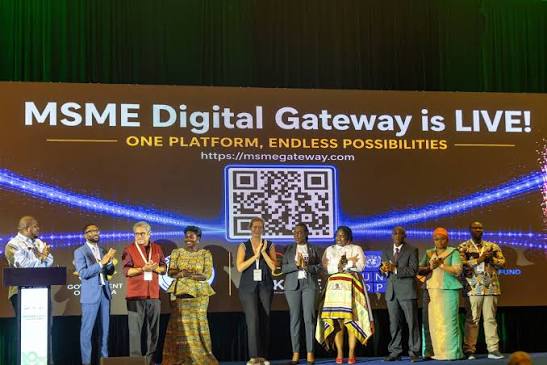
The Ghana Enterprises Agency is seeking to deepen that shift through the launch of the MSME Digital Gateway, developed in partnership with the United Nations Development Programme. The platform is intended to connect entrepreneurs to market intelligence, business-support services and digital networks.
The initiative could help reduce information gaps that disproportionately affect smaller businesses. But its success will depend on whether entrepreneurs can convert the information provided into actual financing, customers, productivity improvements and stronger revenues.
That is where implementation becomes more important than the launch itself. Ghana has seen numerous programmes aimed at supporting entrepreneurship, but small businesses ultimately judge such interventions by whether they reduce the practical barriers to operating and expanding.
Ansei said Ghana’s entrepreneurial ecosystem has evolved significantly over the decade since National MSME Day was established, supported by stronger partnerships, increasing investment and changes in government policy. The business environment, however, is evolving even faster.
Digital technologies are changing how companies market products, collect payments, source inputs, raise finance and compete across borders. Small businesses unable to adapt risk becoming increasingly disconnected from customers whose commercial behaviour is moving rapidly online.
The shift has particular importance for Ghana because of the African Continental Free Trade Area. Hosting the AfCFTA Secretariat gives the country political visibility, but the economic benefits will depend largely on whether Ghanaian companies can produce competitively and access regional markets.
A continental market means little to a small manufacturer that cannot meet quality standards, fulfil large orders, process digital payments or manage cross-border logistics. Digital capabilities could therefore become an important part of Ghana’s attempt to convert AfCFTA access into actual exports.
Yet technology can create new inequalities as easily as it removes old ones. Businesses in urban areas with reliable internet, digital literacy and capital may adopt new tools rapidly, while firms in rural communities or lower-income markets could fall further behind.
That means the digitalisation strategy will have to be accompanied by investment in skills, connectivity and affordable technology. If these foundations remain weak, a platform designed to broaden opportunity could end up serving primarily enterprises that are already relatively well positioned.
The same applies to finance. Digital records may make businesses easier to assess, but they do not automatically make credit affordable, particularly where interest rates, collateral requirements and perceptions of risk remain high.
For younger entrepreneurs, the stakes are particularly significant. Ansei said the next generation of Ghanaian businesses should not be treated as a distant possibility, pointing instead to entrepreneurs who are already launching and pitching businesses today.
“We do not mean a generation waiting in the wings. We mean the young woman pitching her enterprise this afternoon,” she said.
The argument is closely connected to Ghana’s employment challenge. With thousands of young people entering the labour market, neither government nor established corporations can be expected to provide enough jobs on their own.
Small businesses will therefore have to absorb a substantial share of future employment. But the number of enterprises created will matter less than their ability to survive and hire.
That means Ghana needs more businesses capable of progressing from micro to small, from small to medium-sized and eventually from domestic operators into regional competitors. That transition requires finance, technology, infrastructure, management capacity and predictable regulation working together.
The 10th National MSME Day brought government officials, entrepreneurs, financial institutions, diplomats and development partners together around that challenge. After a decade of celebrating entrepreneurship, the next phase is likely to be judged more rigorously by productivity, business survival and employment outcomes.
The MSME Digital Gateway gives Ghana another tool for that effort, but technology should not be confused with transformation itself. Digital platforms can widen access, yet the real economic impact will come only when businesses use them to lower costs, improve management, reach customers and secure capital.
Ghana’s broader objective should therefore be to make digitalisation a pathway to scale rather than simply another layer of business administration. If thousands of small enterprises can become more productive, formal and competitive, they could provide a stronger foundation for private-sector-led growth.
The challenge now is turning the government’s declared confidence in Ghanaian entrepreneurs into measurable improvements in their ability to finance, digitise and expand their businesses.

