

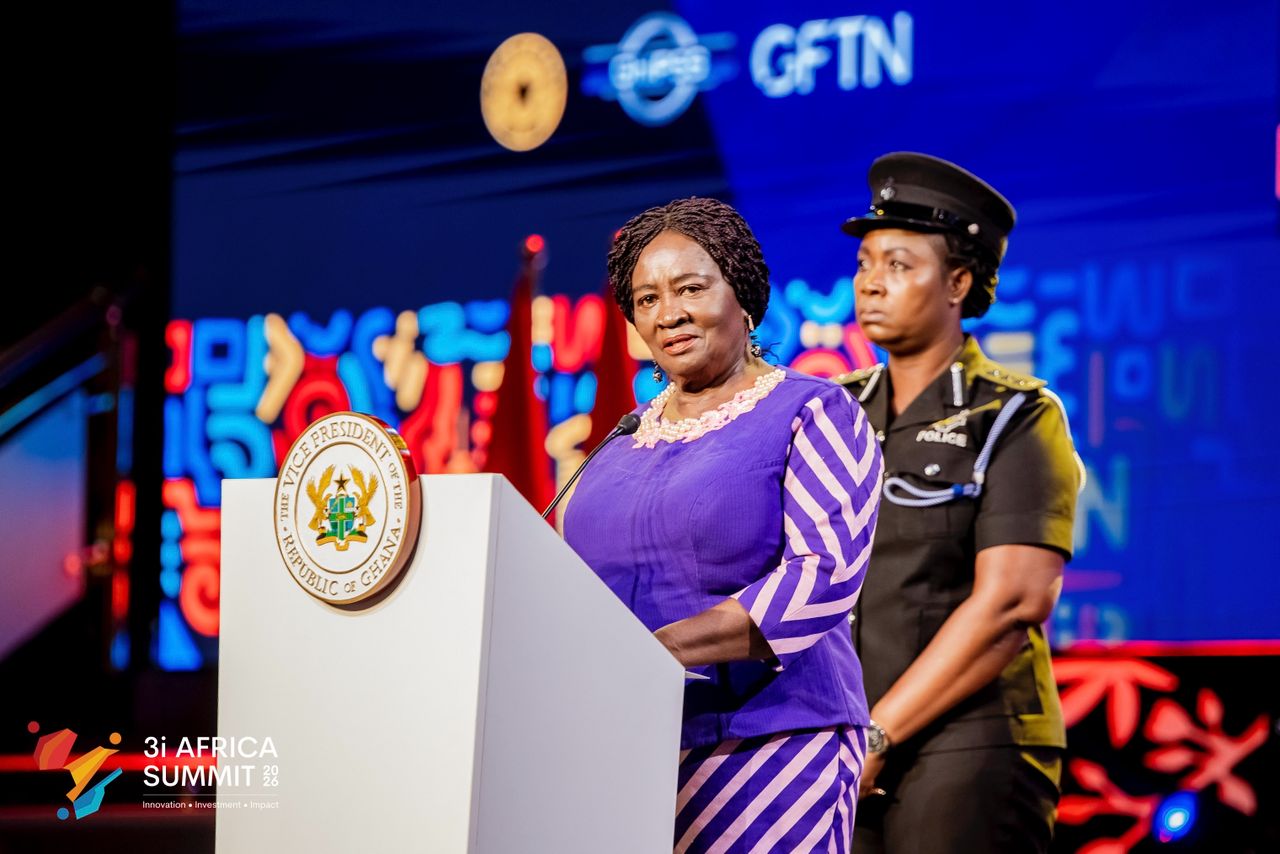

Ghana calls for digital integration push as Africa seeks single market architecture
Africa’s ambition to build a single digital economy will depend on whether governments can move beyond political rhetoric and establish interoperable systems for payments, identity, regulation and infrastructure, Ghana’s Vice President has said.
Reading a speech on behalf of President John Dramani Mahama at the 3i Africa Summit in Accra, Prof Jane Naana Opoku Agyemang said Africa’s long-standing description as a “frontier” economy must give way to a more deliberate focus on coordination and system-building at scale.
“What matters now is not how we are described, but how we organise ourselves to compete, to integrate, and to build at scale,” she said.
From gateway narrative to functional infrastructure
Prof Nana said Ghana’s positioning as a “gateway to Africa” must be judged not by geography or trade flows, but by the efficiency of systems that enable economic activity.
A true gateway, she said, is defined by whether transactions clear seamlessly, businesses connect efficiently, and markets operate with certainty.
She added that Ghana’s role is anchored in political stability, openness to trade, and its hosting of the secretariat of the African Continental Free Trade Area.
However, she stressed that modern economic competitiveness is increasingly determined not by ports and physical logistics alone, but by digital infrastructure and regulatory systems that underpin cross-border commerce.
Economic sovereignty shifting to digital systems
The Vice President said Africa’s economic sovereignty now depends heavily on digital integration, where value creation and exchange are increasingly mediated through digital platforms.
She cited mobile money, digital identity systems and financial technology as evidence that Africa has already demonstrated its ability to leapfrog legacy systems.
However, she warned that these gains remain fragmented and must be scaled continent-wide.
To achieve this, she outlined four essential pillars: payments, identity, regulation and infrastructure.
Payments still routed outside Africa
On payments, she said many intra-African transactions are still routed through external financial systems and denominated in third currencies, increasing costs and undermining the concept of a unified African market.
She pointed to initiatives such as the Pan-African Payment and Settlement System and the African Union’s Digital Trade Protocol (2024) as efforts to reduce friction through interoperability and cross-border electronic settlement.
The goal, she said, is a system in which African enterprises can transact directly across borders in local currencies, efficiently and at lower cost.
Identity as foundation of trust
She said digital identity remains a critical barrier, with large segments of the population still lacking verifiable credentials.
Without interoperable identity systems, she warned, millions of Africans remain excluded from formal financial systems and cross-border trade.
“Trust begins with identity,” she said, describing it as essential infrastructure for participation in the digital economy.
Regulation requires coordination, not uniformity
On regulation, she said integration does not require identical legal systems across countries but does require coordination and alignment.
Fragmented regulatory environments, she said, increase the cost of doing business and discourage innovation.
She highlighted regulatory sandboxes and the Digital Trade Protocol as mechanisms to support harmonisation while preserving national sovereignty.
Infrastructure and digital sovereignty
She said Africa’s digital transformation will not be sustainable without significant investment in broadband, cloud infrastructure and data centres.
She warned that Africa’s limited share of global data infrastructure has implications for both performance and sovereignty.
“If our data is stored and processed elsewhere, then even when we participate, we lack control,” she said.
Continental digital trade corridor announced
In a key policy announcement, she said Ghana will work with Rwanda, Zambia and other partners to pilot a continental digital trade corridor.
The pilot will focus on mobile money interoperability, mutual recognition of digital identity for cross-border KYC, and harmonised electronic invoicing systems.
She said the initiative would be tested, measured and refined for broader continental rollout.

