



- Ghana Challenges Canada’s Visa Refusal for Partey, Cites Unproven Charges and Due Process
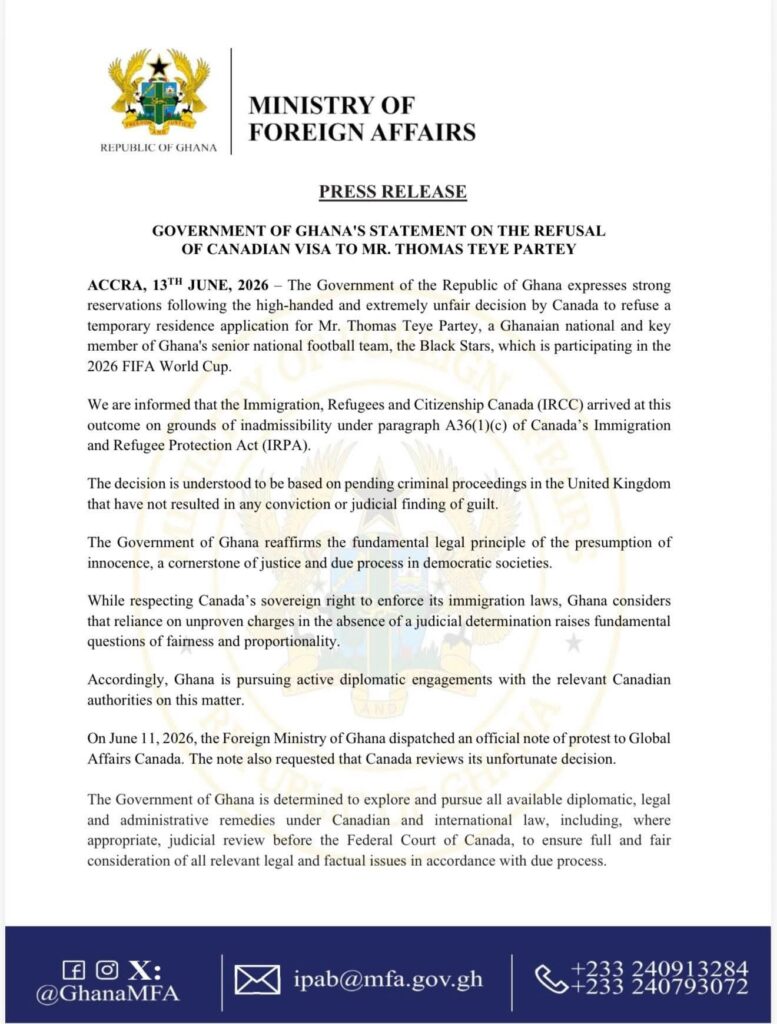
Ghana has formally challenged Canada’s decision to deny Black Stars midfielder Thomas Partey entry into the country for Ghana’s opening match at the 2026 FIFA World Cup, describing the reliance on unproven criminal charges as unfair and inconsistent with the principle of due process.
The Ministry of Foreign Affairs has disclosed that it has initiated diplomatic engagements with Canadian authorities to have the decision reviewed, following confirmation that the player will be unable to travel to Canada for Ghana’s first group match against Panama.
According to the Ministry, an official note of protest was sent to Global Affairs Canada on June 11, requesting a reconsideration of the visa refusal.
Foreign Affairs Minister Samuel Okudzeto Ablakwa has also held discussions with Canadian officials, including Canada’s High Commissioner to Ghana, as part of efforts to resolve the matter through diplomatic channels.
Ghana is further exploring all available diplomatic, legal and administrative remedies under Canadian and international law, including the possibility of seeking judicial review before Canada’s Federal Court if necessary.
The government’s position is that Partey, who has denied all allegations against him, should not be denied entry on the basis of charges that have not been proven in court.
The midfielder is facing criminal charges in the United Kingdom, including seven counts of rape and one count of sexual assault. He has pleaded not guilty to all the charges, and the matter remains before the courts.
The case has now created a sensitive intersection of sport, immigration control, criminal justice, diplomacy and the rights of a player selected to represent his country at football’s biggest tournament.
FIFA has confirmed that Partey will be unable to travel from Ghana’s team base in Boston, United States, to Canada for the Black Stars’ opening match against Panama after his visa application was refused by the Canadian government.
The world football governing body, however, said it has no role in the immigration processes of host countries, stressing that visa decisions remain solely the responsibility of national governments.

The decision means Ghana will begin its World Cup campaign without one of its most experienced midfielders, in a match that could prove decisive to the Black Stars’ hopes of advancing from the group stage.
Partey, who currently plays for Spanish club Villarreal, has already been granted entry into the United States and remains available for Ghana’s subsequent group matches scheduled to be played there.
Ghana opens its campaign against Panama on June 17 in Toronto before returning to the United States for its remaining group fixtures against England and Croatia.
The Foreign Ministry has argued that Partey’s selection for the national team carries significant sporting implications and has urged Canadian authorities to reconsider their decision in the interest of fairness and due process.
The Ministry’s challenge also appears intended to protect a broader principle: that Ghanaian citizens should not be subjected to adverse international decisions based solely on allegations that remain untested before a court.
Sports Minister Kofi Adams had earlier said government would not remain silent when one of its citizens is affected by a decision it considers deserving of review.
He said government had engaged the Ministry of Foreign Affairs and other relevant state institutions to challenge the decision through appropriate diplomatic channels.
The controversy has also placed FIFA under scrutiny, with government officials questioning whether the world football governing body should do more to protect the integrity of its tournaments when host-country immigration decisions affect the availability of eligible players.
FIFA, however, has maintained that immigration decisions fall outside its jurisdiction and remain within the authority of host governments.
Despite the diplomatic tension, Ghana has reaffirmed its commitment to maintaining strong bilateral relations with Canada while pursuing what it describes as a fair and amicable resolution.
The government has expressed optimism that continued engagement with Canadian authorities could still lead to a reconsideration of the decision.
For the Black Stars technical team, the immediate task is to prepare for the Panama fixture without certainty over Partey’s availability.
The midfielder’s absence would force a reshuffle in Ghana’s midfield, where his experience, passing range and tactical discipline have long been central to the team’s structure.
While officials pursue diplomatic and legal options, the episode has raised wider questions about how host-country visa decisions can affect competitive fairness at global sporting events.
With the Panama match approaching, Ghana’s position is clear: it wants Canada to review the refusal, respect the presumption of innocence and allow the Black Stars to field one of the players selected for the tournament.

