


- Ghana, Côte d’Ivoire Deepen Maritime Security Ties to Protect Offshore Assets
Ghana and Côte d’Ivoire are deepening cooperation along their shared maritime frontier, transforming a boundary that was once the subject of international litigation into a platform for protecting offshore petroleum assets, fisheries, shipping routes and other economic interests in the Gulf of Guinea.
The two countries are preparing for another joint inspection of their common maritime boundary from August 22, 2026, extending a programme that began in 2023 and has so far produced six coordinated exercises.
The initiative is intended to strengthen surveillance of the frontier while improving cooperation among military, maritime and technical institutions on both sides of the border.
Ghana and Côte d’Ivoire both have offshore petroleum industries, while large coastal populations depend on fisheries for employment, incomes and food. The same maritime space is also exposed to illegal fishing, piracy, illicit trafficking and potential threats to offshore energy installations.
Greater coordination therefore provides benefits extending beyond conventional border security.
Major General Anthony Ntem, Commissioner General of the Ghana Boundary Commission, said the foundation for the current cooperation was created by the 2017 judgment of the Special Chamber of the International Tribunal for the Law of the Sea, which settled the long-running maritime boundary dispute between the two countries.
He described the ruling as providing “a solid foundation for renewed cooperation between Ghana and Côte d’Ivoire.”
The significance of that transition is difficult to overstate.
Before the ITLOS decision, uncertainty over the precise location of the boundary created risks for petroleum exploration and development in an area containing commercially important offshore resources.
Maritime disputes can complicate licensing, delay investment and increase political risk for international oil companies where deposits or exploration blocks are close to contested waters.
The 2017 ruling removed the legal ambiguity. The current inspection programme is helping translate that legal settlement into operational cooperation.
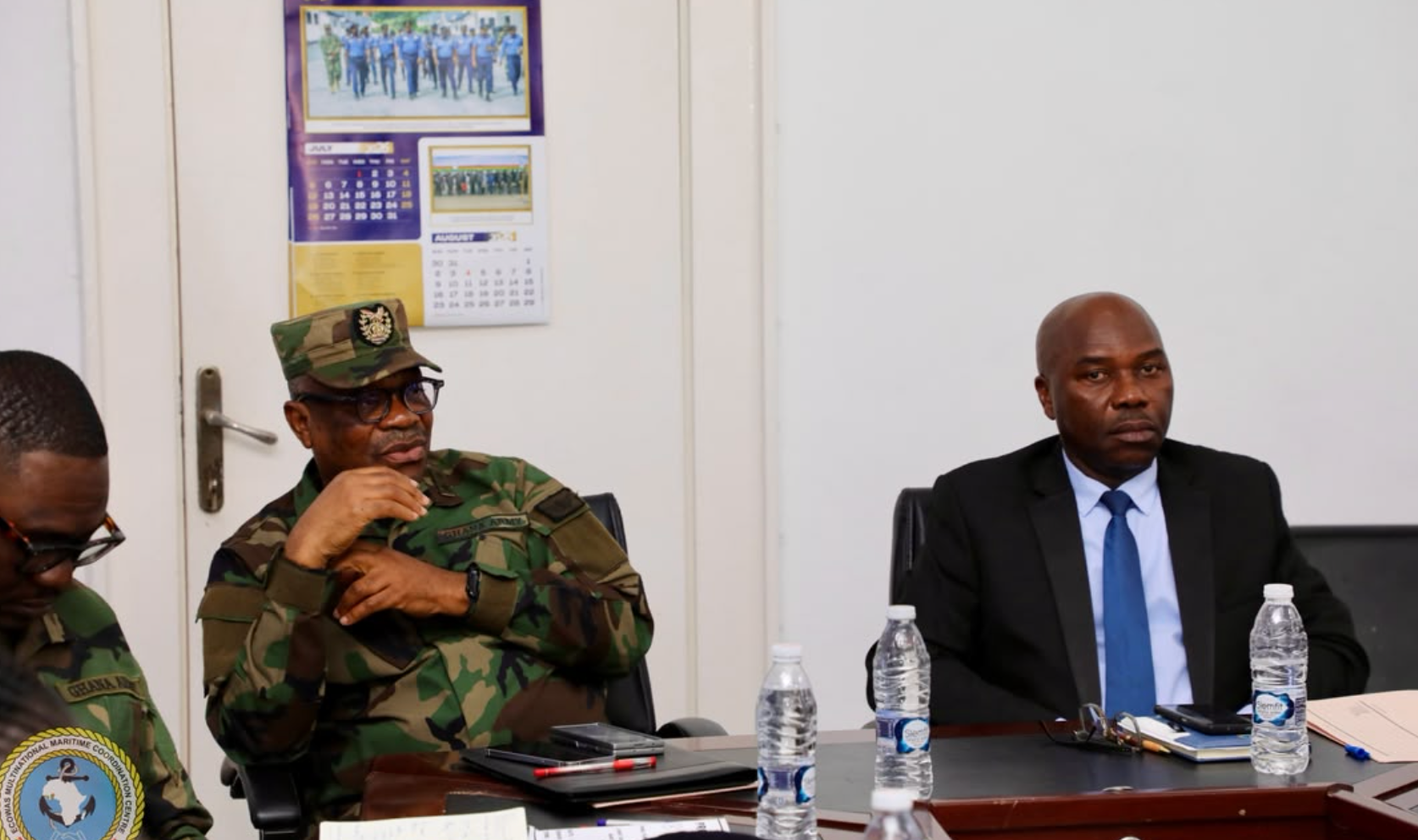
Major Gen. Ntem made the comments at the Final Planning Conference for the Western Maritime Boundary Inspection, hosted by the ECOWAS Multinational Maritime Coordination Centre Zone F.
The conference is expected to finalise technical, logistical, operational and security arrangements for the latest exercise while clarifying the responsibilities of participating institutions.
That coordination is becoming increasingly important as the economic value of the maritime domain grows.
For Ghana, offshore petroleum remains an important source of export earnings, government revenue and foreign investment. Protecting installations, vessels and associated infrastructure is therefore directly linked to macroeconomic and energy security.
Illegal, unreported and unregulated fishing has become one of the most serious threats facing West African coastal economies. The depletion of marine stocks can reduce incomes for artisanal fishermen, weaken food security and increase dependence on imported fish.
Joint surveillance can help strengthen enforcement where vessels move across national jurisdictions or attempt to exploit gaps between neighbouring enforcement agencies.
Captain Daniel Gnamien Ehu, Director of the ECOWAS Multinational Maritime Coordination Centre Zone F, said Ghana and Côte d’Ivoire shared not only a geographical boundary but also “common economic opportunities and maritime security challenges.”
Those common risks make unilateral enforcement less effective. Piracy, trafficking networks and illegal fishing fleets do not operate according to national boundaries. Information-sharing, coordinated patrols and compatible procedures are therefore increasingly important if governments are to protect maritime assets effectively.
Captain Ehu said the inspection should move beyond being an administrative exercise and demonstrate the countries’ determination to convert geographical proximity into a “concrete operational alliance.”
That approach also carries implications for investors. Security around offshore fields, ports and shipping routes forms part of the risk assessment for companies committing capital to coastal economies. Persistent maritime crime can increase insurance and security costs, while uncertainty around boundaries can discourage long-term investment.
The Ghana-Côte d’Ivoire partnership sends a different signal. A dispute that once required international adjudication is increasingly being managed through repeated joint operations and institutional cooperation.
The latest inspection builds on an operation conducted in August 2025 involving the Ghana Boundary Commission, Ghana Navy, Ghana National Petroleum Corporation and Ivorian counterparts under ECOWAS Maritime Zone F supervision.
That exercise was aimed at monitoring adherence to the ITLOS judgment and preventing violations along the demarcated frontier.
The continuation of inspections in 2026 suggests the countries are institutionalising the arrangement rather than treating it as a one-off confidence-building measure.
Maritime security is most effective when cooperation survives changes in governments and personnel and becomes embedded within the institutions responsible for defence, petroleum, fisheries and boundary management.
Captain Ehu has also proposed that Côte d’Ivoire host the Final Planning Conference for the 2027 inspection in Abidjan, signalling an expectation that the joint programme will continue.
For both countries, the economic test will be whether the expanding cooperation produces measurable results.
Fewer illegal incursions, better protection of fishing stocks, safer petroleum operations and more secure commercial shipping would provide evidence that the partnership is translating diplomacy into economic value.
The transformation since the 2017 ITLOS ruling is already notable. Ghana and Côte d’Ivoire have moved from contesting where their maritime boundary should lie to jointly supervising the space around it.
That shift provides a broader lesson for resource-rich African states. Clear legal boundaries matter, but their economic value ultimately depends on what comes afterwards: enforcement, institutional coordination and the ability of neighbouring states to manage shared risks.
In a Gulf of Guinea where offshore energy, fisheries and maritime commerce are becoming increasingly valuable, the Ghana-Côte d’Ivoire relationship is evolving from boundary settlement into something more strategic a shared effort to ensure that the ocean separating the two economies does not become a source of renewed dispute, but an asset both have an interest in securing.

