


- Ghana-Origin Cargo at Centre of Australia’s US$208 million Meth Bust
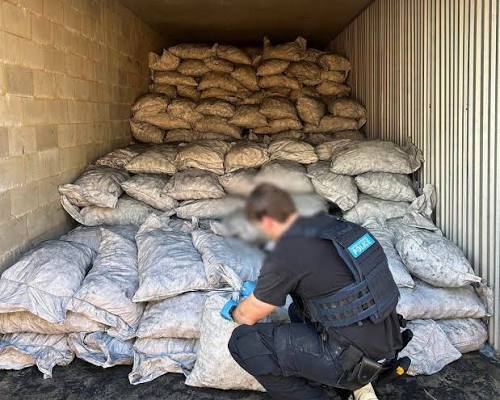
Australian authorities have intercepted a methamphetamine shipment with an estimated street value of US$208 million after border officials uncovered narcotics concealed in containers that originated from Ghana.
The seizure, involving about 320 kilograms of methamphetamine hidden in cargo declared as charcoal, has triggered a wider investigation into an alleged international drug trafficking network using commercial shipping channels to move illicit substances across continents.
Authorities say the drugs, had they reached the Australian market, could have generated about A$296 million, equivalent to approximately US$208 million, and supported more than 3.20 million individual drug transactions.
The operation began in April when officials at Sydney’s Port Botany identified irregularities in two containers shipped from Ghana. The containers had been declared as charcoal, a commodity that investigators believe may have been used to disguise the narcotics within legitimate commercial cargo.
Forensic testing later confirmed the presence of methamphetamine, prompting Australian law enforcement agencies to conduct a controlled operation aimed at identifying the individuals allegedly linked to the attempted importation.
Australian prosecutors have since charged three individuals, including British actress Emaa Hussen, over their alleged involvement in the scheme.
Investigators allege that the suspects played roles in logistics coordination and in securing storage facilities intended to receive the shipment after its arrival in Australia.
The charges remain allegations, and the accused persons are entitled to due process under Australian law.
The case is likely to intensify scrutiny of international cargo routes linking West Africa to Asia-Pacific markets, particularly at a time when organised crime networks are increasingly exploiting commercial supply chains to move narcotics, contraband and other illicit goods.
The use of charcoal as a concealment vehicle points to a growing trend in global trafficking operations, where criminal networks attempt to hide drugs within low-risk or ordinary commodities that appear to fit normal trade patterns.
For customs authorities, such methods pose a significant challenge.
Global trade depends on speed, scale and trust. Millions of containers move across ports each year, and only a fraction can be physically inspected. Criminal syndicates exploit this reality by embedding illicit shipments within legitimate cargo flows.
The Australian interception shows both the sophistication of trafficking methods and the importance of intelligence-led border control.
Officials reportedly detected irregularities in the shipment before forensic analysis confirmed the presence of narcotics. That suggests the case may have involved more than routine inspection and could have relied on profiling, scanning, intelligence sharing or risk assessment.
The seizure also raises uncomfortable questions for Ghana.
While no Ghana-based suspect has been publicly identified, the fact that the shipment originated from Ghana will draw attention to the country’s export monitoring systems, port inspection procedures and anti-narcotics enforcement architecture.
Ghana has over the years made investments in customs modernisation, port security, cargo scanning and anti-narcotics enforcement. Yet the latest case shows how determined international trafficking networks may still attempt to exploit the country’s trade routes.
The incident does not necessarily mean that the drugs were produced in Ghana or that Ghanaian officials were involved. But the use of a Ghana-origin shipment places the country within the investigative chain and may require cooperation between Ghanaian and Australian authorities.
That cooperation will be critical in determining how the drugs entered the containers, who arranged the shipment, whether legitimate exporters were compromised, and whether any local facilitators were involved.
For Ghanaian authorities, the case should be treated with urgency.
The country’s reputation as a trading and logistics hub depends on the integrity of its export systems. When narcotics are discovered in shipments originating from a country, even if organised by foreign networks, the reputational consequences can be significant.
International buyers, shipping lines, port operators and customs partners may respond by increasing scrutiny of Ghana-origin cargo, which could impose additional compliance burdens on legitimate exporters.
This is why the case goes beyond criminal prosecution in Australia.
It touches on trade facilitation, port security, export integrity and Ghana’s international image.
The seizure also comes at a time when West Africa remains under heightened scrutiny as a transit corridor for global narcotics trafficking.
For years, international drug networks have used parts of the region as staging points for narcotics moving between Latin America, Europe, Asia and other destination markets.
The Australia case suggests that trafficking routes may be expanding or adapting, with criminal networks seeking new pathways into high-value consumer markets.
Methamphetamine is particularly concerning because of its high street value, addictive potential and damaging social consequences.
Australian authorities have long treated methamphetamine imports as a major organised crime threat, given the profitability of the drug and the harm associated with its distribution.
A 320-kilogram shipment therefore represents more than a large criminal consignment. It is a potential public health and security threat.
Authorities estimate that preventing more than 3.20 million individual transactions from entering the market represents a major disruption to criminal supply chains.
However, seizures of this scale often represent only one part of a broader network.
The shipment would likely have required financiers, suppliers, transport coordinators, freight handlers, receivers, storage managers and distributors. Identifying the full chain will be essential if investigators are to move beyond the immediate suspects and dismantle the wider operation.
Australian Federal Police officials have indicated that efforts are continuing to identify suppliers, financiers and organisers behind the shipment.
That suggests the arrests made so far may be only the first stage of a wider international investigation.
For Ghana, the key issue will be whether local agencies are asked to assist with tracing the origin of the cargo, the exporter records, shipping documentation, port handling details and any domestic actors connected to the consignment.
The case also highlights the need for stronger risk profiling of exports, not only imports.
Customs systems often focus heavily on revenue collection and import controls, but export channels can also be exploited by criminal networks. Commodities such as charcoal, timber, food products, minerals, scrap materials and agricultural goods can be used as cover for illicit trade if inspection systems are weak.
Improved scanning, intelligence sharing, exporter verification, container tracking and inter-agency coordination are therefore essential.
The private sector also has a role to play.
Freight forwarders, shipping agents, warehouse operators and exporters must strengthen due diligence to ensure that their services are not exploited by criminal networks. A single compromised shipment can expose companies to prosecution, reputational damage and international sanctions risk.
The broader lesson is that transnational crime increasingly hides within legitimate commerce.
As global trade volumes rise and supply chains become more complex, criminal organisations are adapting faster, using commercial documentation, legitimate commodities and cross-border logistics systems to conceal illicit goods.
This requires a coordinated response that goes beyond one country’s border agency.
It demands cooperation among customs authorities, police, financial intelligence units, port operators, shipping companies, anti-narcotics agencies and international partners.
The Australia seizure is therefore both a law enforcement success and a warning.
It demonstrates that authorities can detect and disrupt sophisticated trafficking attempts. But it also shows that Ghana-linked cargo routes may be attractive to criminal networks seeking to move narcotics into distant, high-value markets.
The full facts of the case will emerge through the courts and ongoing investigations.
Until then, caution is necessary in assigning responsibility.
What is clear, however, is that the seizure has placed Ghana-origin cargo under international attention and raised fresh questions about how effectively global trade routes are being protected from criminal exploitation.
Australia has stopped a major consignment from reaching its streets

