

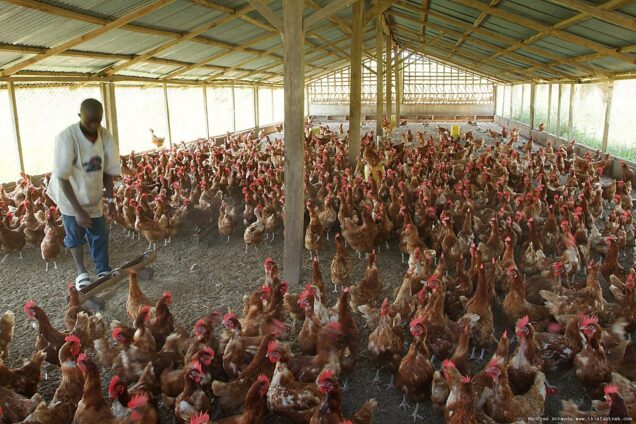

- Ghana Poultry Farmers Warn of 15% Christmas Price Increase as Feed Costs Rise
Ghanaian households could pay at least 15 per cent more for poultry products during the Christmas season as farmers struggle with rising feed, freight and imported input costs, renewing concerns about the country’s ability to make locally produced chicken and eggs affordable.
The Greater Accra Poultry Farmers Association said consumers should prepare for price adjustments before the festivities, when demand for chicken, eggs and other poultry products traditionally increases.
“Maybe not less than 15 per cent; we must see some price change,” Mohammed Ali, Chief Executive of the Association, told Joy Business during an outreach to schools in Dansoman marking World Egg Day.
It exposes a production system in which farmers remain vulnerable to movements in grain prices, freight charges, exchange rates and the cost of imported veterinary products and feed additives.
Mr Ali identified maize and soya as critical pressures on poultry-feed costs. Consequently, increases in the prices of these ingredients quickly weaken margins and ultimately reach consumers.
Although maize and soya can be produced locally, inadequate and inconsistent supplies leave poultry businesses competing with households, food processors and other livestock producers. Imports or imported components then fill the gap, exposing farmers to international prices and transportation costs.
“When we are able to have an abundance locally, the feed price will surely come down. But without them, we can’t do anything about poultry feed,” Mr Ali said.
His comments capture the central policy problem. Ghana cannot sustainably reduce poultry prices by asking farmers to absorb higher costs. If production becomes commercially unattractive, farmers may reduce flock sizes, delay restocking or leave the industry, tightening supply and creating stronger price pressure later.
The proposed increase will arrive at a difficult moment for consumers. Christmas normally produces stronger demand for animal protein as families organise celebrations, restaurants expand orders and traders build stocks. When seasonal demand meets constrained domestic supply, the market gains another reason to adjust prices upward.
The Association’s evidence on eggs reveals how the supply chain can magnify farm-level costs. Mr Ali said crates currently leave farms for between GH¢40 and GH¢45 but some retailers allegedly add as much as GH¢20, pushing the final price well beyond what farmers consider reasonable.
“We don’t expect an egg to go beyond 50 cedis. Take or leave,” he said, calling for intervention by the Ministry of Trade and Agribusiness to promote greater discipline in the market.
That claim raises an important distinction between a production-cost increase and retail inflation. Farmers may require higher prices to cover feed and inputs, but consumers can face an even steeper increase when transport, handling and multiple trading margins are added between the farm and the market.
Efforts to protect consumers must therefore avoid treating farmers as the sole source of inflation. Price controls imposed without reducing costs could force producers to sell below sustainable levels. The more durable response is to improve market transparency, shorten distribution chains and increase competition among wholesalers and retailers.
Publishing indicative farm-gate and retail price ranges could help consumers and regulators distinguish genuine cost increases from excessive mark-ups. Digital marketplaces, direct purchasing arrangements and farmer-owned distribution centres could also allow schools, hotels, restaurants and households to buy more directly from producers.
The deeper solution begins with feed. Government support for maize and soya production must extend beyond distributing seed or announcing acreage targets. Farmers require irrigation, storage, mechanisation, affordable credit, extension services, reliable market contracts and protection against post-harvest losses.
Poultry farmers and crop growers could also benefit from structured supply agreements. Guaranteed purchase contracts between feed mills, poultry associations and maize or soya producers would give crop farmers clearer demand while helping poultry businesses secure inputs at predictable prices.
Local feed production alone will not eliminate every cost. Poultry businesses still depend on imported vaccines, medicines, premixes, equipment and breeding materials. Domestic input substitution should therefore be accompanied by stronger hatcheries, veterinary services, feed-testing systems and biosecurity infrastructure.
The latest warning also tests Ghana’s poultry-support programmes. Mr Ali urged an expansion of the Nkokor Nkitinkiti initiative, arguing that assistance should reach farmers with the capacity to produce enough birds to influence national supply and prices.
Targeting larger producers may produce faster increases in volume, but policymakers must avoid excluding smaller farms that provide employment and local food security. A tiered programme could support commercial farms to scale while organising smaller producers into clusters that share inputs, veterinary services, processing and distribution.
Any public support must be tied to measurable outcomes. Subsidised inputs should produce verifiable increases in birds, eggs, survival rates and market supply. Otherwise, the programme risks becoming a transfer to selected businesses without delivering lower prices or greater food security.
That nutrition campaign sits uneasily beside the price warning. Encouraging families to consume more eggs will have limited impact if low-income households cannot afford them. Nutrition policy, agricultural policy and market policy must therefore work together rather than operate as separate initiatives.
School feeding offers one opportunity. Reliable contracts to buy locally produced eggs and chicken could provide farmers with predictable demand while improving children’s diets. Such contracts, however, must pay suppliers promptly and use transparent procurement standards.
The Christmas increase is not inevitable at precisely 15 per cent; it is a projection based on current pressures. Feed prices could ease, demand may change or traders may absorb part of the adjustment. Yet the warning should not be dismissed merely because the final percentage remains uncertain.
It is an early signal that the poultry value chain is transmitting agricultural, logistics and import costs towards household food budgets. The appropriate response is not a temporary festive intervention but a production strategy that makes local poultry competitive throughout the year.
If Ghana can expand maize and soya supplies, improve distribution, strengthen veterinary systems and demand accountability from support programmes, seasonal price warnings could become less severe. Without those reforms, Christmas will continue to expose a familiar national weakness: Ghana wants to consume locally produced poultry but has not yet built the cost structure required to make it consistently affordable.

